Wilson disease
Rare autosomal recessive copper overload of liver, brain, cornea and kidney: copper studies, Leipzig score, lifelong chelator or zinc treatment.
- Wilson disease is a rare, fatal if untreated, autosomal recessive disorder of copper metabolism: mutations in ATP7B stop the liver from excreting copper into bile, so copper accumulates first in the liver and later in brain, cornea, kidney and other organs.
- The signature clues are combinations, not single tests: a low serum ceruloplasmin, a raised 24-hour urinary copper, Kayser-Fleischer rings on slit-lamp examination, hepatic copper above 250 micrograms per gram dry weight, ATP7B mutations, and a Leipzig score of 4 or more.
- Hepatic disease often comes first (asymptomatic raised enzymes, chronic hepatitis, cirrhosis or acute liver failure with Coombs-negative haemolysis); neurologic, psychiatric and eye findings usually declare themselves later.
- Every patient needs lifelong treatment: a chelator (penicillamine or trientine) or zinc, with a low-copper diet and regular monitoring of urinary copper and non-ceruloplasmin copper.
- The disease is treatable and, if diagnosed before irreversible damage, compatible with a normal life: untreatable acute liver failure and decompensated cirrhosis are the main reasons for liver transplantation.
By the end of this page you should be able to:
- Explain how an ATP7B mutation produces copper accumulation and why the liver is affected first.
- Recognise the hepatic, neurologic, psychiatric, ophthalmic, renal, haematologic, skeletal and cardiac features of Wilson disease and connect each to copper toxicity.
- Plan initial and confirmatory investigations for a patient with suspected Wilson disease and interpret a Leipzig score.
- Choose and dose initial, maintenance and pregnancy-appropriate therapy and set up a monitoring plan.
- Identify early neurologic worsening, penicillamine toxicity and the need for liver transplantation.
- Screen first-degree relatives, including an asymptomatic sibling, and know the low-resource pathway.
DefinitionWilson disease
Wilson disease, or hepatolenticular degeneration, is an autosomal recessive disorder of copper metabolism caused by biallelic mutations in the ATP7B gene. Copper cannot be excreted into bile or incorporated into ceruloplasmin, so it accumulates in the liver and, once hepatic capacity is exceeded, in brain, cornea, kidney and other tissues.
Wilson disease is a single disease with one mode of inheritance, but its clinical spectrum is wide. A recognised shorthand is to call a patient "hepatic", "neurologic" or "psychiatric" according to the presentation that led to diagnosis. In reality most patients, if followed, have more than one system involved.
Wilson disease is caused by biallelic mutations in ATP7B on chromosome 13, which encodes a copper-transporting P-type ATPase expressed in hepatocytes.[1] That protein performs two tasks: it moves copper into bile for excretion and it transfers copper into ceruloplasmin so the protein can be secreted. Loss of either function produces copper overload and, because apoceruloplasmin has a shorter circulating half-life, a low steady-state serum ceruloplasmin.[1]
Inheritance is autosomal recessive: an affected person inherits two pathogenic variants, one from each parent. Parents are usually asymptomatic carriers. About 1 in 90 people carries a disease-causing variant, although the distinction between pathogenic variants and variants of uncertain significance is still being refined.[1] Well over 700 ATP7B variants have been described, of which roughly 200 are considered likely pathogenic.[1]
A useful normal reference point is copper handling itself. Adults take in about 1.5 to 3.0 mg of copper per day.[1] The gut absorbs copper, the liver uses what it needs, incorporates copper into ceruloplasmin (which carries about 90% of circulating copper), and excretes surplus copper into bile. Only a small fraction of copper is excreted by the kidney.[1] In Wilson disease that final export route fails.
Wilson disease is rare. Most series quote a clinical prevalence of about 1 in 30,000, which would give roughly 8,300 to 11,000 cases in the United States.[1] UK genetic studies suggest a genetic prevalence of about 1 in 7,000 to 1 in 20,000, so the true clinical prevalence may be higher than classic estimates, partly because many cases are misdiagnosed as other liver or neuropsychiatric disorders.[1] Incomplete penetrance may also play a part.
- Age. The usual age of presentation is 4 to 40 years, although disease has been detected in children as young as 3 and in adults in their early 70s.[1][4] Most patients who become symptomatic do so in their 20s or 30s. WD rarely produces symptoms before 5 years of age, neurologic manifestations are rare before 10, and although liver presentation predominates in the young, late-onset disease is well reported.[1]
- Sex. Prevalence is equal in males and females.[1] Presentation, however, is not: hepatic features are slightly more common in females (about 57% vs 43%) and neurologic features slightly more common in males (about 60% vs 40%), and females are more likely to develop acute liver failure.[1]
- Ethnicity. Wilson disease has been described on every continent and in all ethnic groups.[1]
- Characteristic numbers. About 3% to 5% of patients present with acute liver failure, Kayser-Fleischer rings are present in about 90% of those with neurologic manifestations (about 95% in the 2023 World Journal of Hepatology pediatric review) and are absent in about 60% of those with hepatic presentation (although the same review reports rings in 44% to 62% of hepatic presentations), and sunflower cataracts occur in about 1.2% of newly diagnosed patients.[1][9]
Pathophysiology proceeds in three steps: failure of biliary excretion, hepatocellular injury with secondary organ deposition, and a self-amplifying cycle of free-radical damage.
- Copper accumulates in the liver. Wilson disease liver cells cannot excrete surplus copper into bile, so copper builds up in hepatocytes. About 95% of copper excretion is through the liver, and only a minor amount is excreted by the kidney.[1]
- Ceruloplasmin falls. The same enzyme failure reduces the incorporation of copper into ceruloplasmin. Apoceruloplasmin is degraded rapidly, so serum ceruloplasmin and serum copper bound to it are low.[1]
- Oxidative injury begins. Excess copper acts as a pro-oxidant, generating free radicals, oxidising proteins and lipids, disturbing methionine metabolism and DNA methylation, and damaging mitochondria, nuclei and peroxisomes.[1]
Hepatic copper can remain silent for years, with progressive steatosis, hepatitis and fibrosis, and then exert its systemic toxicity once hepatocellular storage is exceeded and copper is released into the circulation. That second phase explains the characteristic pattern: liver disease earliest, often in children; neurologic and psychiatric features in adolescents and young adults; multi-organ disease if the diagnosis is missed.
Copper from the circulation deposits preferentially where it is unbound to ceruloplasmin: the corneal Descemet membrane (Kayser-Fleischer rings), the basal ganglia (tremor, dystonia, parkinsonism), the renal tubules and bone. This is downstream of hepatic failure of excretion, which is why controlling hepatic copper with treatment eventually clears the deposits.
Figure 1Kayser-Fleischer ring
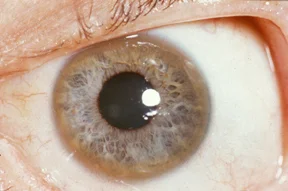
Long description
Photograph of an eye showing a brown-grey ring around the outer edge of the iris, where the cornea meets the sclera. The ring is caused by copper deposition in Descemet's membrane and is seen in most patients with neurological Wilson disease.

Wilson disease is a systemic disease. The signs and symptoms are non-specific, so the unifying move is to spot a young patient with liver disease or a young adult with movement or psychiatric disorder and think of it.
Hepatic disease is the earliest and often the only manifestation in children. The spectrum runs from no symptoms to acute liver failure.
- Asymptomatic with isolated elevation of transaminases, sometimes found during screening of relatives.
- Chronic hepatitis with fatigue, anorexia and jaundice, often indistinguishable from autoimmune hepatitis on biopsy in the young.
- Steatosis (mainly macrovesicular), which can rival nonalcoholic fatty liver disease in severity.
- Compensated and decompensated cirrhosis, with portal hypertension.
- Acute liver failure in 3% to 5% of patients, which is the most dangerous presentation. It combines jaundice, coagulopathy, ascites, encephalopathy and renal dysfunction, and is distinguished by Coombs-negative (non-immune) haemolytic anaemia plus two biochemical ratios: an alkaline phosphatase to total bilirubin ratio below 4 and an aspartate to alanine aminotransferase ratio above 2.2.[1] Untreated acute liver failure from Wilson disease is almost always fatal (AASLD: mortality approaches 100%[1]; the 2023 World Journal of Hepatology pediatric review cites 95%[9]), so hepatology and transplant teams must be involved immediately.
Neurologic illness usually appears in adolescents and young adults, at a mean age around 20 years, and reflects copper toxicity to the basal ganglia. A movement disorder is the dominant finding.[1]
- Tremor - postural, intention or "wing-beating" tremor.
- Dystonia - limb or generalised; can produce the characteristic open-mouthed smile from facial dystonia.
- Parkinsonism - bradykinesia, rigidity, postural instability.
- Dysarthria - often the earliest neurologic complaint.
- Ataxia and gait disturbance.
- Chorea and orofacial dyskinesias.
- Drooling (sialorrhoea), dysphagia and, later, contractures and spasticity.
The neurologic phenotype of Wilson disease is the commonest mimic of juvenile parkinsonism and of generalised dystonia, so a young patient with a movement disorder and a liver abnormality must be assessed for Wilson disease. Early neurologic disease can improve substantially with treatment; late disease may leave residual deficits.
Psychiatric presentations can precede hepatic or neurologic ones by years and are frequently misread as a primary mental illness.
- Depression, irritability and apathy.
- Personality change and declining school or work performance.
- Anxiety, sleep disturbance.
- Psychosis and, rarely, an organic delirium.
A psychiatric or cognitive change in a young person with subtle liver test abnormalities should prompt copper studies.
Ophthalmic signs are the most specific physical findings.
- Kayser-Fleischer rings. Golden-brown or greenish-golden rings at the corneal limbus, caused by copper deposition in the Descemet membrane. They are best seen on slit-lamp examination and, in advanced disease, with the naked eye. They occur in about 90% of patients with neurologic manifestations (about 95% in the 2023 World Journal of Hepatology pediatric review) but are absent in about 60% of those presenting with liver disease (although that review reports rings in 44% to 62% of hepatic presentations).[1][9]
- Sunflower cataracts. Rare (about 1.2% of newly diagnosed patients), these are a central opacification beneath the anterior capsule with radiating, petal-like extensions. They do not affect acuity and usually reverse with treatment.[1]
Copper oxidises red-cell membranes, producing non-immune haemolysis. This ranges from mild anaemia and reticulocytosis to the intravascular haemolysis that is a hallmark of Wilson disease acute liver failure: Coombs-negative, with a falling haemoglobin, low haptoglobin and raised bilirubin and lactate dehydrogenase.[1] Thrombocytopenia and leukopenia from hypersplenism occur if cirrhosis and portal hypertension develop.[1]
Renal copper handling produces three recognisable problems:
- Renal tubular dysfunction with aminoaciduria, hyperphosphaturia, glycosuria and uric acid handling problems, which can amount to a Fanconi syndrome.
- Nephrolithiasis, since excess urinary copper and uric acid loss favour stone formation.
- Hypokalaemia and secondary hypouricaemia from renal tubular losses.[1]
Renal features are often asymptomatic and appear when liver disease is advanced.
Wilson disease bone disease includes osteoporosis and, rarely, an "osteomuscular" presentation with rickets-like changes, demineralisation, renal tubular dysfunction and muscle weakness. Arthralgia, premature arthritis and recurrent fractures are described in chronic disease. Neurological immobility compounds the problem.
Cardiac involvement ranges from subclinical cardiomyopathy to arrhythmias and, reported in some patients, atrial fibrillation.[1] Endocrine effects include hypoparathyroidism, infertility and recurrent miscarriage, requiring preconception counselling and coordinated care in women of child-bearing age.[1]
| System | Typical features | Key clue |
|---|---|---|
| Liver | Asymptomatic enzyme rise, hepatitis, steatosis, cirrhosis, acute liver failure | Young patient, copper ratios in acute failure |
| Brain | Tremor, dystonia, parkinsonism, dysarthria, ataxia, chorea | Onset 20-30, MRI basal ganglia, Kayser-Fleischer rings |
| Mind | Depression, personality change, psychosis | Late rising in a young adult |
| Eye | Kayser-Fleischer rings, sunflower cataract | Slit-lamp exam |
| Blood | Coombs-negative haemolysis | Anaemia with acute liver failure |
| Kidney | Fanconi-type tubulopathy, stones, hypokalaemia | Follows copper overload |
| Bone | Osteoporosis, rickets-like changes | Chronic disease |
| Heart | Cardiomyopathy, arrhythmias | Usually subclinical |
| Mimic | How it differs |
|---|---|
| Autoimmune hepatitis | Stronger in young women, steroid-responsive, lacks Kayser-Fleischer rings and markedly low ceruloplasmin; can coexist with Wilson disease in rare cases[1] |
| Viral hepatitis | Serology, acute or relapsing course |
| Alcohol-associated and nonalcoholic steatohepatitis | No fixed neurologic signs, normal or borderline copper studies |
| Other causes of cirrhosis | Cholestatic disease, metabolic storage disease, genetic iron or alpha-1 antitrypsin disease |
| Young-onset Parkinson disease | Poor or short-lived response to levodopa is a clue; copper studies and Kayser-Fleischer rings separate it |
| Essential tremor, dystonia | No systemic features, normal copper studies |
| Primary psychiatric illness | No copper abnormality; diagnosis rests on copper studies |
| Acute liver failure (other cause) | Drug-induced or autoimmune cause lacks haemolytic copper ratios |
A liver biopsy in Wilson disease can look identical to autoimmune hepatitis in children and to steatohepatitis or cirrhosis from any cause. Therefore, normal liver histology does not exclude Wilson disease in an asymptomatic relative, and a partial response to corticosteroids should reopen the Wilson disease question.[1]
No single test diagnoses Wilson disease. The approach is to gather parallel streams of evidence and then score them.
- Serum ceruloplasmin. Usually low in Wilson disease, typically below 14 mg/dL (normal over 20 mg/dL).[1] But ceruloplasmin has false negatives and false positives: it can be low in heterozygous carriers, malnutrition and other liver diseases, and it can be normal or even raised in Wilson disease, especially as an acute-phase reactant. Therefore, do not rely on ceruloplasmin alone.[1]
- Serum copper. Total copper is often low because it is ceruloplasmin-bound, yet the non-ceruloplasmin-bound ("free") copper is raised. Free copper is usually above 25 micrograms/dL in untreated patients and in the range 10-15 micrograms/dL (AASLD/WJH guidelines) or below 10 micrograms/dL (Syprine product labeling[10]) in treated, stable patients; values above 15 micrograms/dL suggest under-treatment and below 5 micrograms/dL suggest over-treatment, but measurement is method-dependent and is used more for monitoring than diagnosis.[8][9]
- 24-hour urinary copper. Symptomatic patients excrete over 100 micrograms (over 1.6 micromoles) in 24 hours; an asymptomatic sibling or child may have values over 40 micrograms (over 0.6 micromoles), which requires further evaluation.[1][6] Collect accurately: missed or contaminated urine invalidates the result.
- 24-hour urinary copper is not validated as the sole screening test for siblings or relatives.[6]
- Slit-lamp ophthalmic examination for Kayser-Fleischer rings should be performed in every suspected case by an experienced observer; optical coherence tomography can complement it. Earliest rings may need specialist examination.[1]
- Neurologic evaluation, ideally by a movement-disorder or neurology specialist, because early parkinsonism and dystonia are subtle and because severe (paradoxical) neurologic worsening can be precipitated by inappropriate chelation.
- Hepatic copper on liver biopsy, measured on dry weight, is the most reliable tissue test. Wilson disease guidelines use over 250 micrograms per gram dry weight (over 4 micromoles per gram) as diagnostic, 50 to 249 micrograms as indeterminate, and below 50 as normal.[4] (In asymptomatic patients without organ damage the AASLD proposes over 75 micrograms per gram.) Fibrosis, steatosis and inflammation are non-specific; rhodanine-positive granules support the diagnosis when quantitative copper is not available.[4]
- Caution: copper distribution in the liver is patchy with cirrhosis, so a normal biopsy copper does not exclude the disease, and cholestasis of any cause raises hepatic copper.
- MRI of the basal ganglia (especially T2 weighted) may be striking. The classic but uncommon finding is the "face of the giant panda" sign, with increased T2 signal in the midbrain; it is seen in advanced neurologic disease and is not a first-line diagnostic test. More common are T2 hyperintensity in the putamen, caudate, thalamus and brain stem and volume loss.
- Cranial imaging also documents the distribution of disease and helps decide prognosis. It is not required in purely hepatic disease.
- ATP7B mutation analysis confirms the diagnosis when biochemical testing is equivocal and is the most efficient way to screen relatives. It is not required for diagnosis in a typical clinical case, and a negative or inconclusive result does not exclude Wilson disease.[1][4]
- Good practice includes genetic counselling for the patient, parents and potential future offspring, because treatment is lifelong and offspring testing has implications.
Approach to suspected Wilson disease
- Suspect Wilson diseaseYoung patient with unexplained liver disease; any age with neurologic or psychiatric disorder; acute liver failure with Coombs-negative haemolysis
- Initial screenCeruloplasmin, 24-hour urinary copper, slit-lamp for Kayser-Fleischer rings, liver tests, full blood count, INR, neurologic exam
- Question: Copper studies compatible with Wilson disease?
Yes
- Confirm and stageLeipzig score, ATP7B genetic testing where helpful, liver biopsy for copper if diagnosis still uncertain, MRI brain if neurologic features
- Start treatment and screen first-degree relatives
No but suspicion remains
- Investigate mimics and repeatAutoimmune hepatitis, viral hepatitis, drug-induced liver injury, cholestatic disease; repeat copper studies (AASLD: 3-6 months; Wilson Disease Association: at least 3-monthly in the initial phase) if doubt remains
- Refer to specialist centre
Wilson disease is a clinical diagnosis supported by the copper panel and by the Leipzig score, an expert consensus arithmetic score combining clinical and laboratory features. A total of 4 or more supports the diagnosis, 3 is "possible", and 2 or under makes Wilson disease unlikely. Its components are:
| Item | 0 points | 1 point | 2 points |
|---|---|---|---|
| Kayser-Fleischer rings | Absent | - | Present |
| Neurologic symptoms | Absent | Mild | Severe |
| Serum ceruloplasmin | Normal (over 0.2 g/L) | 0.1-0.2 g/L | Under 0.1 g/L |
| Coombs-negative haemolysis | Absent | Present | - |
| Liver copper (dry weight) | Normal (under 50 micrograms/g) | 50-249 micrograms/g | Over 250 micrograms/g |
| 24-hour urinary copper | Normal | 1-2x upper limit of normal | Over 2x upper limit of normal |
| Genetic testing | No variants | One variant | Two variants (or haplotype) |
The Leipzig score threshold requires careful clinical judgement. A patient with a score of 3 can still have Wilson disease, and a patient with a score of 4 (for example one based on Kayser-Fleischer rings, severe neurologic disease and a low ceruloplasmin) should be treated only after a thorough assessment has excluded other causes of the same findings, because low copper findings are not specific.
Severity and transplant scoring. Two prognostic indices help in acute liver failure: the Nazer score (bilirubin, AST and prothrombin time) and the New Wilson Index (bilirubin, INR, AST, white cell count and albumin). A New Wilson Index of 11 or more predicts mortality without liver transplantation; such patients are strong candidates for transplant assessment.[4] Indices are guides, not absolute deciders, and have false positives in both directions.[8]
All patients with a confirmed diagnosis need lifelong copper-directed therapy. Drug treatment falls into two families: chelators that increase urinary copper excretion, and zinc, which blocks intestinal copper absorption. The AASLD 2022 guidance and the EASL 2012 guideline both endorse this approach, with trientine increasingly favoured because it is usually better tolerated than penicillamine.[2][3][7]
Choice depends on presentation:
- Symptomatic hepatic or neurologic disease: start with a chelator.
- Asymptomatic disease without organ damage: a chelator (at lower dose) or zinc may be used.
- Pregnancy: continue therapy; pre-conception counselling is mandatory.
- Advanced liver failure: transplant, with medical therapy as bridge if possible.
D-penicillamine is the original oral therapy and is effective, but requires well-rehearsed monitoring. The adult dose escalates to avoid early toxicity: start 250 to 500 mg per day, increase by 250 mg increments every 4 to 7 days to about 1000 to 1500 mg per day (15 to 20 mg per kg per day, to a maximum of 2000 mg per day), given in 2 to 4 divided doses; take it on an empty stomach because food cuts absorption by about 50%.[1] Children are treated with 20 mg per kg per day, rounded to the nearest 250 mg, given in 2 or 3 divided doses, started incrementally.[1]
Supportive measures:
- Vitamin B6 (pyridoxine) 25 to 50 mg (AASLD) or 25 mg/day (Cuprimine label[11]) by mouth daily with penicillamine, because symptomatic pyridoxine deficiency can occur and may worsen neurologic outcomes.[6]
- Avoid iron and zinc supplements in patients taking penicillamine or trientine, since they chelate them.[1]
- Take the drug on an empty stomach; separate from meals and from other chelated drugs.
Adverse effects of penicillamine that drive switching include fever, rash, lymphadenopathy, neutropenia, thrombocytopenia and proteinuria in the first 1 to 3 weeks ("early sensitivity"), as well as nephrotic syndrome, degenerative skin changes, iron deficiency, and the well recognised but unpredictable worsening of neurologic symptoms (see below).[1][6]
Trientine is an alternative chelator with a similar mechanism. Its initial dose is 20 mg per kg per day, up to 2000 mg daily, in 2 to 3 divided doses, increased gradually over 2 to 3 weeks.[1] It has no hypersensitivity reactions in most series, and early (paradoxical) neurologic worsening seems less common than with penicillamine.[1] Capsules or tablets must be stored properly and taken on an empty stomach; check the formulation, because different salt forms (dihydrochloride and tetrahydrochloride) have different strengths.[2]
Zinc blocks intestinal copper absorption by inducing metallothionein in enterocytes, which traps copper that is then lost in shed cells. It is the AASLD-recommended first-line therapy for asymptomatic patients and is widely used for maintenance.[1]
Dosing (elemental zinc):
- Adults and larger children over 50 kg: 150 mg per day in three divided doses.
- Smaller children (over 5 years old, under 50 kg): 75 mg per day in three divided doses.[1]
Take zinc on an empty stomach, one hour before or two hours after meals, and be aware of dose spacing, because zinc and chelators interfere with each other and with iron. Common adverse effects are nausea and gastric irritation; divided doses with food are sometimes needed for tolerability at some cost to absorption.
Zinc is not suitable as monotherapy for severe hepatic or neurologic disease at outset, because it acts too slowly.
Early neurologic worsening on starting treatment occurs in roughly 14% of treated patients overall (up to 20% with neurologic disease, 1% to 2% with hepatic presentation, and none in asymptomatic patients) and usually within the first three months.[5] Penicillamine accounts for about 70% of cases and trientine about 14%.[5] Symptomatic deterioration has been reported anywhere from "10 to 50%" of patients starting penicillamine in older series, so this is not a minor risk.[6] Measures that reduce it: gradual dose escalation, daily pyridoxine, avoiding concomitant copper-mobilising drugs, close neurologic review in the first 1 to 3 months (AASLD; at least 3-monthly in the initial phase per the Wilson Disease Association), and prompt switching or suspension of the offending drug with clinical deterioration. A practical bedside rule is to stop or reduce the chelator if new or worsening dysarthria, dysphagia or gait disturbance occurs, and to take imaging and copper studies before rechallenge.
A low-copper diet supports drug treatment but cannot replace it, because copper is ubiquitous. The AASLD-promoted target is keeping copper intake below about 0.9 mg per day.[1] (Product labeling advises no more than 1 to 2 mg of copper daily.[11]) During initial therapy and whenever copper is poorly controlled, avoid high-copper foods: shellfish, liver and other organ meats, nuts, mushrooms, chocolate and dried fruit.[6][7][8] Once copper levels have fallen and maintenance is stable, moderate amounts may be reintroduced under medical advice. Patients should avoid copper-containing multivitamins and mineral supplements and have home tap water tested if it runs through copper pipes or comes from a well.[7] Collaboration with a dietitian, as the AASLD advises, is the most practical way to achieve this without causing avoidance of nutritious foods.[1]
Maintenance therapy may be a lower dose of the chelator (about 10 to 15 mg per kg per day, or 750 to 1000 mg per day of penicillamine for adults) or full-dose zinc.[1] Transitioning from initial to maintenance treatment needs closer review for the first 2 to 6 months: liver enzymes, 24-hour urinary copper, neurological examination and any side effects.[1]
Routine follow-up for life (at 6-month intervals initially by AASLD, or every 6-12 months by patient status per the Wilson Disease Association, then individualised) uses:
- Urinary copper on treatment: 200 to 500 micrograms per 24 hours (3 to 8 micromoles) on a chelator; less than 100 micrograms per 24 hours (AASLD) or 30 to 75 micrograms per 24 hours (UK practical guidance) on zinc. Values above the target suggest under-treatment or nonadherence; very low values suggest over-treatment.[1][6]
- Non-ceruloplasmin (free) copper: target 10 to 15 micrograms/dL by guideline (AASLD/WJH) and below 10 micrograms/dL per Syprine product labeling[10] in treated, stable patients; over 15 micrograms/dL suggests under-treatment, below 5 micrograms/dL over-treatment.
- Liver enzymes and synthetic function: falling transaminases and stable albumin/INR indicate response. Persistence of ALT/AST elevation requires assessment for ongoing copper overload, interval fibrosis or another cause.
- Neurologic and psychiatric review at each visit and brain imaging where deficits change.
- Blood copper studies, complete blood count and renal tests to catch cytopenias and renal effects, especially on penicillamine.
Pregnancy, intercurrent infection, surgery and travel can unmask instability, so maintenance plans must survive real life. Patients should carry alert documentation (e.g. "Wilson disease: do not stop chelator") and be warned that self-cessation reliably leads to relapse.
Liver transplantation is the only cure for Wilson disease when the liver itself has failed. It is indicated for:
- Acute liver failure in Wilson disease.
- Decompensated cirrhosis that does not respond to medical therapy.
- Situations where medical therapy cannot be tolerated or has failed.
Transplantation cures the underlying metabolic defect in the new liver and removes copper from the system; long-term survival after transplant for Wilson disease is excellent in most series, with attention to neurologic recovery (brain copper is cleared more slowly). Transplant patients still need multidisciplinary follow-up, and neurologic presentations in particular do not always improve. Transplant listing should not wait for irreversible neurologic decline, and copper-directed therapy should continue until the operation.
The decision to list is based on the New Wilson Index (11 or more predicts death without transplantation), the King's College criteria applied to acute liver failure and local transplant policy. Children with acute presentation should be transferred early to a paediatric transplant centre, because deterioration can be rapid.
Pregnancy in Wilson disease is achievable and should be planned. Preconception counselling should cover fertility, the risk of miscarriage, medication safety and genetic counselling.
Anticopper therapy in pregnancy is generally considered safe, and continuing treatment matters. In one retrospective multicentre study of 282 pregnancies in 136 women, the overall spontaneous abortion rate was 26%; women with an established diagnosis who were on treatment had significantly fewer spontaneous abortions than those diagnosed late (odds ratio 2.85).[1] Patients with current or previous decompensated cirrhosis should be discouraged from conceiving, because advanced liver disease carries major maternal and fetal risk.[1]
Therapeutic decisions in pregnancy are multidisciplinary. Zinc is generally considered safe in pregnancy; chelation (penicillamine or trientine) is often continued because stopping risks rapid decompensation, but dosing and monitoring should be coordinated with hepatology and obstetrics. Patients should be warned against unsupervised drug changes.
- Complications of untreated or late disease: cirrhosis and portal hypertension, ascites, encephalopathy, chronic neurologic deficits and irreversible movement disorders, osteoporosis and fractures, renal calculi and the medical and social sequelae of misdiagnosis.
- Acute liver failure with copper-ratio biochemical signature, haemolysis, renal failure; essentially fatal without transplantation.
- On treatment: penicillamine sensitivity (fever, rash, cytopenias, proteinuria), copper or pyridoxine deficiency, pharmacologic over-chelation and the paradoxical early worsening of neurologic symptoms. Late relapses occur almost exclusively after stopping or erratically taking therapy.
- Post-transplant: surgical complications; neurologic improvement may be incomplete in those with long-standing neurologic disease.
With early diagnosis and consistent, lifelong treatment, life expectancy in Wilson disease is essentially normal. The critical variable is how much liver and brain injury has occurred before treatment starts; the disease does not protect against normal ageing, and aging patients need long-term follow-up. The adage is that treated patients die with Wilson disease, not of it; untreated, the disease is fatal.
Wilson disease cannot be prevented, but disability can. Three tiers of early diagnosis matter:
- Family screening, see below, is the most effective prevention at individual level.
- Clinical suspicion: a hepatologist or neurologist who measures copper in every case of unexplained liver, movement or psychiatric illness in a young person converts a fatal disease into a treatable one.
- Population-level genetic screening is not standard, although the carrier frequency would make it attractive; testing remains targeted to families.
Wilson disease rarely produces symptoms before 5 years and neurologic manifestations are rare before 10, but asymptomatic children of known parents can show abnormal copper tests. Paediatric disease presents more often with the liver than the brain. Dosing is weight based (see above). Children should be enrolled in a transition programme as they move to adult services, since nonadherence peaks in adolescence.
Disease can present after 50 and even in the 70s; age alone and severity labels must not be used to deny testing.[1] Hepatic Wilson disease is usually milder at late presentation, neurologic cases are less common, and differential diagnosis from common age-related conditions (essential tremor, Parkinson disease, common liver disease) is more difficult.
See the management section above. Conception should be discussed with the hepatology team in advance; contraception choice has no copper constraint.
Where specialists, tests and drugs are limited, the disease is still recognisable and treatable at a knowable minimum.
- Suspect it cheaply: in a young person with cirrhosis, acute liver failure plus Coombs-negative haemolysis (which can be seen on a blood film and reticulocyte count), a chronic hepatitis biopsy that looks like autoimmune hepatitis, or a movement disorder, Wilson disease should be on the differential.
- Colour tests: serum ceruloplasmin and 24-hour urinary copper are feasible in most laboratories; a slit-lamp (or at least careful side-illumination of the cornea) for Kayser-Fleischer rings is cheap and specific; liver enzymes and coagulation studies complete the picture.
- What can be treated if copper tests are unavailable: careful use of cheap but effective zinc, combined with a low-copper diet and sensible follow-up, can control disease. (Zinc is increasingly available as acetate or sulphate salts; elemental zinc dose is as above.)
- Chelators: penicillamine is older and less expensive than trientine and is effective, but requires the monitoring described.
- Biopsy for hepatic copper may be the only confirmatory test available in some centres; alternatively, send samples out or treat on clinical grounds with close follow-up.
- Neurologic monitoring and pyridoxine with penicillamine (pyridoxine is inexpensive) remain important.
- Transplantation is not available everywhere: early referral before decompensation is the highest-value intervention.
- Wilson disease is an autosomal recessive copper overload disease caused by mutations in ATP7B; hepatic excretion fails, ceruloplasmin falls and copper deposits secondarily in brain, cornea, kidney and bone.
- Prevalence is about 1 in 30,000, with presentations usually between 4 and 40 years, and reported up to the 70s.
- Presentation is protean: hepatic (including acute liver failure with Coombs-negative haemolysis and characteristic copper ratios), neurologic, psychiatric, ophthalmic (Kayser-Fleischer rings), renal tubular, haematologic, skeletal and cardiac.
- No single test diagnoses it. Ceruloplasmin is below 14 mg/dL in most, 24-hour urinary copper is over 100 micrograms in symptomatic and over 40 micrograms in asymptomatic cases, hepatic copper is over 250 micrograms per gram dry weight, MRI can show the "face of the giant panda".
- Dry-weight hepatic copper thresholds: normal below 50, indeterminate 50 to 249, diagnostic over 250 micrograms per gram.
- Leipzig score of 4 or more supports diagnosis; 3 is possible; 2 or less is unlikely. The New Wilson Index is 11 or more when assessing transplant need.
- Penicillamine challenge testing (post-penicillamine urinary copper above about 1600 micrograms per 24 hours after 500 mg at 0 and 12 hours) is rarely used and not recommended now, and has been validated mainly in children, not adults.[6][3]
- Low ceruloplasmin has false positives and false negatives; do not rely on it alone.
- Treatment is lifelong: chelators (penicillamine or trientine) or zinc, with a low-copper diet (under 0.9 mg per day by AASLD[1], no more than 1-2 mg per day per product labeling[11]), dose escalation, pyridoxine with penicillamine and careful monitoring of urinary copper and non-ceruloplasmin copper.
- Early neurologic worsening occurs in roughly 14% of treated patients and is more common with penicillamine; treat by early review, gradual titration and drug change.
- Transplantation is indicated for acute liver failure and for decompensated cirrhosis not responding to therapy.
- Pregnancy is managed by continuing therapy, with preconception counselling.
- Siblings and other first-degree relatives must be screened, preferably by ATP7B analysis, or by clinical and biochemical assessment plus slit-lamp examination.
- Early diagnosis before cirrhosis or severe neurologic disease gives a near-normal life expectancy.
Answer each one in your head first, then open the answer.
A 22-year-old woman has two years of declining school performance, irritability and a hand tremor. She has dark circles under the corneal limbus visible on slit-lamp, alkaline phosphatase 45 (ratio to bilirubin not relevant), ceruloplasmin 12 mg/dL, and 24-hour urinary copper 350 micrograms. What is the most likely diagnosis and the next step?
Show answerHide answer
Wilson disease, most likely with neurologic/psychiatric presentation. The next step is to complete the diagnostic assessment (Leipzig score, ATP7B mutation analysis, and MRI of the basal ganglia as appropriate), start copper-directed therapy only after hepatology review, and screen first-degree relatives.
Which two biochemical ratios are characteristic of acute liver failure due to Wilson disease?
Show answerHide answer
An alkaline phosphatase to total bilirubin ratio below 4 and an aspartate to alanine aminotransferase ratio above 2.2, with Coombs-negative haemolytic anaemia.
What hepatic copper dry-weight threshold supports a diagnosis of Wilson disease and what values are indeterminate and normal?
Show answerHide answer
Diagnostic over 250 micrograms per gram; indeterminate 50 to 249 micrograms per gram; normal below 50 micrograms per gram.
A stable adult on penicillamine maintenance should have what 24-hour urinary copper target and what daily pyridoxine supplement?
Show answerHide answer
200 to 500 micrograms per 24 hours, with 25 to 50 mg of vitamin B6 daily.
What does a Leipzig score of 4 or more indicate, and what score is too low for confident diagnosis?
Show answerHide answer
4 or more makes Wilson disease highly likely; 3 is possible and requires more testing; 2 or less is unlikely.
When should a patient with Wilson disease be referred for liver transplantation assessment?
Show answerHide answer
In acute liver failure, or cirrhosis with decompensation that is not responding to copper-directed therapy, or when medical therapy cannot be tolerated; a New Wilson Index of 11 or more predicts death without transplantation.
Related topics (search the library): autoimmune hepatitis, cirrhosis and its complications, acute liver failure, Coombs-negative haemolytic anaemia, young-onset parkinsonism and dystonia, hepatolenticular degeneration, Schwann cell and basal ganglia disorders, liver transplantation, pregnancy and liver disease, low-resource management of liver disease.
- Alkhouri N, Gonzalez-Peralta RP, Medici V. Wilson disease: a summary of the updated AASLD Practice Guidance. Hepatology Communications 2023;7(6):e0150. doi:10.1097/HC9.0000000000000150. Accessed .
- Schilsky ML, Roberts EA, Bronstein JM, et al. A multidisciplinary approach to the diagnosis and management of Wilson disease: 2022 practice guidance on Wilson disease from the American Association for the Study of Liver Diseases. Hepatology 2025;82(3):E41-E90. doi:10.1002/hep.32801. Accessed .
- European Association for the Study of the Liver. EASL Clinical Practice Guidelines: Wilson's disease. Journal of Hepatology 2012;56(3):671-685. doi:10.1016/j.jhep.2011.11.007. Accessed .
- Weiss KH, Schilsky M. Wilson Disease (GeneReviews). GeneReviews [Internet], University of Washington, last update 12 January 2023. Accessed .
- Neurol Sci 2023;44(10):3443-3455. doi:10.1007/s10072-023-06893-w. Early neurological deterioration in Wilson's disease: a systematic review and meta-analysis. Neurological Sciences. Accessed .
- Roberts EA, Schilsky ML, American Association for Study of Liver Diseases (AASLD). Diagnosis and treatment of Wilson disease: an update. Hepatology 2008;47(6):2089-2111. doi:10.1002/hep.21820. Accessed .
- National Institute of Diabetes and Digestive and Kidney Diseases (NIDDK). Wilson Disease: Eating, Diet, & Nutrition. NIH NIDDK Wilson Disease. Accessed .
- Nutrients 2022;14(15):3141. doi:10.3390/nu14153141. Low Copper Diet - A Therapeutic Option for Wilson Disease?. Nutrients. Accessed .
- J Clin Transl Hepatol 2023, PMC10642431. Challenges and dilemmas in pediatric hepatic Wilson's disease. Journal of Clinical and Translational Hepatology. Accessed .
- Bausch Health US, LLC. Syprine (trientine hydrochloride) capsules: product labeling. DailyMed, National Library of Medicine. Accessed .
- Bausch Health US, LLC. Cuprimine (penicillamine) capsules: product labeling. DailyMed, National Library of Medicine. Accessed .
Figure credits
Educational content for medical students and doctors. It is not a substitute for clinical judgement or local guidelines.