Menarche, puberty and normal female development
Normal female puberty from breast budding to the first periods: Tanner stages, menarche timing, hormones of the menstrual cycle, and what counts as normal.
- Female puberty is the reactivation of the hypothalamic–pituitary–ovarian axis, usually between 8 and 13 years, and it ends in menarche and then in a regular ovulatory cycle. [2]
- The first reliable sign is breast budding (thelarche); pubic hair (pubarche) follows; menarche comes last, usually 2 to 3 years after thelarche at about 12 to 13 years. [1] [3] [4]
- Puberty is staged with the Marshall–Tanner scales from 1 to 5, and the way it progresses matters as much as the calendar age.
- In healthy adolescents the menstrual cycle lengthens and irregularises naturally after menarche; wide ranges are still normal, but some limits are red flags.
- A clear distinction between normal variation and disease rests on age cut-offs, intervals and flow, not on a single number.
By the end of this page you should be able to:
- Describe normal female puberty from its hormonal trigger to menarche and the first ovulatory cycles.
- Stage breast and pubic-hair development with the Tanner scales and use the normal timing windows.
- Explain the roles of oestrogen, progesterone, FSH, LH, androgens and GnRH across the menstrual cycle. [2]
- Use the accepted normal ranges for cycle length, duration and flow, and recognise the cut-offs that require evaluation.
- Plan the practical assessment of a girl with early or delayed development and the red flags for disease.
- State the guidance positions of ACOG, NICE, RCOG and WHO on this topic and how they differ.
This page covers normal female development: how puberty starts, how it is staged, when menarche should happen, and what a normal menstrual cycle looks like in the early years. It deliberately stops at the normal and explains the boundaries where a girl’s pattern stops being a variant and becomes a problem. Disorders of puberty, menstruation and amenorrhoea are described on their own pages and are linked here only where the comparison helps.
A close reading of the paediatric view is worth doing: the paediatrics topic on puberty and sexual development treats the same hormonal machinery but with a focus on children and on central versus peripheral precocious puberty. This gynaecology page keeps the emphasis on the female milestones themselves, on menarche, and on the menstrual cycle as a vital sign. [2]
Useful context from the guidelines that underpin this page is given where the argument changes: the ACOG Committee Opinion No. 651 on menstruation as a vital sign (December 2015, reaffirmed 2025), the RCOG Scientific Impact Paper No. 40 on sex steroids and induced puberty (page reviewed 2013), the NICE heavy menstrual bleeding guideline NG88 (published 2018, last updated July 2026), and WHO data and guidance on adolescent growth and menarche, including the WHO nutrition guideline on effective actions for adolescent nutrition (2018). [1] [6] [7] [8]
Puberty is the reactivation of the hypothalamic–pituitary–gonadal axis in a child. Pulsatile gonadotropin-releasing hormone from the hypothalamus drives pituitary luteinising hormone (LH) and follicle-stimulating hormone (FSH), which in turn drive ovarian oestradiol. The result is a predictable sequence: breast budding (thelarche), growth acceleration, pubic-hair development (pubarche, which is largely adrenal and not ovarian), and finally menarche. [2]
Adrenarche is a separate, earlier event in childhood, in which the adrenal zona reticularis begins to make dehydroepiandrosterone sulphate. It gives pubic hair, underarm hair, acne and body odour, but it does not mean the ovaries are working and it does not mean fertility has begun. [2]
Menarche is the first menstrual period. It occurs most commonly 2 to 3 years after thelarche, at Tanner stage III or IV breast development, and at the average age of about 12 to 13 years across well-nourished populations. [1] [3] By age 15 years, about 98% of girls will have had menarche. [1] [2][4]
A first cycle is not an adult cycle. Early post-menarcheal cycles are commonly irregular and anovulatory because the positive feedback from rising oestradiol on the pituitary has not fully matured. That immaturity is expected and is not a disease. [1]
A normal menstrual cycle, for classification purposes once adolescence matures, has four independent properties: frequency, regularity, duration and volume of flow. These properties are defined separately so that a girl can have, for example, a normal cycle length with heavy flow, or a short cycle with light flow. [1]
Timing varies. The median age at menarche is between 12 and 13 years in well-nourished developed populations, but cross-sectional and longitudinal work shows a worldwide range. In ACOG data the median has not shifted significantly in the last 30 years in most US groups, although the non-Hispanic black population has a 5.5-month earlier median menarche than 30 years ago. [1] Cross-national WHO data have shown that menarche follows the same sequence worldwide but that timing varies with nutrition and environment. [8]
The long-term trend is towards an earlier menarche of roughly 2 to 3 months per decade in some populations, associated with the decline of stunting and with increasing childhood body mass index. WHO data from Iran showed a fall from 13.88 years in women born around 1930 to 12.98 years in women born around 1990, about 0.15 years per decade. [8]
Factors that shift timing include:
- Body mass index. A larger childhood gain in BMI is consistently linked to earlier breast development and menarche. [1]
- Ethnicity. African-American girls tend to enter breast development somewhat earlier, with a longer interval between breast development and menarche (about 3 years). [1] [3]
- Maternal timing. A girl’s menarche is strongly correlated with her mother’s. [2] [8]
- Environmental and social factors. Socioeconomic conditions, nutrition, access to preventive health care, stress, sleep and possibly endocrine-disrupting chemicals all influence timing. [1] [8]
- Exercise and nutrition. Intense training and low energy availability delay menarche; chronic illness and under-nutrition may delay puberty. [2] [8]
- Stunting and chronic disease. In the WHO adolescent nutrition guidance, girls who are stunted enter puberty and reach menarche later, though they may show catch-up growth. [8]
Where breast development is starting earlier, the interval between thelarche and menarche tends to lengthen in some girls; this is one reason the calendar alone is an unreliable threshold. [1] [2]
Figure 1Menstrual cycle
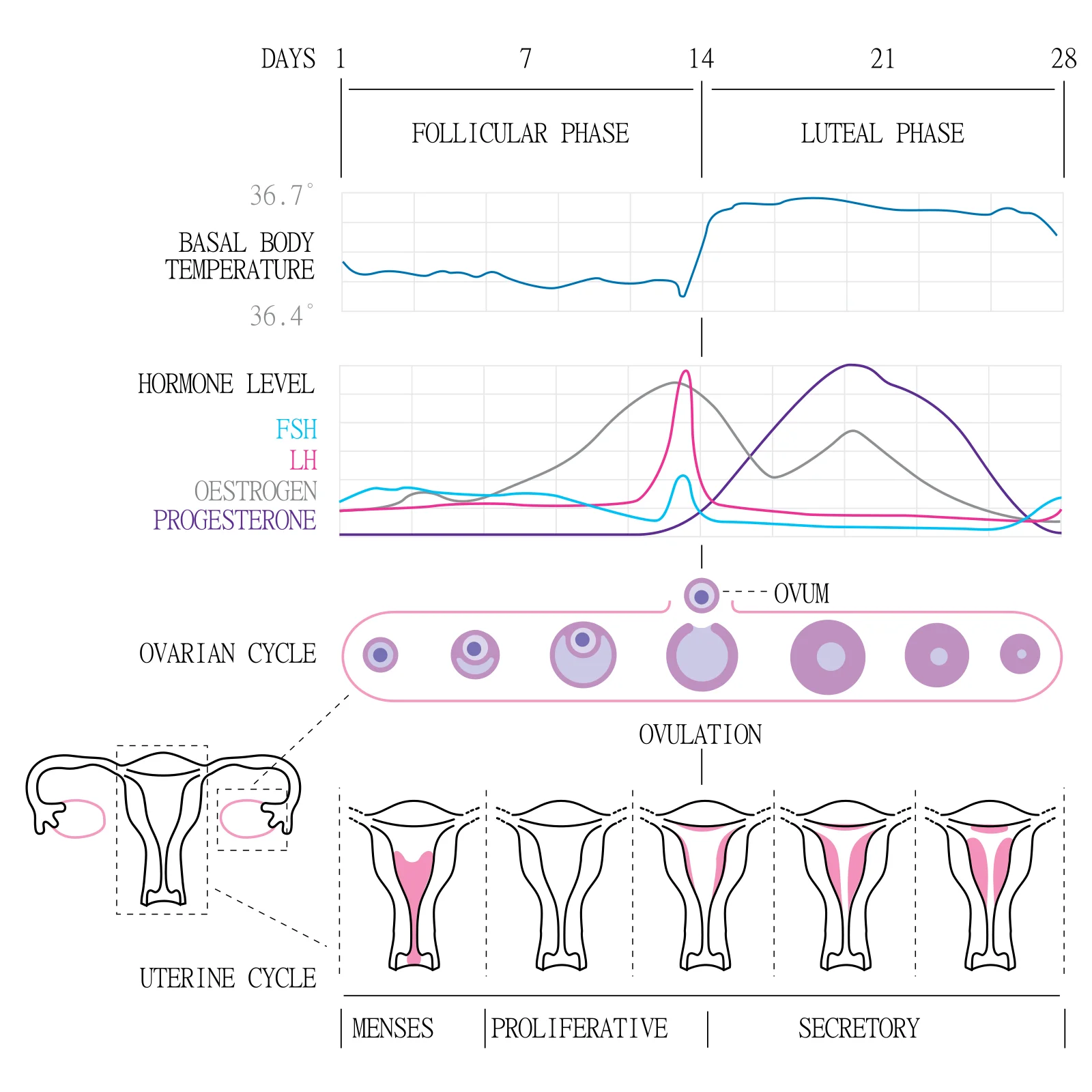
Long description
A 28-day menstrual cycle diagram showing both the ovarian and uterine (menstrual) cycles, with blood levels of FSH, LH, oestrogen and progesterone, plus proliferative and secretory phases of the endometrium, menstruation, ovulation, basal body temperature and ovarian follicle stages.

Normal female puberty is a cascade that runs from the hypothalamus through the uterus.
The trigger. Puberty begins with activation of the hypothalamic–pituitary–gonadal axis. Pulsatile gonadotropin-releasing hormone from the hypothalamus acts on pituitary gonadotrophs, which release LH and FSH in pulses; these reach the ovaries and drive sex-steroid production. [2]
The ovarian effects. Oestradiol grows the breast ducts and glandular tissue, supports uterine growth, and accelerates linear growth. It also slowly matures the positive-feedback loop needed for ovulation, so in the first year or two after menarche LH surges are weak or absent and cycles are often anovulatory. [1] [2]
The menstrual cycle itself. Across a mature cycle two phases are best read together:
- Follicular phase. From day 1 of bleeding, FSH grows a cohort of ovarian follicles. One becomes dominant and secretes rising oestrogen, which thickens the endometrium. When oestrogen stays high for long enough, it feeds back positively on the hypothalamus and pituitary and produces the mid-cycle LH surge. [5]
- Ovulation. The LH surge ruptures the dominant follicle and releases the egg, about 14 days before the next period starts. [5]
- Luteal phase. The ruptured follicle becomes the corpus luteum, which produces progesterone. Progesterone stabilises and matures the endometrium. If no pregnancy occurs, the corpus luteum involutes, progesterone falls, and the endometrium sheds as menstruation. If pregnancy occurs, progesterone stays high. [5]
Why the sequence looks as it does. Breast tissue responds earliest to low levels of oestrogen with the thelarche. Endometrial shedding needs enough accumulated oestrogen and then progesterone exposure to produce a decidualised lining. Hence menarche characteristically lags behind breast budding by about 2 years. [3]
Peak height velocity. The adolescent growth spurt in girls peaks around 11 to 12.5 years and then slows, while menarche generally occurs once growth velocity is falling. This is why girls who mature late are often taller than once predicted. [3] [2]
A thorough history is the most useful intervention in assessing puberty. The important questions are:
- timing of thelarche and pubarche in the child’s own memory and her mother’s memory
- growth pattern on a chart and any recent change in height velocity
- family history of puberty timing, menstrual patterns and bleeding disorders
- nutrition, exercise, chronic disease and medications
- how the girl understands the changes and how anxious she is. [1]
The examination is general (growth, BMI, thyroid, signs of chronic illness) plus the pubertal examination. The clinician should inspect and palpate breast tissue, record Tanner stage, and inspect pubic hair. In most girls, breast budding followed by the pubertal growth spurt is the first visible sign; pubic and axillary hair appear shortly after. A lump under one breast bud before both sides grow symmetrically is very common and should not be mistaken for a tumour. [3]
Menarche occurs about 2 years after the onset of breast development, when the growth in height is slowing after its peak, and it occurs across a wide range. Most girls in the USA begin their periods at 12 or 13 years. [1] [3] [2]
Tanner (Marshall–Tanner) staging uses two separate scales for girls: one for breast development and one for pubic hair. Pubic hair is recorded separately because it is driven largely by adrenal androgens and does not map exactly onto ovarian maturity. [2] [3]
| Stage | Breast | Pubic hair |
|---|---|---|
| 1 | Prepubertal; no glandular tissue; areola flat against chest wall | None |
| 2 | Breast bud: small firm mound of glandular tissue under the areola; areola widens | Sparse, long, straight, lightly pigmented down, mainly along the labia |
| 3 | Breast and areola enlarge further without contour separation | Darker, coarser, curling hair spreading sparsely over the pubic triangle |
| 4 | Secondary mound of areola and papilla above the contour of the breast | Adult-type hair but in a smaller area than in adults |
| 5 | Adult contour; areola recedes into the breast outline (projection of papilla only in many) | Adult-type inverse triangle, extending to the medial thighs |
Table 1. Marshall–Tanner stages in girls: breast and pubic hair. [2] [3]
Estimates of the ages at which stages appear differ by population and by method, and no single mean or range is agreed across samples. [2]
These windows are population descriptions, not deadlines for an individual. The clinical judgement comes from the combination of stage, growth velocity, bone age and family pattern.
The approach is to establish whether puberty has started, whether it is on time, and whether the menstrual pattern is a normal transient phase or a disease.
| Property | What is normal |
|---|---|
| Cycle frequency (cycle length, day 1 to day 1) | 21 to 45 days in the first years after menarche; 21 to 34 days in most adults |
| Duration of bleeding | 2 to 7 days |
| Volume of flow | Mean about 30 mL per cycle; soaking more than one pad or tampon every 1 to 2 hours, or more than 7 days of flow, is excessive [1] |
| Regularity | Bleeding 90 days apart is the 95th percentile and is unusual; girls with more than 3 months between periods should be evaluated [1] |
| Menarche percentile | About 98% of girls have had menarche by 15 years |
Table 3. Normal menstrual patterns in adolescent girls. [1]
The following are commonly used thresholds:
- no breast development by age 13 years. [1] [2]
- no menarche by 15 years, or no menarche within 3 years of thelarche. [1]
- no menarche by 14 years in a girl with signs of hirsutism, or with a history or examination suggestive of excessive exercise or an eating disorder. [1]
- menstrual cycles more frequently than every 21 days or less frequently than every 45 days. [1]
- a period that lasts more than 7 days, or bleeding 90 days apart even for one cycle. [1]
- flow requiring changes every 1 to 2 hours, which is excessive and should be taken seriously, particularly if there is a personal or family history of abnormal bleeding. [1]
- menarche before about 8 to 9 years in girls, which is precocious puberty and needs assessment. [2] [4]
These are common first-line tests, used when the history or timing suggests a problem rather than normal variation:
- A careful history and plotted growth chart, including parental puberty timing.
- A left-hand and wrist radiograph for bone age (the best single window on whether puberty is out of step with chronological age).
- Basal morning LH and FSH with a sensitive assay. A morning LH around 0.1 units per litre or more can support true puberty; thresholds differ by laboratory and guide.
- Oestradiol in girls and testosterone in boys. A low value does not exclude puberty; a high value with low gonadotropins points to a peripheral source.
- Pelvic ultrasound in girls, to assess uterine and ovarian size and ovarian morphology.
- Brain MRI when puberty starts before 6 to 8 years, or at any age with neurological symptoms, very rapid progression or no family history.
- Karyotype when delayed puberty is accompanied by a raised gonadotropin concentration.
Most girls with a normal tempo do not need any of these tests; they need information, an explanation and a follow-up appointment, with observation rather than immediate investigation the right first step.
A distinction worth making clear:
- primary amenorrhoea is the absence of menses by age 15 years with normal growth and secondary sexual development, or the absence of menses by age 13 in the absence of normal growth or secondary sexual development. [1]
There is no treatment for normal puberty itself. Management is mostly reassurance, education and observation over time.
- For a girl with normal timing and an anxious family. Explain the likely sequence: breast buds often appear from 8 to 10 years; menarche usually follows 2 to 3 years later; early cycles may be irregular, longer, and even 3 months apart for a single cycle. Give anticipatory guidance about menstrual hygiene and what flow looks like. ACOG advises clinicians to begin anticipatory guidance at the 7- and 8-year visits. [1] [4]
- For a girl whose pattern is within normal ranges but is distressing. Chart menses for two or three cycles. The clinician should count the cycle from the first day of one period to the first day of the next and explain that an individual cycle can vary. [1]
- For excessive menstrual bleeding. Take into account the range and natural variability in cycles and flow when diagnosing heavy bleeding. NICE defines heavy bleeding by its effect on quality of life rather than by a volume alone, and (in women with fibroids of 3 cm or more) uses a haemoglobin of 102 g per litre or below when stratifying some treatment options. [7]
- For delayed or absent puberty. This is outside normal management. Think constitutional delay of growth and puberty first; it is self-limited and a diagnosis of exclusion. RCOG Scientific Impact Paper No. 40 considers puberty induction for hypogonadism a specialist matter, and in clinical practice combined hormonal contraception is avoided for initiating puberty. Management is usually patience, counselling and, when the delay is marked or psychologically harmful, a short course of low-dose oestrogen under paediatric endocrinology. [6]
- For early puberty. A benign variant, such as premature thelarche or premature adrenarche, is managed with observation; rapidly progressive true precocious puberty is treated by endocrinology with GnRH analogues. Details are on the paediatric puberty page rather than here.
- For menstrual abnormalities. Box 3 of the ACOG opinion lists menstrual patterns that require evaluation, including very frequent or very sparse cycles, more than 7 days of flow, missed menses longer than 90 days, and primary amenorrhoea at the cut-offs above. [1]
- breast development that progresses month to month, with a simultaneous growth spurt and advancing bone age: consider true precocious puberty. [2]
- a unilateral ovarian or testicular abnormality or café-au-lait spots with polyostotic bone change: consider a gonadotropin-independent (peripheral) source. [2]
- prepubertal vaginal bleeding in a girl with no breast development: consider trauma, foreign body, a bleeding disorder, or a local cause, rather than puberty. [2]
Normal puberty is not a disease, but getting the boundary wrong has consequences.
- Missed serious disease. Label a 13-year-old with raised gonadotropins as a “late bloomer” and Turner syndrome or primary ovarian insufficiency can be missed.
- Unnecessary investigation. Treating normal variation as disease produces procedures, radiation and anxiety for young girls and their families.
- Psychological burden. A girl who is told her development is abnormal when it is not will often remember the message for years. Equally, a girl with delayed puberty can suffer social exclusion if she is not supported while observation continues.
- Health consequences of early menarche. Earlier menarche is associated in population studies with higher lifetime oestrogen exposure; associations with adult adiposity and dyslipidaemia are epidemiological observations, not a reason to treat normal timing.
- Confusion of menarche with fertility. A girl who has her first period often assumes she can conceive. Anovulatory cycles in the first years after menarche mean she is usually not fertile immediately, but barrier protection or contraception is still needed. [2]
- A girl who develops within normal windows and has a normal progression can be expected to mature fully.
- Most benign variants of puberty (premature thelarche, premature adrenarche) resolve or remain benign with monitoring. [2]
- 80% of girls have regular, ovulatory cycles within 5 years of menarche. [2]
- Constitutional delay of growth and puberty resolves with time and most adolescents reach an adult height appropriate to their family. [4]
- Menarche is later with under-nutrition, and a normal nutritional status is needed for the timely onset of puberty; menarche usually normalises when nutrition recovers. [8]
Normal puberty cannot be prevented or scheduled, but it can be supported.
- Routine surveillance. Baseline growth and pubertal assessments at well visits catch most deviations. ACOG advises including the menstrual cycle as a vital sign at every preventive or comprehensive visit once a girl is menstruating; her first day of the last menstrual period and her pattern of menses should be recorded. [1]
- Anticipatory guidance. Explain, before they happen, what changes will happen and at what approximate age. Give guidance on using menstrual products and reassure girls about variation. [1]
- Nutritional support. The WHO adolescent nutrition guidance emphasises that energy and nutrient needs rise incrementally with growth and Tanner stage rather than with chronological age, and that under-nutrition delays sexual maturation and menarche. Supporting a healthy weight for height matters more than the calendar. [8]
- Early referral. Refer early when puberty starts before about 8 years, when there is no breast development by 13 years, when there is no menarche by 15 years or within 3 years of thelarche, or when a flow pattern crosses the red-flag cut-offs above. [1] [2]
- Pregnancy and mini-puberty. Brief breast enlargement in newborns of both sexes is physiological and resolves; it does not need treatment.
- Athletes and dancers. Intense training and very low energy availability delay menarche; a girl who is training hard and is not menstruating needs assessment for energy deficiency rather than being reassured that this is a normal part of sport. [2]
- Chronic disease, including anorexia nervosa, inflammatory bowel disease and coeliac disease. These cause functional hypogonadotropic hypogonadism and delay pubertal milestones; restoring the underlying health often restores pubertal progression. [2]
- Survivors of childhood cancer. Cranial or gonadal radiation and chemotherapy can produce either precocious or delayed puberty; long-term endocrine surveillance detects both. [2]
- Overweight and obesity. A larger childhood body-mass-index gain is associated with earlier breast development and menarche. In the paediatrics literature this is a modifiable target for prevention; in an individual girl the clinician interprets the whole clinical picture rather than treating weight alone. [1] [2]
- Disorders of sex development. Atypical puberty needs a specialist multidisciplinary team rather than a standard pubertal protocol. [2]
- Chronic illness and medication. These can delay maturation; timing should be interpreted against growth and nutritional status, and the underlying cause treated. [2]
- Older women. This page is about development, but it is worth remembering that the menstrual cycle is also a marker of ovarian reserve later in life: shortening cycles in the late 30s and 40s are a normal prelude to the menopause, not a disease.
The conditions most often confused with normal puberty, and the feature that separates each from normal development:
| Condition | What makes it different from normal development |
|---|---|
| Precocious puberty (before about 8 to 9 years) | More than 2 standard deviations earlier than the mean; often with accelerated growth and bone-age advance; may be central or peripheral. Peaks and thelarche before 8 years need evaluation rather than observation. [2] [4] |
| Constitutional delay of growth and puberty | Thelarche clearly delayed well beyond the expected age; menarche later than peers; the girl is short for family but otherwise well, with a delayed bone age and often a family history of late bloomers. A diagnosis of exclusion. [2] [4] |
| Delayed puberty with pathology (hypergonadotropism or hypogonadotropism) | Raised LH and FSH suggest ovarian failure; low gonadotropins suggest a hypothalamic or pituitary cause or chronic disease. These need investigation, not reassurance. [2] |
| Premature thelarche | Isolated breast budding under 8 years, with normal growth velocity and bone age, without other pubertal signs. Usually self-limiting. [2] |
| Premature adrenarche | Pubic and/or axillary hair before 8 years driven by adrenal androgens, without HPG activation, with little or no linear acceleration. [2] |
| Primary amenorrhoea | No menarche by 15 years with normal growth, by 13 with poor growth, or no menarche within 3 years of thelarche. Always implies a cause to find. [1] |
| Polycystic ovary-related patterns | Irregular cycles can be normal in adolescence, so a polycystic ovary syndrome label should not rest on cycle irregularity alone in the first years after menarche. [1] |
| Anovulatory heavy bleeding | Development is normal, but the unopposed oestrogen of early adolescence can cause heavy or prolonged bleeding; a coagulopathy is present in an important minority of adolescents with heavy bleeding. [1] |
Table 4. How normal female development differs from the common abnormal patterns. [1] [2] [5]
Assessing pubertal development and menarche in a girl
- PresentationConcern from girl, parent or clinician; plot growth and puberty; ask about maternal timing
- Question: Is this a normal variant rather than disease?
Yes (age and progression within range)
- Explain and reassureGive anticipated timeline, hygiene advice and what irregular cycles look like
- Provide red-flag listWhen to return: no breast by 13, no menarche by 15 or 3 years after thelarche, very frequent or very sparse cycles, more than 7 days of bleeding, bleeding every 90+ days
- Follow up in 6–12 monthsRe-check growth and Tanner stage
Uncertain or outside the expected windows
- Full history and examinationGrowth, BMI, Tanner stage, thyroid, signs of chronic illness
- Question: Are breasts or pubic hair on time (8–13 years)?
Too early (before 8 years)
- Exclude a peripheral cause firstConsider McCune–Albright, adrenal or ovarian sources, exogenous steroids
- If central patternBaseline LH/FSH/oestradiol and bone age; refer for MRI and GnRH testing
Too late (no breast development by 13 years)
- Bone age and morning LH/FSHRaised gonadotropins point to ovarian failure; low gonadotropins point to hypothalamic/pituitary disease or functional delay
- Constitutional delay likely if otherwise wellCounselling, observation; short low-dose oestrogen only if delay is marked
- Question: Has menarche occurred?
No, day 1 never happened
- Apply primary-amenorrhoea thresholdsBy 15 years (normal growth), by 13 years (poor growth or no development), or more than 3 years after thelarche
- Investigate causesAnatomical, hypergonadotropic and hypogonadotropic causes; refer to endocrinology
Yes
- Apply Box 3 menstrual patternsFrequency under 21 or over 45 days, flow over 7 days, bleeding more than 90 days apart, or soaking a pad every 1–2 hours requires evaluation
- Treat or refer by causeCoagulopathy, thyroid or pituitary disease, polycystic ovary-related patterns to be diagnosed by agreed criteria only
Abbreviation: GnRH = gonadotropin-releasing hormone. Flowchart adapted for teaching; follow local guidance.
- Female puberty is the reactivation of the hypothalamic–pituitary–ovarian axis; pubic hair comes largely from the adrenal glands and is a separate process. [2]
- The first reliable sign is thelarche, with menarche following roughly 2 years later at an average age near 12 to 13 years. [1] [3]
- Breast budding and pubic hair are staged separately on the Tanner scales; stage 5 is adult. [2] [3]
- Adrenarche (from about 6 years) and gonadarche are different processes; a child can have pubarche without true puberty. [2]
- Early cycles are commonly irregular, anovulatory and 3 weeks to 6 and a half weeks apart; regular ovulatory cycling in 80% of girls only arrives within 5 years of menarche. [1] [2]
- Normal flow is 2 to 7 days and a mean of about 30 mL per cycle. [1]
- About 98% of girls have menarche by 15 years. [1]
- Anticipatory guidance should start at the 7- and 8-year visits, and the menstrual cycle should be treated as an extra vital sign once menstruation starts. [1]
- Red flags include no breast development by 13, no menarche by 15 or 3 years after thelarche, very frequent or very sparse cycles, more than 7 days of bleeding, and bleeding more than 90 days apart. [1]
- Late menarche is not always a problem: constitutional delay usually resolves; investigation is needed when growth or gonadotropins are abnormal. [2] [4]
- Normal variants of puberty such as premature thelarche and premature adrenarche should be observed rather than treated. [2]
- All the guideline thresholds above are reference points; population and clinical context always matter. [1] [2] [8]
Answer each one in your head first, then open the answer.
A 9-year-old girl has only a unilateral breast bud. There is no growth acceleration, her bone age is equal to her chronological age, and there are no other pubertal signs. What is the most likely explanation and what should happen?
Show answerHide answer
Premature thelarche: a benign variant with isolated breast tissue, normal growth velocity and normal bone age. Management is reassurance and monitoring every few months, with reassessment if progression begins.
A 12-year-old girl notices breast budding at 10 years. She has not yet had a period, and her growth chart shows her height velocity beginning to fall. Explain what you tell her family and why.
Show answerHide answer
Menarche usually occurs about 2 years after breast budding, so a first period at about 12 is expected. The slowing growth velocity is a normal part of the later phase of puberty. Reassure, give anticipatory guidance about menstruation, and review in 6 to 12 months.
What is the difference between adrenarche and gonadarche, and why does it matter clinically?
Show answerHide answer
Adrenarche is adrenal androgen production (from about 6 years) causing pubic hair, axillary hair and body odour; gonadarche is gonadal activation, with oestrogen driving breast development and, later, menarche. A girl can have pubarche from adrenarche without having entered true puberty, so pubic hair alone must never be used as proof of ovarian activation.
Which features separate a normal early-adolescent irregular cycle from a pattern that needs evaluation?
Show answerHide answer
Irregularity in the first years after menarche is normal, and 90% of cycles are 21 to 45 days long. Patterns that need evaluation include cycles more frequent than every 21 days or less frequent than every 45 days, a single gap of more than 90 days, periods lasting more than 7 days, and flow that soaks more than one pad or tampon every 1 to 2 hours. [1]
A 14-year-old has Tanner stage 2 breast development and an LH that is high for her age with a delayed bone age. Her father had voice deepening at 16. What is the likely diagnosis and next step?
Show answerHide answer
Constitutional delay of growth and puberty: late but otherwise healthy, with delayed bone age and a family history of late maturation. Management is counselling and observation; refer and consider low-dose oestrogen only if the delay is marked or psychologically harmful.
Why is menarche not the same as fertility?
Show answerHide answer
Menarche occurs when endometrial shedding is possible, but ovulation is driven by a mature positive feedback loop. In the first year after menarche only about half of cycles are ovulatory in early maturers, and all cycles may not be ovulatory for 8 to 12 years in late maturers. Nonetheless, contraception is still needed if sex occurs.
A 16-year-old has had menarche but has not had a period for 4 months. She is of normal weight and takes no medication. What are your priorities?
Show answerHide answer
Pregnancy is the first thing to exclude sensitively and early. Failing that, consider thyroid, prolactin, hypothalamic, ovarian and the other causes in the ACOG Box 2 pattern. A 4-month gap in a teenager who has previously menstruated needs evaluation rather than reassurance.
Puberty and sexual development (paediatric topic) is the natural companion page. This page is about normal female development; the paediatric page carries the full evaluation and treatment of precocious and delayed puberty. Related pages in the catalogue also include amenorrhoea, abnormal uterine bleeding and heavy menstrual bleeding, polycystic ovary-related patterns for later cycles, Turner syndrome and other chromosomal causes of primary amenorrhoea, eating disorders, thyroid disease, and the menopause. Link each of them with a TopicLink only once they are verified topics.
- American College of Obstetricians and Gynecologists Committee on Adolescent Health Care. Menstruation in Girls and Adolescents: Using the Menstrual Cycle as a Vital Sign. Obstetrics & Gynecology 2015;126(6):e143–e146. Committee Opinion No. 651, reaffirmed 2025. Accessed .
- Bramsweig JH, Dübbers A. Disorders of Pubertal Development. Deutsches Arzteblatt International 2009;106(17):295–304 (PMC2689583). Accessed .
- Graber EG, Pekarsky AR (reviewers), Merck Manual Professional Version. Physical Growth and Sexual Maturation of Adolescents. Merck Manual Professional Version, reviewed January 2025. Accessed .
- MedlinePlus Medical Encyclopedia (A.D.A.M. editorial review). Adolescent development. MedlinePlus, reviewed 1 January 2025. Accessed .
- UCSF Center for Reproductive Health. Normal Menstrual Cycle. UCSF Center for Reproductive Health patient education. Accessed .
- Royal College of Obstetricians and Gynaecologists. Sex Steroid Treatment for Pubertal Induction and Replacement in the Adolescent Girl. RCOG Scientific Impact Paper No. 40, page reviewed 2 August 2013. Accessed .
- National Institute for Health and Care Excellence. Heavy menstrual bleeding: assessment and management. NICE guideline NG88, published 14 March 2018, last updated 7 July 2026. Accessed .
- Tehrani FR, Mirmiran P, Zahedi-Asl S, Nakhoda K, Azizi F. Menarcheal age of mothers and daughters: Tehran Lipid and Glucose Study. Eastern Mediterranean Health Journal 2010;16(4):391–395. Accessed .
Figure credits
Educational content for medical students and doctors. It is not a substitute for clinical judgement or local guidelines.