Drug eruptions, erythema multiforme and SJS/TEN
How to recognise common drug rashes and tell erythema multiforme, DRESS, and SJS or TEN from benign eruptions, and how to manage them.
- Most drug eruptions are mild, begin one to two weeks after starting a medicine, settle when the medicine is stopped, and need only antihistamines and emollients.
- The important skill is to pause at every new rash and ask whether it is an early severe cutaneous adverse reaction.
- Erythema multiforme is usually triggered by infection, most often herpes simplex virus, and is generally self-limiting. [6]
- DRESS is a delayed, systemic illness that appears two to eight weeks after a drug, with fever, facial swelling, swollen glands, eosinophilia and internal organ involvement.
- Stevens-Johnson syndrome and toxic epidermal necrolysis are emergencies: pain, fever, mucosal erosions and epidermal detachment. Stop the drug immediately and arrange multidisciplinary care.
By the end of this page you should be able to:
- Classify a suspected drug eruption by morphology, timing and severity.
- Recognise and investigate the common benign patterns: morbilliform eruptions and fixed drug eruptions.
- Diagnose DRESS, including the RegiSCAR scoring thresholds.
- Recognise erythema multiforme, name its usual infection triggers, and manage recurrent disease.
- Assess SJS/TEN by body surface area involvement, apply SCORTEN, and plan immediate supportive care.
- Explain the roles of allopurinol and HLA-B58:01 and carbamazepine and HLA-B15:02, and when to screen.
- Describe the differences between EM, DRESS and SJS/TEN in a single glance table.
Drug-induced skin disease is the most visible adverse effect of medicines. Roughly one in ten adverse drug reactions involves the skin, with estimates in the literature of 10 to 30 percent depending on the setting. [1] The majority are benign and self-limiting, but a small proportion progress to the severe cutaneous adverse reactions described here: DRESS, Stevens-Johnson syndrome (SJS) and toxic epidermal necrolysis (TEN). Delayed recognition is the main avoidable cause of harm, because continued exposure to the culprit drug worsens the outcome. [1]
This topic covers the whole spectrum for a first encounter: benign morbilliform eruptions and fixed drug eruptions, infection-triggered erythema multiforme, DRESS, and the SJS/TEN spectrum, with the scoring systems and supportive-care principles used in current practice.
A drug eruption is any cutaneous reaction attributed to a medication. The useful first division is by severity.
- Mild and self-limiting: morbilliform (exanthematous) eruptions, urticarial reactions, fixed drug eruptions, photosensitivity rashes, acneiform and lichenoid eruptions.
- Severe cutaneous adverse reactions (SCARs): erythema multiforme major, DRESS (drug reaction with eosinophilia and systemic symptoms), acute generalised exanthematous pustulosis (AGEP), SJS, SJS/TEN overlap, TEN, and generalized bullous fixed drug eruption.
The SJS/TEN spectrum is defined by the percentage of total body surface area with detached or detachable epidermis. SJS is under 10 percent, SJS/TEN overlap is 10 to 30 percent, and TEN is over 30 percent. [2][7][8] Mucosal involvement, in two or more sites (oral, nasal, conjunctival, genital, anal), occurs in about 90 percent of SJS/TEN cases. [7]
Erythema multiforme is a distinct acute mucocutaneous syndrome with targetoid lesions, usually self-limiting, classically linked to infection. [6] It is no longer considered part of the SJS/TEN spectrum in modern consensus.
Incidence. SJS/TEN is rare, with a reported incidence of 1 to 5 cases per million people per year, and a higher incidence in adults than in children. [8] Morbilliform reactions are common: around 10 to 30 percent of adverse drug reactions involve the skin. [1]
Mortality. SJS carries mortality below 5 percent and TEN over 30 percent in many series, with sepsis the commonest cause of death. [3] A 2026 Moscow cohort reported 18.7 percent in-hospital mortality. [2] Reported mortality rates are as high as 34 to 50 percent, correlating with body surface area involvement. [8]
Risk factors for benign eruptions. Antibiotics, anticonvulsants and nonsteroidal anti-inflammatory drugs are the most commonly implicated agents. [1] Polypharmacy, older age and female sex increase the chance of a drug rash.
Risk factors for severe reactions. Host genetics matter. The strongest and most clinically actionable associations are HLA-B58:01 with allopurinol (described below) and HLA-B15:02 and HLA-A*31:01 with aromatic anticonvulsants. HIV infection, advanced cancer and chronic kidney disease increase SCAR risk and worsen prognosis.
Morbilliform eruptions usually appear one to two weeks after the drug is started and favour the trunk and proximal limbs. [1] Common culprits are beta-lactam antibiotics, sulfonamides, allopurinol, anticonvulsants and nonsteroidal anti-inflammatory drugs. [1] They can also occur as an immune reconstitution rash after starting antibacterial therapy, and mild cases can continue the drug if essential and under close review, although most departments stop it.
A fixed drug eruption is a sharply demarcated erythematous or violaceous patch or plaque at one site, often with a central blister. It recurs at exactly the same anatomical site on re-exposure and resolves with post-inflammatory hyperpigmentation. [1] Favoured sites are the lips, genitalia, hands and feet. Triggers include antibiotics (co-trimoxazole, tetracyclines), nonsteroidal anti-inflammatory drugs and antiepileptics. [1] A generalized bullous variant exists and can mimic SJS/TEN.
DRESS is a delayed T-cell-mediated hypersensitivity reaction usually appearing two to eight weeks after the drug. [1] Classically it produces fever, a widespread pruritic rash, facial oedema, lymphadenopathy, eosinophilia and hepatitis or other organ injury, most often renal. [1] High-risk drugs include aromatic anticonvulsants, allopurinol, sulfasalazine, minocycline, dapsone and the antiretrovirals abacavir and nevirapine. [3][8]
Erythema multiforme is usually post-infectious. Herpes simplex virus is the most common trigger, and Mycoplasma pneumoniae may trigger it when there are respiratory symptoms. [6] It produces the classic target lesions with a dusky centre on the acral surfaces and can include mucosal erosions in the major form. Drugs are an infrequent trigger compared with SJS/TEN.
Over 80 percent of adult cases are medication-induced. [8] The highest-risk drugs are allopurinol, anticonvulsants (carbamazepine, phenytoin, phenobarbital, lamotrigine), sulfonamides, antibacterial agents (especially sulfa-containing ones), oxicam nonsteroidal anti-inflammatory drugs and antiretrovirals. [7][8] Mycoplasma pneumoniae was formerly considered a common trigger, particularly in children, but is now recognised as reactive infectious mucocutaneous eruption, a milder condition with a distinct course. [7]
More than 300 different drugs and supplements have been implicated. [8]
Allopurinol is one of the commonest SJS/TEN triggers. [7] The allele HLA-B58:01 is strongly associated with allopurinol-induced severe cutaneous adverse reactions. [5] Carriage accounts for 100 percent of affected patients in Han Chinese cohorts but only 55 to 64 percent in Northern and Southern European cohorts, so a negative test does not exclude risk. [5] The 2012 ACR gout guideline, echoed by CPIC (2015 update), recommends testing HLA-B58:01 before allopurinol in selected high-prevalence groups, such as individuals of Korean descent with stage 3 or worse chronic kidney disease and those of Han Chinese or Thai descent. [4][7] A US cohort identified HLA-A*34:02 as an additional independent risk factor in mixed-ancestry populations. [5]
HLA-B15:02 is strongly associated with carbamazepine and oxcarbazepine-induced SJS/TEN, while HLA-A31:01 is associated with carbamazepine-induced maculopapular exanthema, DRESS and SJS/TEN. [3] Allele frequency is highest in East Asian (6.9 percent), Oceanian (5.4 percent) and South/Central Asian (4.6 percent) populations, much lower in Japanese and Korean people, and very low in African, Caucasian and Hispanic populations. [3] CPIC recommends testing before starting carbamazepine or oxcarbazepine in at-risk populations; if positive, the drug should be avoided. [3] The FDA label for carbamazepine carries a boxed warning. [3] Frequency tables are HLA, not destiny: a Southeast Asian who has taken the drug safely for more than three months is at extremely low future risk. [3]
Drug rashes are usually delayed type IV hypersensitivity reactions. The medicine or a reactive metabolite acts as a hapten, binding to host proteins. Drug-specific T cells recognise the altered self-peptide presented on major histocompatibility complex molecules and release cytokines and cytotoxic mediators. [1]
In SJS/TEN, cytotoxic CD8 T cells and natural killer cells attack keratinocytes through Fas ligand, granulysin and annexin A1 signalling, producing full-thickness epidermal necrosis. [8] In DRESS, the pathway involves the same T-cell activation but with eosinophilia and reactivation of herpesviruses such as HHV-6, reflecting a more systemic inflammatory drive.
The latency period is therefore a clinical clue. Morbilliform eruptions appear one to two weeks after dosing, DRESS after two to eight weeks, and SJS/TEN after three to four weeks, though onset as early as three or four days and as late as eight weeks has been reported. [1][7]
Ask about every medicine and supplement started in the last three months, including over-the-counter products and herbal remedies, and the exact date of each. [7] Establish the latency between starting or changing a drug and the onset of the rash. Ask about fever, sore throat, dysphagia, breathlessness, eye pain, dysuria and diarrhoea, all of which suggest systemic involvement. Ask about previous drug reactions and asthma or atopy.
Examine the whole skin and all mucous membranes. Note lesion morphology, distribution and whether it is symmetrical or confined to sun-exposed areas. Count the blisters and record the body surface area detached. In morbilliform eruptions look for confluent erythematous macules and papules beginning on the trunk, without mucosal disease and without fever. [1] In SJS/TEN look for skin pain, purpuric macules, targetoid lesions, early vesicles, and rapid confluence. [8]
Eye, mouth, nose and genital examinations are essential in any severe rash, because mucosal erosions occur in about 90 percent of SJS/TEN cases and can be the only early sign. [7] Examine the respiratory and renal systems and check vital signs, since airway involvement and hypovolaemia can develop suddenly. [7]
The conditions most often confused with a drug eruption are summarised here.
| Condition | Typical picture | What separates it |
|---|---|---|
| Viral exanthem | Maculopapular rash, often in children, with fever | Follows an infection, no clear drug trigger, and resolves as the fever settles |
| Erythema multiforme | Target lesions with dusky centres, usually acral | Post-infectious, most often herpes simplex virus; limited mucosal disease compared with SJS/TEN [6] |
| DRESS | Fever, facial oedema, widespread rash, eosinophilia | Delayed (2 to 8 weeks), with systemic organ involvement [1] |
| SJS/TEN | Painful purpuric macules, blistering, mucosal erosions | Drug trigger, rapid spread, epidermal detachment, high systemic toxicity [7][8] |
| AGEP | Sudden fever and hundreds of sterile pustules | Neutrophilia, resolves within days of drug withdrawal |
| Generalised bullous fixed drug eruption | Large bullae on previous fixed-drug sites | Previous fixed-drug history and identical sites |
| Staphylococcal scalded skin syndrome | Superficial peeling in children | Positive staphylococcal focus, lack of mucosal involvement, more superficial split |
| Paraneoplastic pemphigus | Severe mucositis with an underlying tumour | Known malignancy, autoantibody positivity |
Figure 1Toxic-epidermal-necrolysis
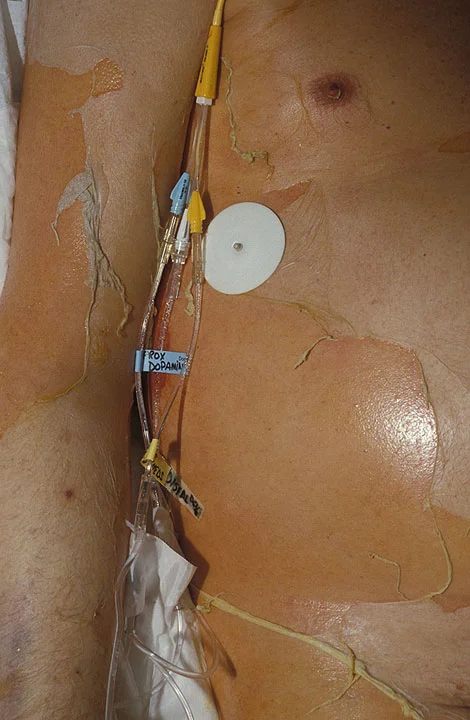
Long description
Clinical photograph labelled 'Toxic epidermal necrolysis' from dermnet.com, uploaded by User:Madhero88 and categorised under toxic epidermal necrolysis on Wikimedia Commons; it is the lead illustration used by the English Wikipedia article on toxic epidermal necrolysis with the caption 'Characteristic skin loss and peeling in toxic epidermal necrolysis'.

No investigation diagnoses a benign drug eruption. The diagnosis rests on timing and morphology. [1]
When a severe reaction is suspected, take a full blood count with differential, liver and renal function tests, electrolytes, C-reactive protein and an erythrocyte sedimentation rate. [7] Add blood cultures and wound or blister cultures because sepsis is the leading cause of death. [7] Mycoplasma pneumoniae is a more common trigger of SJS/TEN in children and young adults under 21 years; test for it when mucocutaneous disease is suspected. Take a chest radiograph if respiratory symptoms exist. [7] Skin biopsy can confirm SJS/TEN if the diagnosis is uncertain. [7][8]
Diagnosis is clinical: acute onset of typical or atypical target lesions on the extremities, often with a recent herpes simplex infection or respiratory illness. Histology is rarely needed.
DRESS is diagnosed with the RegiSCAR scoring system. The score ranges from -4 to 9, and a risk factor adds one point each. Scores below 2 mean no DRESS, 2 to 3 possible DRESS, 4 to 5 probable DRESS, and above 5 definite DRESS. [5] Important components are fever, facial oedema, eosinophilia, atypical lymphocytes, lymphadenopathy, internal organ involvement and a prolonged course.
SJS, overlap and TEN are defined by body surface area detached, as above. [7][8]
SCORTEN is a validated severity score used in SJS/TEN to estimate in-hospital mortality and guide the level of care. [1][2][7] It has seven binary variables, scored one point each.
| Variable | Points | Trigger |
|---|---|---|
| Age older than 40 years | 1 | [2] |
| Associated malignancy | 1 | [2] |
| Heart rate above 120 beats per minute | 1 | [2] |
| Serum urea above 28 mg per dL | 1 | [2] |
| Serum bicarbonate below 20 mmol per L | 1 | [2] |
| Initial epidermal detachment above 10 percent | 1 | [2] |
| Serum glucose above 14 mmol per L | 1 | [2] |
SCORTEN has seven points and higher scores mean higher predicted in-hospital mortality. Newer cohorts suggest SCORTEN overestimates mortality with modern supportive care, so it should be interpreted alongside the clinical picture. [2]
ALDEN, the algorithm of drug causality in epidermal necrolysis, is a structured causality score combining latency, known drug risk, dechallenge and alternatives. [1] It is most useful in polypharmacy.
Identify and stop the suspected offending drug as early as possible. [7][8] Early recognition and withdrawal matter because continued exposure to the culprit drug worsens outcome. [1]
Stop the culprit if the drug is not essential and if a safe alternative exists. Give oral antihistamines and topical corticosteroids or emollients. [1] A simple morbilliform rash usually settles within days to weeks.
For fixed drug eruptions, avoid the trigger permanently and document the allergy clearly, because re-exposure produces the same lesion. Generalized bullous fixed drug eruption can be severe and should be managed like SJS/TEN if extensive.
EM is usually self-limiting. Treat pain, protect mucosal surfaces and use bland mouthwashes. A short course of systemic corticosteroids at diagnosis is reasonable for the major form. [6] Look for an infectious trigger: herpes simplex virus is the commonest, and Mycoplasma pneumoniae when respiratory symptoms are present. [6] Recurrent herpes-related EM, defined as two or more episodes in a year, is treated with prophylactic antiviral therapy for 6 to 12 months. [6] There is no agreement on whether herpes simplex serology should guide prophylaxis, because negative serology does not exclude prior infection. [6]
Stop the drug and arrange admission if there is systemic involvement. Hospital-based management usually includes supportive care and systemic corticosteroids. [1] Specific regimens differ; published series use prednisolone or ciclosporin in tapering courses, and infectious triggers and comorbidity need attention. Reported options in the literature include systemic corticosteroids, ciclosporin and intravenous immunoglobulin, given in a specialist setting. [1] Hepatitis, renal injury and haematological abnormalities should be monitored, because the illness often persists for weeks after the drug is stopped.
SJS/TEN is a medical emergency. Admit to hospital, ideally a burn unit or intensive care unit if the SCORTEN is 3 or more or more than 30 percent of body surface area is involved. [7]
Core supportive measures, drawn from the emergency and hospital medicine literature, are: [7][8]
- Fluids and electrolytes. Balanced crystalloids to restore euvolaemia; daily electrolytes and glucose. [7]
- Wound care. Non-adherent dressings, gentle debridement of non-viable epidermis, infection prevention. [7][8]
- Pain control. This is often the limiting step in nursing and feeding.
- Mucosal care. Oral, ocular and urogenital care, with daily specialist examination. [7]
- Infection surveillance. Blood and wound cultures, sepsis recognition, and empirical antibiotics only when infection is suspected, not routinely. [7]
- Nutrition and temperature. High-protein enteral feeding and warming if surface area loss is large.
- Thrombosis and ulcer prophylaxis. [7]
Pharmacological adjuncts reported in small trials and unblinded studies include cyclosporin, etanercept, intravenous immunoglobulin, ciclosporin and plasmapheresis. [7][8] Cyclosporin 5 mg per kg per day for 10 days has been used successfully in published case series. [7] Etanercept has been reported in recent case series. [8] None has a large evidence base, and all should be started by the treating consultant team with burn or intensive care support. [8]
Stop the suspected drug immediately and document it as an allergy. [7] Avoid related drugs in the same class unless the reaction has been carefully reassessed, particularly for the aromatic anticonvulsants. [3]
SJS/TEN survivors need ophthalmology, dental and gynaecology follow-up where mucosal surfaces were involved, because chronic dry eye, symblepharon, dysphagia and genitourinary strictures are common late complications. [8]
- SJS/TEN: sepsis and septic shock from loss of skin barrier, hypovolaemia, acute kidney and lung injury, corneal scarring and blindness, oral and oesophageal strictures, genitourinary scarring, post-inflammatory dyspigmentation and a long-term reduction in life expectancy. [7][8]
- DRESS: hepatic failure, renal injury, myocarditis, thyroiditis, and prolonged viral reactivation; some patients develop autoimmune disease months later.
- Benign eruptions: pruritus, pigment change and, for fixed drug eruption, cumulative hyperpigmentation.
- Morbilliform eruptions and fixed drug eruptions recover fully once the drug is stopped.
- Erythema multiforme is usually self-limiting within two to four weeks; the major form can be prolonged.
- DRESS usually resolves over weeks to months after drug withdrawal.
- SJS/TEN mortality is below 5 percent for SJS and over 30 percent for TEN, rising with age, delayed withdrawal and comorbidity. [3][8] SCORTEN provides the practical bedside estimate. [2]
- Prescribe fewer unnecessary drugs and review medicine lists regularly, especially in older adults.
- Document every suspected reaction clearly and tell the patient in writing which drugs to avoid.
- Report adverse drug reactions to national pharmacovigilance systems.
- Screen HLA-B*58:01 before allopurinol in high-prevalence groups. [4][7]
- Screen HLA-B15:02 and, in appropriate populations, HLA-A31:01 before carbamazepine or oxcarbazepine. [3]
- When a SCAR is suspected, photograph and record the lesions and save the name of the culprit drug in the permanent record.
Children. Viral exanthems are common and mimic drug rashes, so attribution of causality should be cautious. [1] SJS/TEN is rarer in children and often follows infection rather than drugs; Mycoplasma pneumoniae is a more common trigger in children and young adults under 21 years.
Pregnancy. Drug choices are constrained and many commonly used medicines are avoided. Pregnant patients with severe reactions need specialist multidisciplinary care. [1]
Older adults. Polypharmacy and reduced renal clearance increase risk. Use a lower threshold for investigation and referral. [1]
- A careful drug history and a physical examination of the skin and mucosae make most diagnoses.
- Body surface area can be estimated with a rule-of-nines or palmar method; under 10 percent can be managed on a ward, higher scores need intensive care.
- Balanced crystalloid resuscitation, non-adherent dressings, eye care with lubricants and pain control are the interventions that matter most.
- Cyclosporin is relatively cheap and widely used where immunomodulatory therapy is available.
- Always send any excised or shed tissue for histology if the diagnosis is in doubt.
Approach to a suspected drug eruption
- New rash and recent drug exposureConfirm the drug, dose and start date; stop the drug if severe
- Question: Any red flag?
Yes: fever, pain, mucosal erosions, blisters, facial oedema, abnormal liver or kidney tests
- Treat as possible SCARAdmit, support, refer to dermatology or burn unit
- Question: Which phenotype?
Dusky target lesions, acral
- Erythema multiformeOften post-infectious; seek herpes simplex virus or Mycoplasma
Fever, facial oedema, eosinophilia, organ involvement at 2-8 weeks
- DRESSRegiSCAR diagnosis; systemic corticosteroids; monitor liver and kidney
Painful macules, blisters, mucosal erosions
- Body surface area detached?
- Under 10 percent: SJS; 10-30 percent: overlap; above 30 percent: TENSCORTEN for mortality and level of care
No red flag
- Classify the patternMorbilliform, fixed drug, urticarial, photosensitive
- If non-essential drug, stop it; otherwise document and monitor
- Most drug eruptions are benign, but any new rash in a medicated patient deserves a severity check.
- Morbilliform eruptions usually begin one to two weeks after starting the drug and settle after withdrawal. [1]
- Fixed drug eruptions recur at the same site and leave hyperpigmentation.
- Erythema multiforme is usually post-infectious, with herpes simplex virus the commonest trigger.
- DRESS starts two to eight weeks after a drug, with fever, facial oedema, eosinophilia and organ involvement. [1]
- SJS and TEN are defined by body surface area: under 10 percent, 10 to 30 percent overlap, and over 30 percent. [7][8]
- Early drug withdrawal improves survival in SJS/TEN.
- SCORTEN uses seven variables, one point each, to estimate mortality and guide level of care. [2]
- Screening HLA-B58:01 and HLA-B15:02 in at-risk populations prevents some severe reactions to allopurinol and carbamazepine.
Answer each one in your head first, then open the answer.
A 25-year-old woman started co-trimoxazole recently and now has a symmetrical erythematous maculopapular rash on the trunk. She is afebrile and has no mouth ulcers. What is the most likely diagnosis and what should you do?
Show answerHide answer
A morbilliform drug eruption. Stop the drug if a safe alternative exists, give antihistamines and emollients, and document the reaction. Arrange review because these rashes can evolve into more severe reactions in the first days. [1]
A 40-year-old man has a painful erosion on his lower lip at exactly the same spot as a previous sulphonamide reaction, now that he has taken co-trimoxazole again. What pattern is this?
Show answerHide answer
A fixed drug eruption. The sharp border, fixed site and post-inflammatory pigmentation on healing are characteristic. Avoid the drug permanently and tell the patient in writing. [1]
A 30-year-old man started allopurinol for gout recently. He now has fever, facial swelling, a widespread rash, eosinophilia and hepatitis. Which severe syndrome is this and how would you score it?
Show answerHide answer
DRESS. Use RegiSCAR: a score below 2 means no DRESS, 2 to 3 possible, 4 to 5 probable, and above 5 definite. This patient has at least fever, widespread rash and organ involvement, so he is probable or definite. [5]
A teenager presents with target lesions on the hands after a cold sore. There are a few mouth ulcers but no skin pain. What is the likely trigger?
Show answerHide answer
Herpes simplex virus is the most common trigger of erythema multiforme. Treat supportively, control pain, and consider a short corticosteroid course for the major form. [6]
A 70-year-old man presents with a 3-week history of painful purpuric patches, widespread blisters and erosions of the mouth and eyes, taking carbamazepine for epilepsy. How do you classify the disease and what immediate steps follow?
Why test for HLA-B*15:02 before starting carbamazepine in people of Han Chinese, Thai or Malaysian origin, but not in most Europeans?
Show answerHide answer
The allele is common in those populations and strongly predicts carbamazepine-induced SJS/TEN, with a very high negative predictive value. It is rare in European populations, so routine testing there is not cost-effective. [3]
No verified MedGrasp topics are linked from this page. Planned topics that would naturally follow include acute generalised exanthematous pustulosis, severe drug hypersensitivity in children, and pharmacogenomics of drug reactions.
Guideline editions used in this page: the Cureus 2026 narrative review on drug-induced cutaneous reactions; the Frontiers in Medicine 2026 SCORTEN cohort; the CPIC carbamazepine 2017 update and CPIC allopurinol 2015 update; the JAMA Dermatology 2025 US allopurinol HLA study; the Nayee 2026 international expert consensus on oral management in erythema multiforme and SJS/TEN; the CJEM 2026 bedside guide for SJS/TEN; and the Am J Clin Dermatol 2024 update. National guidance from the British Association of Dermatologists (BAD SJS/TEN guideline 2016 adults, 2018 children), the American Academy of Dermatology and the Society of Dermatology Hospitalists 2020 supportive care guidelines, NICE CKS and StatPearls were also consulted for naming and structure, without citing quantities from them.
- Elmehallawy GS, Alharbi RA, Kurdi SKA. Drug-Induced Cutaneous Reactions: A Clinically Oriented Review for Frontline Physicians. Cureus 2026;18:e104176. Accessed .
- Nikitina E, Dushkin A, Streltsov Y, et al. Predictive value of a severity-of-illness score for toxic epidermal necrolysis (SCORTEN) factors for in-hospital mortality in Stevens-Johnson syndrome/toxic epidermal necrolysis. Front Med (Lausanne) 2026;12:1735242. Accessed .
- Phillips EJ, Sukasem C, Whirl-Carrillo M, et al. Clinical Pharmacogenetics Implementation Consortium (CPIC) Guideline for HLA Genotype and Use of Carbamazepine and Oxcarbazepine: 2017 Update. Clin Pharmacol Ther 2018;103:574-581. Accessed .
- Saito Y, Stamp LK, Caudle KE, et al. Clinical Pharmacogenetics Implementation Consortium (CPIC) guidelines for HLA-B genotype and allopurinol dosing: 2015 update. Clin Pharmacol Ther 2016;99:36-37. Accessed .
- Campbell CN, Krantz MS, Yu A, Phillips EJ, et al. HLA-B*58:01 and Risk of Allopurinol-Induced Severe Cutaneous Adverse Reactions in the US. JAMA Dermatol 2025;161:1258-1263. Accessed .
- Nayee S, Harte M, Ingen-Housz-Oro S, et al. Expert consensus on oral management in autoimmune bullous diseases, erythema multiforme and SJS/TEN. J Eur Acad Dermatol Venereol 2026;40:1756-1764. Accessed .
- Yeung J, Dytoc M, Mutter E, Dutz JP. Just the facts: diagnosis and management of Stevens-Johnson syndrome/toxic epidermal necrolysis. CJEM 2026;28:396-400. Accessed .
- Shah H, Parisi R, Mukherjee E, Phillips EJ, Dodiuk-Gad RP. Update on Stevens-Johnson Syndrome and Toxic Epidermal Necrolysis: Diagnosis and Management. Am J Clin Dermatol 2024;25:891-908. Accessed .
Figure credits
Educational content for medical students and doctors. It is not a substitute for clinical judgement or local guidelines.