Acute pharyngitis
Acute pharyngitis: why most sore throats are viral, how to spot and test for group A strep, antibiotic choice and duration, complications and red flags.
- Most acute pharyngitis is caused by viruses, so antibiotics are not helpful and are not given for most sore throats.
- The bacterium that matters is group A streptococcus (Streptococcus pyogenes): it causes about 20 to 30% of sore throats in children and 5 to 15% in adults.[2]
- Clinical scores (Centor, McIsaac) estimate the chance of group A strep, but they cannot prove it; a positive rapid antigen test or throat culture is needed before antibiotics.[2][4]
- When group A strep is confirmed, penicillin or amoxicillin for 10 days is first-line; azithromycin or clarithromycin is used in true penicillin allergy.[1][2]
- Antibiotics shorten symptoms, cut spread, and prevent complications such as peritonsillar abscess and, rarely, acute rheumatic fever.[2] [3]
- Red flags (airway compromise, severe pain out of proportion, neck swelling, dehydration, or systemic toxicity) move the patient out of outpatient care.[2]
By the end of this page you should be able to:
- Explain why most sore throats are viral and how this shapes management.
- Distinguish group A streptococcal pharyngitis from viral and other bacterial causes using history and examination.
- Apply the Centor and McIsaac scores and choose between rapid antigen testing and throat culture.
- Prescribe first-line antibiotics with dose, route, and duration, and safe alternatives for penicillin allergy.
- List the suppurative and nonsuppurative complications and their warning signs.
- Recognise red flags and manage pharyngitis in low-resource settings.
DefinitionAcute pharyngitis
Acute pharyngitis is inflammation of the mucosa of the pharynx and tonsils lasting less than about 3 weeks.[4] In practice clinicians also say "sore throat" or "tonsillitis"; these overlap. The cause is usually infection, viral more often than bacterial.
Acute pharyngitis is a symptom, not a diagnosis. The clinically useful split is between viral infection (the great majority), group A streptococcal infection (the commonest bacterial cause), and a small group of other bacteria and non-infectious causes.[2]
Infectious pharyngitis can be further thought of as:
- Viral pharyngitis, usually self-limiting, with cough, coryza, hoarseness or conjunctivitis often present.[2]
- Group A streptococcal (GAS) pharyngitis, the only commonly occurring form for which antibiotic therapy is definitely indicated.[4] [2]
- Other bacterial or fungal pharyngitis in the appropriate setting (below).
Non-infectious causes include post-nasal drip, gastro-oesophageal reflux, smoking or irritants, and Kawasaki disease in children. Checking for these matters when tests for infection are negative and symptoms persist.
Pharyngitis is one of the most common reasons people seek medical care. In the United States 1 to 2% of visits to physicians' offices and emergency departments each year are for sore throat, and estimates of Americans seeking care annually range from 11 to 18 million; as many as four to six times more people have a sore throat and do not seek care.[4]
Group A streptococcus is a global pathogen: there are estimated to be more than 616 million new cases of GAS pharyngitis worldwide each year.[4] Its prevalence varies by age and setting. In the United States, 5 to 15% of adults and 15 to 35% of children with pharyngitis have a GAS infection; in other words, GAS causes 20 to 30% of pharyngitis episodes in children and 5 to 15% in adults.[2][4]
Age shapes risk. GAS pharyngitis is most common among children aged 5 through 15 years and is rare in children younger than 3 years.[2] In adolescents and adults reported prevalence ranges from about 19 to 30%.[3] In younger children under about 3 years, infection is uncommon and tends to present not as a sore throat but as "streptococcosis" (mucopurulent rhinitis with fever and irritability).[2]
Transmission is by contact with respiratory secretions from an infected person. The incubation period is 2 to 5 days, and disease is communicable during that time.[2][4] Treatment with an appropriate antibiotic limits transmission after about 12 hours.[2]
Viruses are the most common cause of acute pharyngitis in all age groups.[2] Pellegrino and colleagues, summarising guidelines, note that viral pharyngitis is frequently sustained by adenovirus, Epstein-Barr virus (EBV), or Coxsackievirus.[3] EBV (infectious mononucleosis) deserves special thought because it can mimic GAS with fever, exudative tonsillitis, tender cervical nodes and an atypical lymphocytosis, and amoxicillin can produce a rash in these patients.
| Cause | Typical features | Practical note |
|---|---|---|
| Viruses (adenovirus, rhinovirus, influenza, parainfluenza, respiratory syncytial virus, EBV, Coxsackievirus) | Cough, coryza, hoarseness, conjunctivitis, diarrhoea, oral ulcers | Antibiotics do not help; treat symptoms |
| Group A streptococcus (Streptococcus pyogenes) | Sudden sore throat, fever, tonsillar swelling or exudate, tender anterior cervical nodes, no cough; scarlet rash in scarlet fever | The commonest bacterial cause; the only common one for which antibiotics are definitely indicated |
| Group C and G streptococci | Pharyngitis clinically like GAS | Usually self-limiting; antibiotics only if severe |
| Mycoplasma pneumoniae and Chlamydia pneumoniae | Atypical, often in older children/young adults | Consider in persistent cases |
| Arcanobacterium haemolyticum | Pharyngitis with scarlet-like rash in young adults | |
| Corynebacterium diphtheriae | Grey adherent pseudomembrane, systemic toxicity, low-grade fever; in unimmunised patients | Reportable; treat as diphtheria |
| Neisseria gonorrhoeae | Often asymptomatic; risk in people with new or multiple sexual partners, or sexual contact with a partner with urethritis | Take a throat, urethral/cervical and rectal screen as indicated |
| Fusobacterium necrophorum | Severe sore throat in adolescents and young adults; may precede Lemierre syndrome | Think of it when a young person with pharyngitis becomes systemically ill |
| Candida species | Oral thrush, often immunosuppressed |
Risk factors are straightforward:
- Age: GAS pharyngitis peaks in children 5 to 15 years.[2]
- Contact: close contact with a person with GAS pharyngitis is the most common risk factor; crowded settings (schools, daycare, dormitories, military) amplify spread.[2]
- Season: more common in late winter and spring in temperate countries.
- Host: no modifiable behavioural risk factor is known; adults in contact with school-aged children are at higher risk.[2]
Understanding the mechanism makes the clinical picture readable.
Bacterial infection. After GAS lands on the pharyngeal mucosa, the incubation is 2 to 5 days.[2] The bacterium's virulence comes from the M protein (resistance to phagocytosis), streptolysins (tissue damage and inflammation), and superantigen exotoxins (the rash of scarlet fever). The inflammatory response produces the classic picture: sudden sore throat, fever, exudate on the tonsils, and tender cervical lymph nodes. Because the infection is above the larynx, cough, hoarseness and lower-respiratory symptoms are not expected, which is why "no cough" is a useful Centor feature.[2]
Viral infection produces a milder, more diffuse inflammation of the mucosa and often spreads to adjacent structures, giving cough, coryza, hoarseness or conjunctivitis.[2]
From infection to complications. An untreated GAS infection can spread locally to give a peritonsillar or retropharyngeal abscess (suppurative spread). Separately, the immune response can attack distant organs, producing the nonsuppurative sequelae: acute rheumatic fever (ARF) and post-streptococcal glomerulonephritis.[2][4] Scarlet fever is toxin-mediated and occurs during the acute infection, not after it.
Carriage. About 10% of asymptomatic children in high-income settings (up to about 21% in some cohorts) carry GAS without disease.[3] A carrier with an intercurrent viral sore throat will have a positive swab without GAS being the cause, so testing should be aimed at patients who clinically look like GAS infection, not at carriers.
Ask for:
- Sore throat, its onset (sudden favours GAS), severity, and whether swallowing is painful.
- Fever and rigors.
- Cough, coryza, hoarseness, conjunctivitis, diarrhoea or oral ulcers: their presence strongly suggests a viral cause.[2]
- Headache, nausea, vomiting, abdominal pain (especially in children).[2]
- Rash (scarlet fever), whether there has been contact with strep throat, and relevant sexual history (gonococcal pharyngitis).
- Duration. Symptoms lasting more than 3 weeks point away from uncomplicated acute pharyngitis.
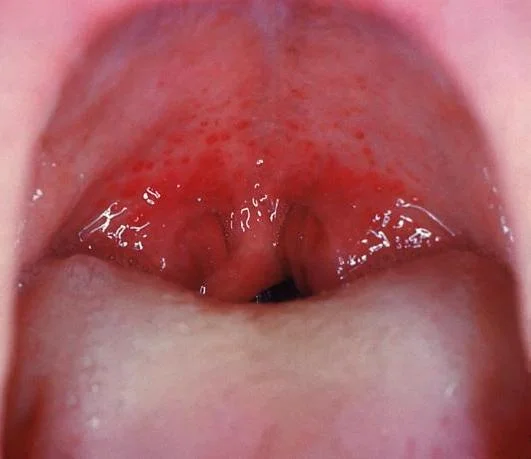
Figure 1Streptococcal pharyngitis
Long description
Open mouth showing a red, inflamed throat with small red petechiae scattered over the soft palate, as in streptococcal pharyngitis.

Look into the oropharynx with good light; a tongue depressor helps.
Signs that favour GAS:[2]
- Tonsillar hypertrophy with or without exudate.
- Pharyngeal and tonsillar erythema.
- Palatal petechiae.
- Tender anterior cervical lymphadenopathy.
Signs that favour viral: red but often not pus-covered tonsils, injected conjunctivae, rhinorrhoea.
In GAS the fever tends to be higher and the onset more abrupt. The overlap is large, so examination alone cannot separate the two in most patients without viral features.[2]
Scarlet fever is GAS pharyngitis plus a toxin-mediated scarlatiniform rash: fine, sandpaper-like erythema that starts on the trunk and spreads, with circumoral pallor, strawberry tongue (white then red), and pastia's lines in flexures. It is a syndrome of the acute infection, not a complication after it.[2]
The main task is to separate viral pharyngitis, GAS pharyngitis, the uncommon bacterial causes above, and non-infectious mimics.
| Alternative | How it differs |
|---|---|
| Viral pharyngitis | Cough, coryza, hoarseness or conjunctivitis present; no exudate or only mild; usually afebrile or low-grade fever |
| Infectious mononucleosis (EBV) | Teenager/young adult, prolonged fatigue, generalised lymphadenopathy, splenomegaly, atypical lymphocytosis; exudative tonsillitis with palatal petechiae |
| Diphtheria | Grey adherent membrane beyond the tonsil, "bull-neck", systemic toxicity; unimmunised or traveller to endemic area |
| Gonococcal pharyngitis | Often asymptomatic; new sexual partners, concurrent genital infection |
| Peritonsillar abscess | Severe unilateral throat pain, muffled ("hot potato") voice, trismus, deviated uvula, drooling |
| Epiglottitis / airway emergency | Muffled voice, drooling, stridor, tripod posture, toxic appearance; do not examine the throat |
| Kawasaki disease (child) | Fever over 5 days, conjunctival injection, rash, swollen hands, strawberry tongue but no exudate and throat culture negative |
| Reflux or post-nasal drip | No fever, normal exam, chronic or recurrent symptoms |
Guidance differs by country. The CDC approach is representative and practical:[2]
- If clear viral features are present, no testing is needed.
- If there are no viral features, perform a rapid antigen detection test (RADT) or throat culture to confirm GAS.
A throat swab cultured on blood agar, ideally with a bacitracin disk, remains the gold standard for diagnosing GAS pharyngitis.[2] Technique matters: swab the posterior pharyngeal wall and both tonsils (or tonsillar fossae), avoiding the tongue and lips. Cultures are read after overnight incubation, often at 24 hours and sometimes up to 48 hours.
RADTs detect the Lancefield group A carbohydrate antigen on a throat swab, with results in under 10 minutes, without specially trained staff.[4]
- Specificity is high (about 96% in meta-analyses); a positive RADT can be treated as GAS.[2][4]
- Sensitivity varies by test and by operator technique: meta-analytic point estimates are around 85% sensitivity and 96% specificity.[4]
- Because sensitivity is not 100%, guidelines still back up a negative RADT with a culture in children over 3 years, where acute rheumatic fever matters most.[2]
United States
In the United States the CDC advises that a throat culture after a negative RADT is not routinely indicated for adults and children under 3 years, because acute rheumatic fever is very rare in those groups; for children over 3 years it should be sent.[2]
- Do not test people without symptoms of pharyngitis: a positive result usually means carriage, not disease.[3]
- Do not test within the incubation period if symptoms just started? In practice test when the clinical picture suggests GAS.
- Nucleic acid amplification tests (NAATs) exist and are highly sensitive but are not the routine first test everywhere and may also detect carriers.
| Test | What it measures | Sensitivity | Specificity | Turnaround |
|---|---|---|---|---|
| Throat culture (blood agar) | Viable GAS | Gold standard (reference) | Gold standard (reference) | 24-48 h |
| RADT (antigen detection) | Lancefield group A carbohydrate | About 70-90% (point estimate ~85%) | About 95-100% (point estimate ~96%) | Under 10 minutes [4] |
| NAAT | GAS DNA | Higher than RADT | High | Same day in lab |
Clinical scores estimate pre-test probability and guide whether to test or treat. They cannot diagnose on their own.
Assign 1 point for each:[4]
- Tonsillar exudate.
- Tender anterior cervical lymph nodes.
- History of fever.
- Absence of cough.
In the original emergency-department sample of adults, a score of 4 carried a 56% probability of a positive GAS culture, and a score of 0 only 2.5%.[4]
McIsaac adds age to account for the higher prevalence in children:[4]
- Temperature over 38 °C (1 point).
- Tonsillar swelling or exudate (1).
- Tender anterior cervical adenopathy (1).
- No cough (1).
- Age 3-14 years (1 point); 15-44 years (0); 45 years or older (-1).
A higher score means a higher chance of GAS. McIsaac reported 83% sensitivity and 94% specificity in its derivation sample.[4]
A five-item score (fever in the previous 24 hours, purulence, attendance within 3 days because of severity, inflamed tonsils, no cough or coryza). Used in some UK settings to guide testing and delayed prescribing.[3]
Scores work best as triage: low scores make GAS unlikely and avoid tests and antibiotics; high scores prompt testing. They are less accurate in children and should not replace a swab when a firm diagnosis matters.[4]
Acute sore throat: a teaching approach
- Sore throat with or without feverHistory, examine oropharynx and neck
- Question: Clear viral features? (cough, coryza, hoarseness, conjunctivitis, oral ulcers)
Yes
- Viral pharyngitis likelySymptomatic care; no antibiotics; no test
No
- Calculate Centor / McIsaac score
- Question: Score suggests GAS is likely?
Low
- Viral or other cause more likelySymptomatic care; no antibiotics
Intermediate or high
- Perform RADT (+/- culture)Throat swab: posterior pharynx and tonsils
- Question: Positive?
Positive
- GAS pharyngitisPrescribe first-line antibiotics for 10 days and advise home isolation until afebrile and 12-24 h on therapy
Negative
- Culture if child over 3 yearsAdults/under-3 (some areas): no routine back-up culture
- If culture positive, treat; if negative, viral
- Airway: rule out epiglottitis, peritonsillar abscess and severe tonsillar hypertrophy.
- Hydration: offer oral fluids; use intravenous rehydration if vomiting or poor intake.
- Pain and fever control: paracetamol or ibuprofen in standard age-appropriate doses. Warm saline gargles and lozenges soothe adults.
- Avoid antibiotics until GAS is confirmed.
Confirmed means a positive RADT or culture in a symptomatic patient. Treatment goals are symptom relief, reducing transmission, preventing complications (suppurative spread and, where relevant, ARF), and shortening illness.[2]
First-line and duration: penicillin or amoxicillin for 10 days where preventing ARF is the goal; some guidelines accept 5 to 7 days when rapid symptom relief is the only goal, because guidelines differ on this point.[3] Since GAS has never been reported to be resistant to penicillin, first-line therapy remains unchanged.[2]
| Drug | Dose | Duration |
|---|---|---|
| Penicillin V, oral | Children: 250 mg 2 or 3 times daily; adolescents/adults: 250 mg 4 times daily or 500 mg twice daily | 10 days [2] |
| Amoxicillin, oral | 50 mg/kg once daily (maximum 1000 mg), or 25 mg/kg twice daily (maximum 500 mg) | 10 days [2] |
| Benzathine penicillin G, intramuscular | Weight under 27 kg: 600,000 units; 27 kg or more: 1,200,000 units; single dose | Single dose [2] |
| Cephalexin, oral (penicillin allergy, non-immediate) | 20 mg/kg per dose twice daily (maximum 500 mg per dose) | 10 days [2] |
| Cefadroxil, oral (penicillin allergy, non-immediate) | 30 mg/kg once daily (maximum 1 g) | 10 days [2] |
| Clindamycin, oral (beta-lactam allergy) | 7 mg/kg per dose 3 times daily (maximum 300 mg per dose) | 10 days |
| Azithromycin, oral (beta-lactam allergy) | 12 mg/kg on day 1 (maximum 500 mg), then 6 mg/kg once daily (maximum 250 mg) for days 2 to 5 | 5 days [2] |
| Clarithromycin, oral (beta-lactam allergy) | 7.5 mg/kg per dose twice daily (maximum 250 mg per dose) | 10 days [2] |
Notes:
- Azithromycin and clarithromycin are macrolides; clindamycin is a lincosamide. Macrolide resistance in GAS varies by region and time, so these are reserved for true penicillin allergy.[2]
- Avoid cephalexin and cefadroxil in patients with immediate-type hypersensitivity to penicillin.[2]
- Benzathine penicillin G as a single intramuscular dose is useful when adherence is uncertain or swallowing is impossible.
- Confirmation of penicillin allergy is worthwhile: many reported allergies are not genuine, and penicillin remains the safest, narrowest agent.
Supportive care is the whole treatment for viral pharyngitis:
- Rest and fluids.
- Analgesia/antipyresis: paracetamol or ibuprofen.
- Throat lozenges and warm salt-water gargles in adults.
- Avoid unnecessary antibiotics: they do not speed recovery from viral infection and drive resistance.[2]
- No follow-up swab is needed after treatment in uncomplicated GAS pharyngitis.
- Advise return to work, school or daycare only when afebrile and at least 12 to 24 hours after starting appropriate antibiotics, because infectivity falls sharply within about 12 hours of therapy.[2]
- Reassess if there is no improvement within 3 to 5 days, or if any red flag develops.
- Airway compromise: stridor, severe trismus, drooling, or inability to swallow (suspected epiglottitis or abscess).
- Suspected peritonsillar or retropharyngeal abscess.
- Severe dehydration or inability to drink.
- Toxic appearance, sepsis, or suspected diphtheria.
- Scarlet fever with high fever and toxic appearance in a young child.
- Recurrent episodes or suspected rheumatic fever.
Complications are uncommon, but because they can be serious, warn the patient and plan follow-up. They fall into suppurative (local spread during the acute infection) and nonsuppurative (immune-mediated, after the infection settles).[2]
| Complication | Type | What to look out for |
|---|---|---|
| Peritonsillar abscess | Suppurative (local) | Severe one-sided throat pain, muffled voice, trismus, deviated uvula, drooling |
| Retropharyngeal abscess | Suppurative (local) | Neck pain/stiffness (torticollis), drooling, stridor, soft-tissue swelling |
| Cervical lymphadenitis | Suppurative (local) | Tender, enlarged neck nodes, may suppurate |
| Mastoiditis | Suppurative (local) | Ear pain, post-auricular swelling and tenderness, protruding pinna |
| Acute rheumatic fever | Nonsuppurative | Carditis, arthritis, chorea, erythema marginatum; occurs mainly in children/young adults; often follows untreated GAS |
| Rheumatic heart disease | Nonsuppurative (chronic) | Valvular damage as a long-term sequela of rheumatic fever |
| Post-streptococcal glomerulonephritis | Nonsuppurative | Haematuria, oedema and hypertension, appearing after the acute infection |
| Scarlet fever | Toxin-mediated (during acute infection) | Diffuse sandpaper rash, strawberry tongue, circumoral pallor |
| Lemierre syndrome | Septic complication, often after Fusobacterium pharyngitis | Young adult with pharyngitis then high fever, neck pain, sepsis, lung abscesses; internal jugular vein thrombosis |
Key points for patients:
- Suppurative complications are more likely after an untreated infection.[2]
- The nonsuppurative sequelae occur after the infection resolves and are thought to be immune-mediated, not direct bacterial spread.[2]
- ARF prevention is the main reason many guidelines still advocate a full 10-day course and throat-culture confirmation in children.[3]
Uncomplicated viral and GAS pharyngitis both resolve. With appropriate antibiotics GAS symptoms improve within 24 to 48 hours; without antibiotics the illness lasts about a week. The mortality of uncomplicated pharyngitis is negligible; serious outcomes come from airway complications, invasive GAS and rheumatic fever (the latter preventable).
- Hand hygiene and respiratory etiquette reduce spread.[2]
- People with confirmed GAS pharyngitis should stay home until afebrile and at least 12 to 24 hours after starting antibiotics.[2]
- Targeted testing and treatment, not mass antibiotic prophylaxis, are the standard. Screening of asymptomatic people is not recommended because carriage is common and not disease.
- Invasive GAS and rheumatic fever are both notifiable concerns in many settings; suspected diphtheria must be notified.
GAS pharyngitis is rare and presents as "streptococcosis" (mucopurulent rhinitis with fever and irritability) rather than a sore throat; routine testing is not recommended.[2]
Treat confirmed GAS with penicillin or amoxicillin; both are considered safe in pregnancy. Avoid macrolides in pregnancy where possible and check local guidance.
A broader differential applies (Candida, CMV, HSV); a low threshold for culture and specialist advice is appropriate.
Asymptomatic carriers do not need routine treatment. Repeated positive tests in a child with recurrent sore throats usually reflect repeated viral infections in a carrier, not repeated GAS disease; only treat when clinical features and a positive test agree, and consider ENT referral for very frequent infections.
Red flagRed flags in sore throat
Airway compromise (stridor, dysphagia, drooling, voice change), unilateral severe pain with trismus, drooling or a deviated uvula (possible peritonsillar abscess), a toxic or septic appearance, suspected diphtheria, or dehydration that prevents drinking. These patients need urgent assessment, not outpatient antibiotics.
Other urgent concerns: a grey pharyngeal membrane, extreme lethargy in a child, high fever with a sandpaper rash and hypotension (possible streptococcal toxic shock), or neck swelling with respiratory distress.
Where tests or drugs are scarce, the principles stay the same: avoid antibiotics for clearly viral illness, and treat confirmed or highly likely GAS so as to prevent ARF and suppurative spread. Pragmatic steps:
- Use a clinical score (Centor/McIsaac) for triage where no test exists. Treat empirically when the score is high and the patient has no viral features, but accept that this over-treats some carriers.
- Send (or collect) a throat swab for culture when local laboratories can process it; culture is cheaper than an RADT long-term and is the gold standard.[2]
- Benzathine penicillin G intramuscularly (single dose) is inexpensive, needs no adherence, and is first-line where oral courses are unreliable.[2]
- Reserve macrolides for proven beta-lactam allergy because resistance varies and they are costly.[2][3]
- Treat pain with locally available analgesics (paracetamol/ibuprofen), push fluids, and identify red flags for referral.
- Educate staff that most sore throats are viral and that antibiotics do not shorten them.
- Where ARF and rheumatic heart disease are endemic, be more aggressive about diagnosing and treating GAS in children aged 5 to 15 years.[3]
- Most acute pharyngitis is viral; antibiotics are not useful and should not be prescribed for viral sore throats.[2]
- Group A streptococcus causes about 20 to 30% of pharyngitis in children and 5 to 15% in adults.[2]
- A positive RADT or throat culture, not clinical impression alone, justifies antibiotics.[2]
- In children over 3 years a negative RADT should be backed up by a culture.[2]
- Centor and McIsaac scores estimate risk; they do not diagnose.[4]
- Penicillin or amoxicillin for 10 days is first line for confirmed GAS; penicillin has never been reported to fail because of resistance.[1][2]
- For penicillin allergy: first-generation cephalosporins for non-immediate allergy; clindamycin or a macrolide for beta-lactam allergy, depending on local resistance.[2][3]
- Antibiotics make a patient non-infectious after about 12 hours and reduce complications.[2]
- Suppurative complications (peritonsillar/retropharyngeal abscess, mastoiditis) come from local spread; nonsuppurative ones (ARF, rheumatic heart disease, post-streptococcal glomerulonephritis) are immune-mediated.[2]
- Asymptomatic carriage is common; do not test or treat people without symptoms.[3]
- Red flags (airway, abscess, toxicity, dehydration) require urgent referral.[2]
- In low-resource settings, use clinical scores, culture where possible, and single-dose benzathine penicillin G; weigh economic and epidemiological context.[2][3]
Answer each one in your head first, then open the answer.
A 10-year-old has a sore throat, temperature 39 °C, tonsillar exudate, tender anterior cervical nodes, no cough, and no coryza. What is the likely diagnosis and the best next step?
Show answerHide answer
Group A streptococcal pharyngitis is likely. The next step is a rapid antigen detection test (or throat culture), not starting antibiotics on clinical grounds alone; if the test is positive, treat with penicillin or amoxicillin for 10 days. A back-up culture is sent if the RADT is negative because of its imperfect sensitivity in children.
Which features in a sore throat make a viral cause much more likely?
Show answerHide answer
Cough, coryza, hoarseness, conjunctivitis, diarrhoea and oral ulcers favour a viral cause; their presence means no GAS testing is needed.[2]
How do you treat confirmed group A strep pharyngitis in a 30 kg child who is genuinely allergic to penicillin (immediate-type hypersensitivity)?
Why does a negative RADT in a child over 3 years need a follow-up throat culture, while in an adult it usually does not?
Show answerHide answer
RADTs are sensitive but not perfect (around 85% in meta-analyses); a false negative in a child risks missing GAS that could lead to acute rheumatic fever, so a culture is used to catch it. In adults acute rheumatic fever is very rare, so the cost-benefit does not favour routine back-up culture.[2][4]
A 16-year-old has severe one-sided throat pain, a muffled voice, trismus and drooling 5 days after a sore throat. What has probably happened?
Show answerHide answer
A peritonsillar abscess (quinsy), a suppurative complication of acute pharyngitis: pus collects in the peritonsillar space. This is an urgent ENT case, not a routine antibiotic prescription; drainage plus intravenous antibiotics are needed.
What single physical finding best argues against GAS pharyngitis?
Show answerHide answer
The presence of cough, coryza, hoarseness or conjunctivitis strongly argues against group A strep and for a viral cause.[2]
- Acute rheumatic fever and rheumatic heart disease.
- Scarlet fever.
- Post-streptococcal glomerulonephritis.
- Peritonsillar abscess.
- Lemierre syndrome.
- Infectious mononucleosis.
- Diphtheria.
- Sore-throat decision rules (Centor and McIsaac).
- Shulman ST, Bisno AL, Clegg HW, Gerber MA, Kaplan EL, Lee G, Martin JM, Van Beneden C, Infectious Diseases Society of America. Clinical practice guideline for the diagnosis and management of group A streptococcal pharyngitis: 2012 update by the Infectious Diseases Society of America. Clin Infect Dis. 2012 Nov;55(10):e86-e102. doi:10.1093/cid/cis629. Accessed .
- Centers for Disease Control and Prevention. Clinical Guidance for Group A Streptococcal Pharyngitis. CDC. 18 November 2025. Accessed .
- Pellegrino R, Timitilli E, Verga MC, Guarino A, Iacono ID, Scotese I, Tezza G, Dinardo G, Riccio S, Pellizzari S, Iavarone S, Lorenzetti G, Simeone G, Bergamini M, Dona D, Pierantoni L, Garazzino S, Esposito S, Venturini E, Gattinara GC, Lo Vecchio A, Marseglia GL, Di Mauro G, Principi N, Galli L, Chiappini E, et al. Acute pharyngitis in children and adults: descriptive comparison of current recommendations from national and international guidelines and future perspectives. Eur J Pediatr. 2023;182(12):5259-5273. Accessed .
- Mustafa Z, Ghaffari M. Diagnostic Methods, Clinical Guidelines, and Antibiotic Treatment for Group A Streptococcal Pharyngitis: A Narrative Review. Front Cell Infect Microbiol. 2020;10:563627. Accessed .
Figure credits
Educational content for medical students and doctors. It is not a substitute for clinical judgement or local guidelines.