HIV infection and AIDS
HIV and AIDS: virology, transmission, stages, diagnosis, antiretroviral therapy, opportunistic infections, and prevention.
- HIV is a retrovirus. Start ART for everyone at diagnosis. Undetectable equals untransmittable.
- It spreads in blood, semen, vaginal, rectal fluid and breast milk via sex, needles, unscreened transfusions and mother-to-child.
- Acute retroviral syndrome occurs two to four weeks after infection. [1]
- Advanced HIV disease is CD4 under 200 cells per microlitre or an AIDS-defining illness. Untreated progression takes about ten years.
- Modern integrase inhibitor regimens usually make viral load undetectable in six months.
- Prevention includes condoms, circumcision, PrEP and PEP.
By the end of this page you should be able to:
- Describe the HIV life cycle, the roles of gp120, CD4, reverse transcriptase, integrase and protease, and where each drug class acts.
- Distinguish stages including acute retroviral syndrome and AIDS-defining thresholds.
- Interpret fourth-generation antigen/antibody, viral load, CD4 count and resistance genotype, and the window period.
- Explain the WHO and DHHS position to start ART for everyone at diagnosis, and describe integrase inhibitor first-line regimens and toxicities.
- Apply CD4 thresholds for prophylaxis against Pneumocystis, toxoplasmosis and MAC.
- Explain U=U, PrEP, PEP and mother-to-child prevention.
HIV (human immunodeficiency virus) is an enveloped RNA retrovirus that infects CD4+ lymphocytes and other cells, leading to progressive immunodeficiency. AIDS (acquired immune deficiency syndrome, now called advanced HIV disease) is HIV infection meeting the surveillance definition: CD4+ count under 200 cells per microlitre, CD4+ fraction 14% or less of lymphocytes, or one of the AIDS-defining illnesses. [1]
HIV-1 causes most infections; HIV-2, less virulent, is concentrated in West Africa. Staging by CD4 in adults and adolescents (MSD): stage 1 is 500 or more cells per microlitre, stage 2 200 to 499, stage 3 (AIDS) under 200. WHO defines advanced HIV disease as a CD4 count under 200 cells per millilitre or a stage 3 or 4 clinical event in adults and adolescents; every child under five with HIV counts as having advanced disease. [1]
In 2025 WHO estimated about 41 million people living with HIV, 64% in the WHO African Region; about 1.2 million acquired HIV and 570 000 died from HIV-related causes. [3] Testing, treatment and viral suppression are improving (88% know status, 89% of those on ART, 95% of those suppressed). Heterosexual sex dominates in much of the world; men who have sex with men and people who inject drugs carry much of the burden in high-resource settings.
HIV needs contact with an infectious fluid (blood, semen, pre-seminal, rectal, vaginal, breast milk) reaching membrane or damaged skin. Saliva, tears, sweat, urine and vomitus are not infectious unless bloodstained. Risks include condomless vaginal or anal sex with another sexually transmitted infection, mucosal trauma, female genital schistosomiasis, sharing injecting equipment, unscreened blood or tissue, vertical transmission and occupational needlestick (about 0.3% percutaneous or 0.09% mucous membrane). Male circumcision reduces heterosexual male acquisition by 38 to 66% over 24 months. [1]
HIV cannot copy RNA into DNA on its own, so it carries reverse transcriptase. The new DNA is inserted into the host genome by integrase. Viral proteins are made as polyproteins and cut by protease; without cleavage, virions stay immature. All three enzymes are drug targets.
- gp120 binds CD4, then CCR5 or CXCR4; gp41 fuses envelope with cell.
- Reverse transcriptase synthesises DNA from viral RNA without proofreading.
- The DNA-preprotein complex enters the nucleus.
- Integrase inserts the viral DNA into host DNA, forming the provirus.
- Host machinery transcribes and translates viral genes.
- New virions bud and mature through protease cleavage.
Infected CD4+ cells produce over 98% of plasma virions; a latent memory T-cell reservoir forms very early. Normal CD4 count is about 500 to 1500 cells per microlitre; immunity begins to fail below about 200. Viral load set point averages 30 000 to 100 000 copies per mL; gut CD4 depletion drives chronic immune activation. [1]
Untreated median progression to advanced disease is about ten years. Every 3-fold (0.5 log10) rise in HIV RNA increases progression risk over two to three years by roughly 50%. Opportunistic infection risk rises below about 200 cells per microlitre (Pneumocystis, toxoplasmosis, cryptococcosis) and below 50 (CMV, MAC). [1]
Begins two to four weeks after infection and lasts days to weeks; resembles mononucleosis (fever, sore throat, rash, arthralgias, generalised lymphadenopathy, sometimes aseptic meningitis). Viral load is very high. Most people then stay well for ten to eleven years, with generalised lymphadenopathy, oral candidiasis or herpes zoster as clues.
Figure 1Kaposi's sarcoma heel
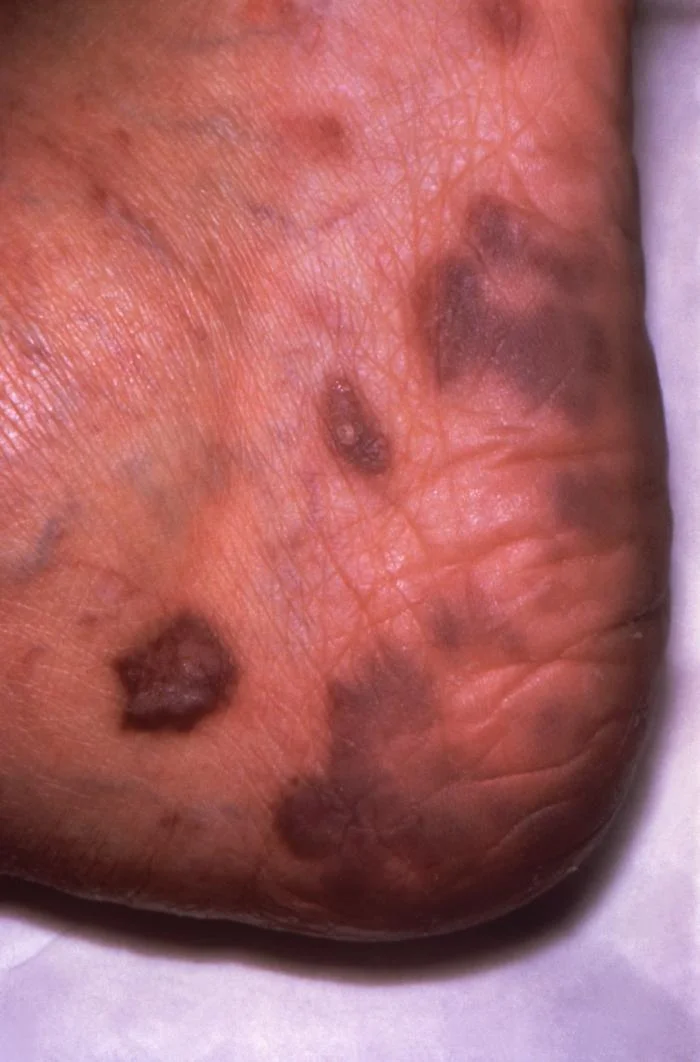
Long description
Clinical photograph of the medial side of a Kaposi sarcoma patient's right heel showing characteristic violaceous cutaneous plaques.

Figure 2HIV-timecourse simple
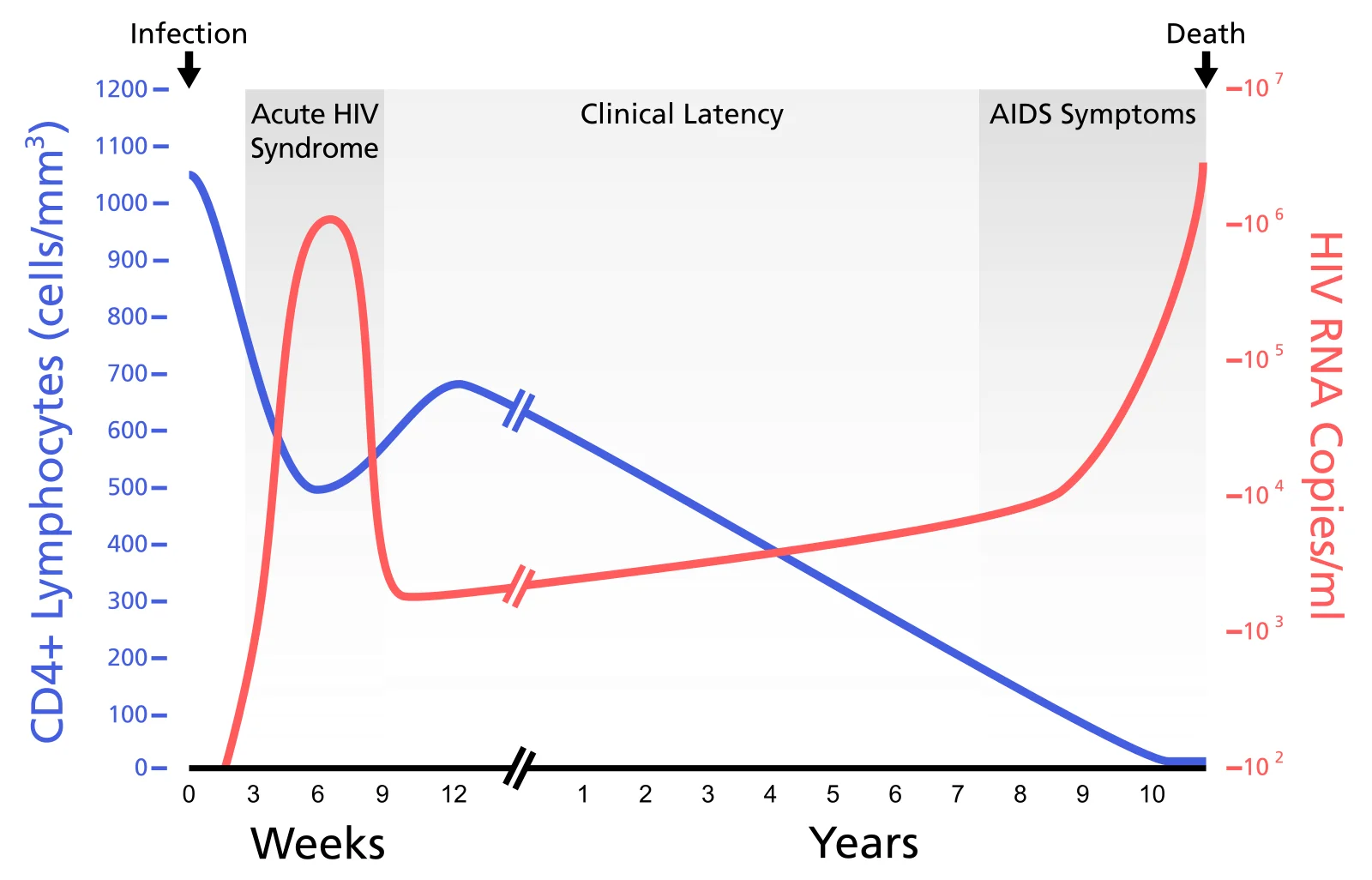
Long description
A graph showing HIV viral load in relation to CD4+ lymphocyte count in an untreated HIV infection.

When CD4 falls under 200 cells per microlitre, AIDS-defining illnesses appear: severe opportunistic infections, Kaposi sarcoma, non-Hodgkin lymphoma, invasive cervical cancer, wasting and neurocognitive impairment.
Acute retroviral syndrome mimics EBV mononucleosis, secondary syphilis, acute hepatitis B, CMV, toxoplasmosis. Advanced disease mimics other causes of immunosuppression. Test for HIV with compatible illness, risk behaviour or unexplained severe opportunistic infection.
Screen with a fourth-generation antigen/antibody immunoassay. Markers appear in order (window period): HIV RNA about days 10 to 12, p24 antigen days 15 to 17, antibodies about day 21. After a reactive screen, use an HIV-1/2 differentiation assay; if negative or indeterminate, or if suspicion persists despite negative serology, use NAAT. Rapid test algorithms matter in low-resource settings. [1]
Diagnosis of suspected HIV infection
- Suspect HIV infectionRisk behaviour, compatible acute illness, or advanced opportunistic infection
- Fourth-generation HIV antigen/antibody immunoassayDetects HIV-1 and HIV-2 antibodies plus p24 antigen
- Question: Result
Reactive
- HIV-1/HIV-2 differentiation assay
- Question: Differentiation assay
HIV-1 or HIV-2 positive
- HIV infection confirmed
Negative or indeterminate
- HIV RNA (NAAT)
Non-reactive
- Too early?Symptoms within about three to four weeks of exposure
- Repeat testing plus HIV RNA NAATWindow period: RNA day 10 to 12, p24 day 15 to 17, antibodies about day 21
At diagnosis determine CD4 count and percentage; viral load; baseline resistance genotype (viral load over about 500 copies per mL); HLA-B*5701 before abacavir (roughly 100-fold higher hypersensitivity risk if positive); co-receptor tropism if a CCR5 antagonist is considered. CD4 count equals white cell count x lymphocyte fraction x CD4 fraction (example 4000 x 0.3 x 0.2 = 240 cells per microlitre; normal range 500 to 1250). Retest after a positive result before enrolment to exclude error; infants under 18 months need virological testing. [1]
Viral load every 8 to 12 weeks for 4 to 6 months, then every 6 months; test before new drugs and 2 to 8 weeks after changes. CD4 every 3 to 6 months early; can be spaced after two years if stable above 200. Safety labs 3 to 12 monthly. Genotype on failure. [1]
Advanced HIV disease: HIV infection plus CD4 under 200, or CD4 fraction 14% or less, or an AIDS-defining illness. Clinical stages 1 to 3 by CD4 as above.
Start for everyone at diagnosis: complications occur even at high CD4 counts, modern drugs are less toxic, and undetectable viral load means no sexual transmission (U=U). The START trial (5472 treatment-naive people, CD4 above 350) showed fewer serious AIDS and non-AIDS events with immediate treatment.
Even long-term non-progressors and elite controllers deserve ART because immune activation persists. Start rapidly, within days; delay 2 to 4 weeks for tuberculous or cryptococcal meningitis. Goals: viral load under 20 to 50 copies per mL, CD4 restoration, prevent transmission. ART works if taken over 95% of the time; most reach goals within six months. [1][2]
DHHS and WHO 2021 guidelines recommend INSTI-based regimens as preferred first line: [2]
- bictegravir, tenofovir alafenamide, emtricitabine (one pill, once daily);
- dolutegravir plus tenofovir alafenamide or disoproxil fumarate plus emtricitabine or lamivudine;
- dolutegravir with lamivudine in appropriate patients.
Dolutegravir/lamivudine is unsuitable above HIV RNA 500 000 copies per mL, with hepatitis B co-infection, or before resistance and hepatitis B results. Prior long-acting cabotegravir PrEP exposure needs integrase resistance testing; a boosted protease inhibitor may be used temporarily. Long-acting options: cabotegravir plus rilpivirine every two months for suppressed adults; lenacapavir every six months for heavily treatment-experienced patients. [2]
| Class | Where it acts | Key toxicities and notes |
|---|---|---|
| NRTIs/nRTIs | Reverse transcriptase; chain termination | Mitochondrial toxicity with older drugs (stavudine); rare lactic acidosis; lipodystrophy; tenofovir disoproxil fumarate nephrotoxic and lowers bone density; alafenamide less so |
| NNRTIs | Bind reverse transcriptase | Rash, hepatotoxicity, neuropsychiatric symptoms (efavirenz); common interactions |
| Protease inhibitors | Viral protease; block maturation | Dyslipidaemia and insulin resistance (older agents); lipodystrophy; cytochrome P-450 interactions |
| INSTIs | Integrase; block integration | Best tolerated; weight gain; small lipid effects |
| Entry/fusion inhibitors | Block cell entry | Class-specific; injection-site reactions with enfuvirtide |
| Attachment, post-attachment, capsid inhibitors | Various early or capsid steps | Oral or injection issues; reserved or adjunctive roles |
In the first months of ART some patients worsen while viral load falls and CD4 rises, as reawakened immunity reacts to subclinical or recently treated infection (paradoxical) or reveals undiagnosed infection (unmasked). Usually self-limited or treated with a short steroid course. Continue ART except in cryptococcal meningitis, where temporary interruption may be needed.
Virological failure (rising load) precedes CD4 failure by months. Suboptimal immunological response is poor CD4 recovery despite suppression. Genotype resistance testing guides a new regimen with at least two, preferably three, active drugs.
Figure 3Opportunistic infections of HIV by CD4 count
Long description
A horizontal bar shows CD4 count falling from left to right with three marked thresholds. Under 200 cells per microlitre: Pneumocystis prophylaxis starts and AIDS-defining illnesses, Kaposi sarcoma and lymphoma appear. Under 100: toxoplasmosis prophylaxis in seropositive patients. Under 50: Mycobacterium avium complex prophylaxis. A note says tuberculosis can occur at any CD4 count.
| CD4 count | Infection | Prophylaxis |
|---|---|---|
| Under 200 cells per microlitre, or with oropharyngeal candidiasis | Pneumocystis jirovecii pneumonia | Co-trimoxazole double-strength once daily or three times weekly; dapsone 100 mg daily, aerosolised pentamidine 300 mg monthly, or atovaquone 1500 mg daily if co-trimoxazole not tolerated |
| Under 100 cells per microlitre | Toxoplasmosis (seropositive patients) | Co-trimoxazole, usually already in place |
| Under 50 cells per microlitre | Disseminated Mycobacterium avium complex | Azithromycin 1200 mg weekly (or clarithromycin); rifabutin if intolerant; often unnecessary if ART suppresses viral load |
| Any CD4 if latent tuberculosis suspected | Tuberculosis | Isoniazid plus rifapentine weekly for three months (with pyridoxine), or rifampicin-based regimens for three to four months; isoniazid for six to nine months as an alternative |
Stop chemoprophylaxis after CD4 stays above threshold for more than three months on suppressive ART. Secondary prophylaxis follows infection-specific guidance.
Cancers (Kaposi sarcoma, non-Hodgkin lymphoma including primary CNS and Burkitt, invasive cervical and anal cancer), neurocognitive impairment and opportunistic neuroinfections (toxoplasma, cryptococcal, progressive multifocal leukoencephalopathy), pulmonary infection (Pneumocystis, tuberculosis, recurrent bacteria, MAC), oesophageal candidiasis, cryptosporidiosis, worsening hepatitis B/C, HIV nephropathy, tenofovir toxicity, cardiovascular and metabolic disease, cytopenias, wasting and lipodystrophy.
Without treatment median progression is about ten years. CD4 predicts short-term risk; viral load predicts longer-term. For every 3-fold (0.5 log10) rise in HIV RNA, mortality over two to three years rises about 50%. Most HIV deaths occur below 50 CD4 cells. Effective ART suppresses viral load and raises CD4 but morbidity remains above age-matched people without HIV. No routine cure. Interruption of ART is harmful. [1]
Test everyone aged 13 to 64 at least once, more often with ongoing risk (every 6 to 12 months). Test pregnant people early in each pregnancy. Low-resource programmes use rapid antibody tests within national algorithms. Attributes that matter everywhere: confidentiality, same-day results, counselling and linkage to care. WHO's advanced disease package (cryptococcal antigen and tuberculosis screening at low CD4) reduces avoidable deaths. [1]
Treat the person with HIV: undetectable equals untransmittable (U=U). Condoms give best mechanical protection (avoid oil-based lubricants with latex). Safer sex remains important when either partner is unsuppressed, for superinfection and other STIs. Medical male circumcision reduces male acquisition by 38 to 66%.
CDC recommends PrEP for sexually active adults and adolescents at least 35 kg at substantial risk, and for people who share injecting equipment, alongside condoms, STI screening and harm reduction. Oral: TDF/FTC for any at-risk group (including injection drug use); TAF/FTC for sexual risk except receptive vaginal sex. Injectables: cabotegravir every two months; lenacapavir every six months after oral lead-in for those at risk of sexually acquired HIV.
Start 28 days of at least three drugs as soon as possible, ideally within hours and no later than 72 hours, after significant exposure (percutaneous, mucous membrane, receptive sex with a non-suppressed partner). Preferred: TDF 300 mg daily plus FTC 200 mg daily plus raltegravir 400 mg twice daily or dolutegravir 50 mg daily; alternative darunavir 800 mg plus ritonavir 100 mg daily. Risk without PEP is about 0.3% after typical needlestick and 0.09% after mucous membrane exposure; saliva, urine, sweat and tears are not infectious unless bloody. Test at baseline, 4 to 6 weeks and 12 weeks with a fourth-generation assay. Pregnancy does not change the regimen. [1]
Without intervention risk is 15 to 45% for the infant (about 15 to 25% through breastfeeding). Measures: [1]
- test all pregnant people early and again in the third trimester if risk continues;
- start ART as soon as possible at any gestational age; suppression cuts risk under 1%;
- prefer caesarean section if viral load over 1000 copies per mL at or near delivery; [1]
- give intravenous zidovudine in labour and oral zidovudine to the neonate for 2 to 6 weeks;
- high-resource settings: alternatives to breastfeeding plus sustained suppression; resource-limited settings without safe formula or donor milk: WHO recommends lifelong maternal ART and adherence support with exclusive breastfeeding 6 months and complementary feeding 12 to 24 months;
- follow postpartum.
Universal precautions, needle-syringe programmes and donor screening with antibody and viral load (transfusion risk about 1 in 2.3 million units in the United States). [1]
Pregnancy: test every pregnancy, ART from diagnosis, once-daily INSTI regimens commonly, follow national pregnancy guidance, offer delivery planning and neonatal prophylaxis. Infants and children: paediatric doses and thresholds; children under five count as advanced disease. Hepatitis B co-infection: use tenofovir-containing backbones and avoid DTG/3TC alone. Drug interactions: always check (rifampicin is contraindicated with coformulated bictegravir). Older adults: more comorbidity and polypharmacy; monitor metabolic and bone effects.
Where viral load is unavailable use clinical staging plus CD4. WHO recommends rapid antibody algorithms, lifelong ART for all in high-burden settings, multi-month dispensing and community distribution. For advanced disease use the AHD package (cryptococcal antigen and tuberculosis screening). Co-trimoxazole prophylaxis is cheap and cost-effective. Mother-to-child option B+: lifelong maternal ART from first contact regardless of CD4. Prioritise tuberculosis. Where options are limited, standardise on a fixed-dose first-line combination and one or two second-line regimens guided by resistance testing.
The pattern of illness follows the CD4 count predictably, which helps both diagnosis and prevention.
- Above 500 cells per microlitre: most people are well; persistent or severe infections should still make you suspect HIV.
- 200 to 500: oral and vaginal candidiasis, herpes zoster, pulmonary and extrapulmonary tuberculosis, idiopathic thrombocytopenic purpura, listeriosis and Kaposi sarcoma can appear.
- Under 200: Pneumocystis jirovecii pneumonia, disseminated histoplasmosis and coccidioidomycosis (in endemic areas), toxoplasmic encephalitis, cryptosporidiosis and isosporiasis, oesophageal candidiasis, extrapulmonary tuberculosis, HIV-associated nephropathy and chronic neuropathy.
- Under 100: cerebral toxoplasmosis, cryptococcal meningitis, microsporidiosis, progressive multifocal leukoencephalopathy, and more frequent bacterial pneumonia.
- Under 50: disseminated Mycobacterium avium complex or M. kansasii, cytomegalovirus disease (retinitis, colitis, oesophagitis), and primary central nervous system lymphoma.
This list is not exhaustive, and regional infections (penicilliosis in South and East Asia, Chagas disease, visceral leishmaniasis, talaromycosis) change the picture. Whenever a second or unusual infection appears, broaden the differential beyond the most common ones.
Adherence above 95 percent is the price of success. Once suppression is achieved, many regimens can be simplified into single-tablet combinations without losing efficacy, which matters for long-term persistence. Switching is usually driven by intolerance, a drug interaction (rifampicin for tuberculosis is a common cause), pregnancy, or resistance. Genotypic resistance testing belongs in every failure work-up; an archive genotype (HIV DNA) can be used when the viral load is too low for standard RNA testing. For people on complex rescue regimens, expert advice and resistance interpretation (guided by national or international panels) are worth seeking before changing anything.
Normalising HIV testing as part of routine care is as important as the assay itself. Universal testing advice removes stigma, finds people earlier, and turns a late diagnosis (often the real cause of avoidable death and transmission) into an outpatient problem. Education works: countries that invested in safer-sex education and condom access saw infection rates fall. The same principle now applies to treatment-as-prevention messaging, which gives people living with HIV a positive reason to stay suppressed.
- HIV is a retrovirus targeting CD4+ lymphocytes; the life cycle depends on reverse transcriptase, integrase and protease.
- CD4 (normal 500 to 1500) and viral load drive risk; immunity fails below about 200 cells.
- Acute retroviral syndrome at 2 to 4 weeks looks like a nonspecific viral illness.
- Advanced HIV disease: CD4 under 200, fraction 14% or less, or an AIDS-defining illness.
- Start ART for everyone at diagnosis; INSTI regimens preferred first line; goals viral load under 20 to 50 copies per mL and CD4 restoration.
- Tests: fourth-generation antigen and antibody, differentiation, NAAT for early or discordant cases, viral load, CD4, baseline genotype (viral load above 500), HLA-B*5701 before abacavir. Window period: RNA days 10 to 12, p24 days 15 to 17, antibodies about day 21.
- Prophylaxis thresholds: Pneumocystis under 200, toxoplasmosis under 100, MAC under 50; tuberculosis for latent infection at any CD4; stop after 3 months above threshold on suppressive ART.
- IRIS in the first months; usually self-limited or short-course steroids.
- U=U: no sexual transmission with undetectable viral load.
- PrEP: oral TDF/FTC or TAF/FTC, cabotegravir every 2 months, lenacapavir every 6 months.
- PEP within 72 hours for 28 days: TDF plus FTC plus an integrase inhibitor.
- Vertical risk 15 to 45% without treatment, under 1% with suppression; caesarean section above 1000 copies per mL; breastfeeding differs by resource.
Answer each one in your head first, then open the answer.
Why does HIV cause opportunistic infections rather than sudden failure of every system at once?
Show answerHide answer
HIV selectively depletes CD4+ T-helper lymphocytes; cell-mediated immunity is largely preserved above about 350 cells per microlitre and fails below about 200. Infections and cancers kept dormant by a healthy immune system (Pneumocystis, Toxoplasma, Mycobacterium avium, Kaposi sarcoma virus) reappear at those thresholds. Early ART prevents this. [1]
A patient with a needlestick from a person known to have HIV presents four hours later. What do you do?
Show answerHide answer
Clean the wound, document exposure, obtain a baseline fourth-generation test, and start 28 days of at least three antiretrovirals without waiting for results (TDF plus FTC plus raltegravir or dolutegravir). PEP is effective only within 72 hours. Re-test at 4 to 6 weeks and 12 weeks.
A patient on ART for eight weeks deteriorates with fever while viral load fell from 100 000 to 80 copies per mL and CD4 rose from 40 to 120. What is likely and what should you do?
Show answerHide answer
Paradoxical IRIS: immune recovery inflaming residual infection despite viral suppression. Exclude treatment failure and active infection; generally continue ART; short-course glucocorticoids for severe symptoms. Cryptococcal meningitis is the exception where temporary interruption may be needed.
Why is dolutegravir plus lamivudine unsuitable if HIV RNA is above 500 000 copies per mL?
Show answerHide answer
The two-drug regimen is less robust in very high viraemia and active hepatitis B, and should not be started before genotypic resistance and hepatitis B results. In those situations a three-drug integrase-based regimen is preferred (or boosted protease inhibitor if resistance is suspected).
What does an undetectable viral load mean for sexual transmission, and what does it not exclude?
Show answerHide answer
Undetectable equals untransmittable (U=U): people with suppressed viral load do not transmit HIV sexually. It does not by itself establish safety from needle sharing, does not replace condoms against other STIs, and does not cure, because the latent reservoir remains.
At what CD4 counts should you start prophylaxis against Pneumocystis, toxoplasmosis and MAC, and when can you stop?
Show answerHide answer
Pneumocystis under 200, toxoplasmosis under 100 in seropositive patients, MAC under 50 (usually only if ART is not suppressing load). Stop after the count rises above threshold and stays there more than three months on suppressive ART.
- tuberculosis (latent and active)
- Pneumocystis jirovecii pneumonia
- toxoplasmosis
- cryptococcal meningitis
- Kaposi sarcoma
- disseminated Mycobacterium avium complex
- hepatitis B in HIV
- opportunistic infection prophylaxis
Two numbers dominate follow-up. The CD4 count is the immune-speedometer: it tells you how urgently to start prophylaxis and how likely an opportunistic infection is this year. The plasma HIV RNA is the speedometer for the virus: it reflects replication and predicts how quickly the CD4 will fall. With effective treatment the log10 viral load drops fast (classically one log per month on potent therapy), while the CD4 rises more slowly, often by 50 to 100 cells per microlitre per year in the first two years and then more slowly. Late presenters (CD4 under 200 at diagnosis) take longer to recover and carry higher late complication rates even when viral load is suppressed, which is why screening strategies matter as much as drugs.
Beyond pregnancy, women with HIV have higher background rates of cervical abnormalities and anal cancer related to human papillomavirus, so cervical smears and, where available, anal smears should follow local screening schedules. Menopausal symptoms and bone loss deserve attention, especially on tenofovir or protease inhibitors. Contraception is largely unrestricted; enzyme-inducing antiretrovirals (such as nevirapine or efavirenz) reduce the efficacy of combined hormonal contraception, so boosted protease inhibitors or non-inducing backbones simplify planning. Intimate-partner violence, economic dependence and caregiving responsibilities often shape adherence support more than pharmacology does.
Tuberculosis is the single leading cause of death in people living with HIV and the commonest serious opportunistic infection in high-burden countries. People with HIV are markedly more likely to develop active disease after infection or reactivation, and sputum smears are often negative even when disease is extensive. The standard six-month anti-tuberculosis regimen is unchanged, but drug interactions drive ART choice (rifampicin with integrase inhibitors in particular). Prophylaxis for latent infection (isoniazid or rifapentine) is effective and cheap, and should be offered whenever latent infection is suspected, independent of CD4 count, as long as active disease has been excluded.
- Cachay ER, reviewed by Muzny CA. Human Immunodeficiency Virus (HIV) Infection. MSD Manual Professional Version, full review June 2026. Accessed .
- Cachay ER, reviewed by Muzny CA. Antiretroviral Treatment of Human Immunodeficiency Virus (HIV) Infection. MSD Manual Professional Version, full review June 2026. Accessed .
- World Health Organization. HIV and AIDS fact sheet. WHO, 27 July 2026. Accessed .
Figure credits
- Figure 1: CDC, via Wikimedia Commons, Public domain, Public domain.
- Figure 2: Thomas Splettstoesser, via Wikimedia Commons, CC0, CC0.
- Figure 3: Original illustration by MedGrasp, CC BY 4.0.
Educational content for medical students and doctors. It is not a substitute for clinical judgement or local guidelines.