Child abuse and neglect
How to recognise and respond to child abuse and neglect: types, red flags, bruises, burns, fractures, head injury, skeletal survey, mimics and safeguarding.
- Child abuse and neglect means any act or omission by a parent or carer that harms a child or young person, and it includes physical, sexual and emotional abuse, neglect and fabricated or induced illness.
- No single finding proves abuse; the diagnosis rests on the pattern of injuries, the explanation offered, the child's age and development, and information from several sources.
- Bruising in a child who is not independently mobile, a burn or scald with an absent or unsuitable explanation, and any fracture in a non-ambulant infant are all red flags that should raise serious concern.
- Rib fractures (especially posteromedial), classic metaphyseal lesions (corner or bucket-handle fractures), and subdural bleeding with widespread retinal haemorrhage are injuries with high specificity for abuse in young children.
- When abuse is suspected, the child's immediate safety comes first; injuries are treated, evidence is documented objectively, and concerns are referred through the local multi-agency safeguarding pathway.
By the end of this page you should be able to:
- Name the five forms of child maltreatment and give examples of each.
- Take a history and examine a child for injury, recognising the red flags that make an explanation unsuitable.
- Describe the bruise, burn and fracture patterns that are highly suggestive of physical abuse, and explain why each is so.
- Explain how abusive head trauma presents and what retinal haemorrhage means in that setting.
- Plan a skeletal survey and the follow-up imaging that completes it.
- List the main conditions that mimic abuse, and say what distinguishes each.
- Carry out the first steps of safeguarding, including how to document findings and whom to tell.
DefinitionChild abuse and neglect
Child maltreatment is any form of harm to a child or young person by an adult or another child. It includes neglect; physical, sexual and emotional abuse; and fabricated or induced illness. NICE uses "suspect" for a serious level of concern about the possibility of maltreatment and "consider" when maltreatment is one possible explanation among others.[1]
The five forms are:
- Physical abuse is the infliction of physical injury, or fear of it, including hitting, shaking, burning, poisoning, drowning or suffocation. Fabricated or induced illness sits here or alongside it, because the harm is physical even when the mechanism is deception.
- Sexual abuse is the involvement of a child in sexual activity to which they cannot consent or comprehend, or that violates social or legal taboos. It includes contact and non-contact acts and sexual exploitation.
- Emotional (psychological) abuse is the persistent emotional ill-treatment that harms a child's development, such as rejection, scapegoating, terrorising, or exposing a child to domestic abuse.
- Neglect is the persistent failure to meet a child's basic physical or psychological needs: food, clothing, shelter, hygiene, supervision, medical care and emotional responsiveness.
- Fabricated or induced illness is a form of maltreatment in which a carer fabricates symptoms, falsifies history, or actually induces illness in a child, leading to unnecessary investigations and treatment.
Neglect deserves special emphasis, because it is common, often chronic rather than acute, and can be hard to separate from poverty. The centre of the assessment must be the child's needs, not the adults' intentions.[2]
Child abuse and neglect occur in every country and socioeconomic group. Figures vary widely because much abuse is never disclosed, and because the definitions used in surveys differ. Many children who are abused are not known to any agency at the time. Sexual abuse disproportionately affects girls in most series, but boys are also victims and are less likely to disclose. Disabled children are more vulnerable to abuse than non-disabled peers.[2]
No child causes their own abuse. Risk accumulates from a combination of factors in the child, the carer and the environment, and most abusive families are not "recognisable" at first glance.
- Substance misuse problems.
- A history of domestic abuse, including sexual violence or exploitation.
- Emotional volatility or difficulty managing anger.
- Mental health problems that significantly affect parenting.
- Their own history of being abused or neglected as a child.
- Not engaging with services, chronic stress, or previous episodes of maltreatment.
Stress alone does not cause abuse, but stress in a carer with poor support, poor coping and a child with high needs is a familiar pattern.[2]
- Age: infants and very young children cannot speak, move away or seek help, and they sustain the most serious injuries.
- Disability or developmental difference.
- Prematurity, chronic illness and high care needs, which raise both stress and time spent with carers.
- Behavioural or emotional difficulties that parents struggle to manage.
Poverty, overcrowding, poor housing and social isolation do not cause abuse, but they raise the pressure on a family and they make early help harder to access. Professional judgement is needed to separate neglect from material poverty; the test is whether other families in similar circumstances have managed to meet the child's basic needs.[1][2]
Each injury type has a mechanism that links the act to the physical finding, and these mechanisms are what allow a clinician to judge whether the story fits.
Bruising is bleeding into the skin from ruptured small vessels caused by blunt force. In non-mobile infants the force has been applied by someone else, because the baby cannot generate it. Patterned bruises (hand slap, belt, ligature, grip, teeth marks) record the object that struck or gripped the child. Bruises on soft or protected sites (eyes, ears, buttocks, back, neck, abdomen, genital area, ankles and wrists as ligatures) are unusual in accidental childhood falls, which normally mark bony prominences.
Burns and scalds follow contact with a hot object or liquid. Forced immersion produces a clear "water line" at a uniform depth; splash scalds in real accidents are irregular and asymmetric. Contact burns take the shape of the object (cigarette tip, iron plate).
Fractures in young children occur when applied force exceeds the strength of immature bone. Rib fractures, particularly posteromedial ones, require squeezing of the chest so that the rib levers over the transverse process of the vertebra; this is the grip of an adult around an infant's chest, and it is not reproduced by chest compressions with the child lying supine with the back supported. A classic metaphyseal lesion (corner or bucket-handle fracture) is a planar shearing injury through the zone of provisional calcification produced by twisting or pulling an extremity; infants cannot generate that force themselves, and the lesion has not been produced by simple falls in studies.
Abusive head trauma is caused by shaking with or without impact. The infant's large head, weak neck muscles and relatively large brain allow acceleration-deceleration injury: bridging veins tear and bleed into the subdural space, the brain swells, and the retina is damaged by vitreoretinal traction. Vigorous shaking of an infant produces no external mark on the scalp in many cases, which is why the internal injuries are found only when someone looks for them.
Neglect injures through omission: chronic undernutrition, untreated infection, unsafe environment, lack of stimulation. The harm accumulates over months, and the pathophysiology is therefore that of the disease that finally presents (faltering growth, rickets, recurrent infection, developmental delay), rather than a single traumatic event.
Take the history first from the child (if age and development allow, and if safe), then from the carer, then compare them. Use open questions and let the child speak in their own words; do not lead. Document words verbatim where possible.[2]
Red flags in the history include:
- Delay in presentation: a fracture, head injury or burn brought in hours or days later, or an injury discovered by someone else.
- An explanation that is absent or unsuitable: one that is implausible, inadequate or inconsistent with the injury, the child's age or development, normal activities, an existing medical condition, or the account of others; or that changes over time or between carers. An explanation based on cultural practice is also unsuitable, because culture does not justify injuring a child.[1]
- An injury that does not match the developmental stage: a burn in a non-mobile infant, a long bone fracture in a child who cannot yet toddle, sexual behaviour beyond the child's understanding.
- Blaming siblings, pets or "accidents" that recur.
- A child who is unusually fearful, withdrawn, frozen, or who monitors the carer's reactions.
- A carer who refuses to let the child be examined alone when that is appropriate.[1][2]
Examine the whole child, including the mouth, ears, scalp, back, buttocks and genital area, with a chaperone and with consent, and in good light. Plot growth. Check the fundi with dilated examination in any infant with acute neurological signs or suspicion of abuse (see below). Note behaviour, interaction and developmental milestones.
Figure 1Mongolianspotphoto
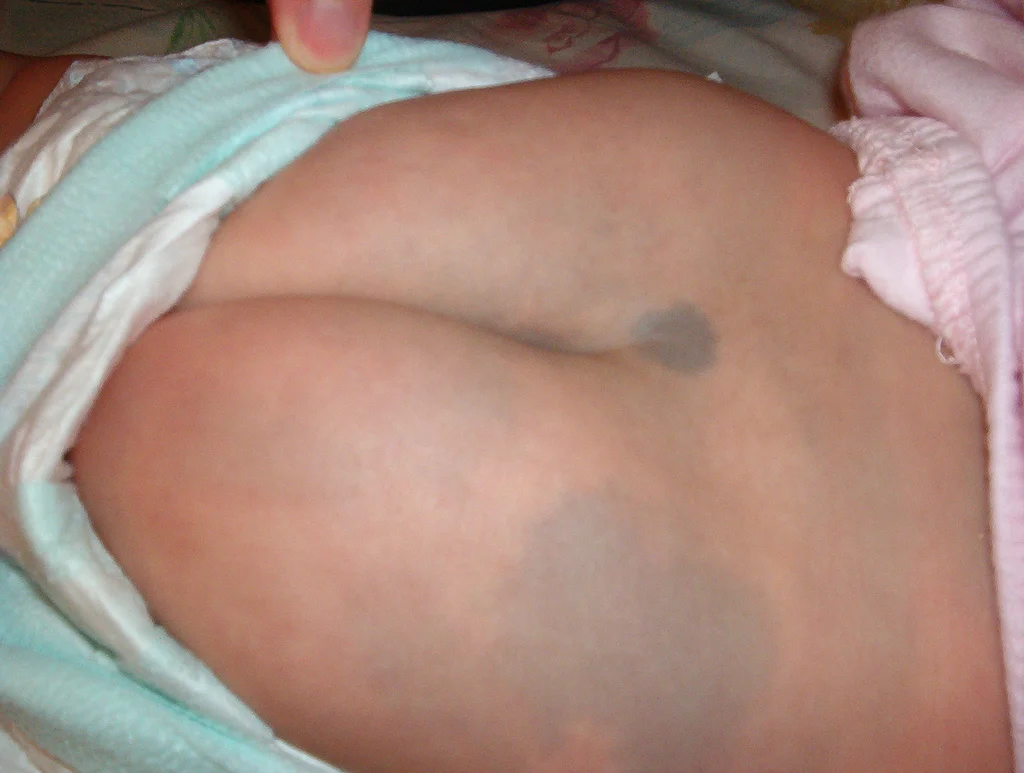
Long description
A Mongolian spot on the lower back of a six-month-old baby girl.

Bruises. Suspect maltreatment when a child has bruising in the shape of a hand, ligature, stick, teeth mark, grip or implement; or bruising or petechiae not due to a medical condition (such as a coagulation disorder) where the explanation is unsuitable. Specific patterns include: bruising in a child who is not independently mobile; multiple bruises or bruises in clusters; bruises of similar shape and size; bruises on any non-bony part of the body or face, including the eyes, ears and buttocks; bruises on the neck suggesting attempted strangulation; and bruises on the ankles or wrists suggesting ligature marks.[1]
A child is independently mobile if they can crawl, bottom shuffle, pull to stand, cruise, climb, or walk with or without aids; children under 12 weeks typically lack the strength and coordination for independent mobility, but age alone should not be used to decide this.[1]
Bruises cannot be dated accurately by their colour, so avoid stating a bruise's age from its appearance.
Bites. Suspect maltreatment with any human bite mark thought unlikely to have been caused by a young child; consider neglect with an animal bite where supervision was inadequate.[1]
Lacerations, abrasions and scars. Consider these as possible abuse when the explanation is unsuitable, especially on a child not independently mobile, when multiple, symmetrical, on areas usually protected by clothing (back, chest, abdomen, axilla, genital area), on the eyes, ears or sides of the face, or with ligature-like marks at the neck, ankles or wrists.[1]
Burns and scalds. Suspect maltreatment with a burn or scald whose explanation is absent or unsuitable; in a child not independently mobile; on soft tissue areas that would not be expected to contact a hot surface in an accident (backs of the hands, soles of the feet, buttocks, back); in the shape of an implement (cigarette, iron); or suggesting forced immersion (scalds to buttocks, perineum and lower limbs, glove or stocking distribution, symmetrical scalds, sharply delineated borders). Minor tap-water scalds are common accidents, but the pattern must fit the story.[1]
Cold injuries (for example swollen, red hands or feet, or hypothermia without an adequate explanation) are a less common alerting feature.[1]
Fractures. Suspect maltreatment if there is one or more fractures in a child without a medical condition predisposing to fragile bones (such as osteogenesis imperfecta or osteopenia of prematurity), or if the explanation is absent or unsuitable. Particular patterns are fractures of different ages, and radiographic evidence of occult fractures such as rib fractures in infants.[1]
No fracture is pathognomonic for abuse, but the following are highly suggestive:
- Rib fractures (especially posteromedial) in young children: up to a 95% positive predictive value for abuse in children under 3 years.[3][4]
- Classic metaphyseal lesion (corner or bucket-handle fracture): a planar shearing injury highly specific in infants, virtually never seen in osteogenesis imperfecta, and not produced by simple household falls in studies.[4][5]
- Long bone fractures in non-ambulant infants: tibia, femur and humerus fractures are commonly attributed to abuse; up to 54% of humerus fractures in children under 3 years and nearly 75% of lower extremity fractures in children under 18 months are attributed to abuse.[3]
- Spiral fractures of the humerus (or femur) in a non-ambulatory infant: more likely abuse. But spiral and transverse fractures occur with equal frequency in abused children, so neither pattern "proves" abuse on its own.[4]
- Multiple fractures, particularly in different stages of healing: about half of abused children have more than one fracture, and having three or more fractures increases the risk of abuse fourfold.[3]
- Displaced physeal fractures, most often a Salter-Harris I of the humerus, are 13 times more likely to be from abuse than displaced supracondylar fractures.[3]
- Fractures at highly specific sites: sternum, scapula, spinous processes.
Overall, approximately one-fourth of fractures in infants under 12 months and about 80% of fractures in children under 18 months are from abuse in published series.[3]
Intracranial injury. Suspect maltreatment if a child has an intracranial injury without major confirmed accidental trauma or known medical cause, and any of the following: the explanation is absent or unsuitable; the child is under 3 years; there are also retinal haemorrhages, rib or long bone fractures, or other inflicted injuries; or there are multiple subdural haemorrhages with or without subarachnoid haemorrhage or hypoxic-ischaemic damage.[1]
Eye injury. Suspect maltreatment if a child has retinal haemorrhages or eye injury without major confirmed accidental trauma or known medical cause, including birth-related causes.[1]
Abusive head trauma (also called shaken baby syndrome) is, by the CDC definition, injury to the intracranial contents or skull of a child under 5 years resulting from blunt force, forceful shaking, or both.[6] It is the commonest cause of traumatic death from abuse in young children. An infant may present with non-specific features only: irritability, lethargy, poor feeding, vomiting, apnoea, or seizures; the absence of bruising does not exclude it, and many infants have no external mark. Reported features more common in abusive than accidental head trauma include bilateral retinal haemorrhage, subdural rather than epidural haemorrhage, intracranial injury without skull fracture, mixed-density haemorrhage, and clusters of seizures.[6]
Retinal haemorrhage is found in about 75% of cases of abusive head trauma in series and has a reported sensitivity of 75% and specificity of 93% for abuse, but the pattern matters more than presence alone. Haemorrhages in abuse are often bilateral, multilayered (intraretinal, preretinal and subretinal), extend to the periphery, and may be accompanied by retinal folds or retinoschisis; accidental trauma causes fewer, unilateral haemorrhages limited mainly to the posterior pole. Retinal haemorrhage is not pathognomonic for abuse: it also occurs with severe accidental trauma, birth trauma, coagulopathy and intracranial infection, so it must be interpreted with the rest of the case.[6] Birth-related retinal haemorrhages are common and are predominantly posterior and intraretinal.
Retinal haemorrhages also cannot be dated reliably, and there is no published evidence of them resulting from ordinary handling or vigorous play.
Visceral injuries. Suspect maltreatment if a child has an intra-abdominal or intrathoracic injury without major confirmed accidental trauma, with an absent or unsuitable explanation, or with delay. There may be no external bruising.[1]
Oral and other injuries. Unexplained oral injury, genital or anal injury, persistent or recurrent genital symptoms with behavioural change, and non-recent sexual abuse disclosures all count as alerting features. Sexually transmitted infection in a child under 13 (or certain infections in older adolescents where consent and power imbalance are concerns), and pregnancy in a child under 13, also raise abuse.[1]
Fabricated or induced illness. Consider this when the history and examination do not fit the recognised clinical picture, or when symptoms appear and disappear with the carer, are only seen by the carer, respond poorly to treatment, or are followed by new symptoms as soon as one resolves. Biologically unlikely histories, repeated seeking of multiple opinions, and a child using more aids or missing more school than expected are also alerts.[1]
Neglect-specific findings. Consider neglect for severe persistent infestations, persistently inappropriate clothing, persistent dirt and poor hygiene, unsafe home environment, faltering growth due to inadequate diet, lack of appropriate supervision of injuries or ingestions, failure to give essential prescribed treatment or to attend essential follow-up, and not engaging with immunisation, health reviews or screening. Suspect neglect when parents fail to seek medical advice to the extent that health or growth is compromised, including ongoing pain, or when a child repeatedly scavenges, steals, hoards or hides food.[1][2]
| Injury | What raises concern | What can look the same |
|---|---|---|
| Bruises | Hand, ligature or implement shapes; a child not independently mobile; clusters; face, ears, neck, buttocks; neck or ankle and wrist ligature marks[1] | Mongolian spots: present from birth on the sacrum, buttocks or back, no tenderness, and they do not change colour. Bleeding disorders and cultural healing practices such as cupping[1] |
| Burns and scalds | Cigarette or iron shapes; backs of the hands, soles, buttocks; glove or stocking distribution, symmetrical scalds with sharp borders suggesting forced immersion[1] | Minor tap-water scalds are common accidents, but the pattern must fit the story[1] |
| Fractures | Fractures of different ages; posteromedial rib fractures; classic metaphyseal lesions; long bone fractures in a non-ambulant infant[3][4] | Osteogenesis imperfecta, osteopenia of prematurity, rickets and other metabolic bone disease[4] |
| Head injury and retinal haemorrhage | Subdural haemorrhage and bilateral, multilayered retinal haemorrhages extending to the periphery, in an infant with an absent or unsuitable explanation[1][6] | Severe accidental trauma, birth trauma, coagulopathy and intracranial infection can also cause retinal haemorrhage |
Both NICE guidelines list behavioural alerts: a marked change in behaviour or emotional state not explained by an ordinary stressor; behaviour not consistent with age or development; self-harm, eating disorders, substance misuse, suicidal behaviour or running away; age-inappropriate sexualised behaviour, especially coercive, precocious or indiscriminate sexual behaviour in a pre-pubertal child; secondary wetting or soiling; and parent-child interactions that are hostile, scapegoating, developmentally inappropriate or emotionally unavailable.[1][2]
The differential is between abuse and the ordinary accidental injuries of childhood (falls from furniture, trivial trauma, sports), together with conditions that mimic abuse. Always take a full social and developmental history and examine the whole child. The mimics matter: missing osteogenesis imperfecta or a bleeding disorder can be as harmful as missing abuse.
| Condition | How it mimics abuse | Features pointing toward the condition |
|---|---|---|
| Osteogenesis imperfecta | Multiple fractures, including in infants | Bone fragility; types 1 and 4 may be mild with little deformity. Biochemical or mutation analysis identifies about 90 to 95% of types 1 to 4. Posteromedial rib fractures are uncommon except in severe disease, and classic metaphyseal lesions are extraordinarily rare. Look for blue sclerae, dentinogenesis imperfecta, family history.[4] |
| Osteopenia of prematurity / rickets | Multiple fractures in a premature or ill infant | Frayed, cupped or osteopenic physes; low mineralisation. Fractures in hospitalised infants can occur with ordinary handling. Chronic renal or liver disease also predisposes.[4] |
| Other metabolic bone disease (vitamin D deficiency in older infants, inherited skeletal dysplasias) | Unexplained fractures, deformity | Radiographic and biochemical signs of the underlying disease; mineralisation changes. |
| Bleeding disorders (ITP, haemophilia, von Willebrand disease, vitamin K deficiency) | Bruising, petechiae, bleeding | Bruising pattern often diffuse or at multiple sites from minimal trauma; abnormal coagulation studies or platelet count. A coagulation disorder must be excluded before bruising is attributed to abuse.[1] |
| Mongolian spots (congenital dermal melanocytosis) | Blue-black patches mistaken for bruises | Present from birth on the sacrum, buttocks or back; do not change colour like a bruise; no tenderness or swelling. |
| Cultural healing practices (cupping, coining, moxibustion) | Patterned bruises or burns in symmetrical rows | Lesions follow the borders of cups or coins; history is usually open. Cultural practice does not justify hurting a child, and the injury still needs assessment.[1] |
| Accidental injury of childhood | Fractures, bruises, cuts | Story fits the development of the child, the mechanism and the injury; a single injury in a plausible site. |
| Conditions with reduced sensation (congenital insensitivity to pain, spinal dysraphism) | Multiple fractures without reported pain | Neurological findings; lack of pain response. Usually rare; a careful neurological examination and history point to the diagnosis.[4] |
| Temporary brittle bone disease | Proposed explanation for infant fractures | This theory has been severely criticised and discredited in many jurisdictions; it should not be accepted as an explanation for abuse.[4] |
Investigate the injury and the child, not only the suspicion. Appropriate tests exclude mimics and protect innocent families, and they must not delay safety decisions.
- History and examination as above, including a careful developmental assessment.
- Child protection medical (forensic) examination when acute injury or sexual abuse is suspected, performed by a clinician trained in the forensic assessment of children.
- Blood tests: full blood count, coagulation screen, liver function, calcium, phosphate and alkaline phosphatase when fracture or bone fragility is suspected; vitamin D where deficiency is possible. This combination is drawn from paediatric fracture guidance.[3]
- Imaging of suspected abuse: skeletal survey in young children; CT of the head, chest and abdomen as indicated; MRI of the brain and spine for suspected head or spinal injury; fundoscopy.
- Photographs: of bruises, burns and rashes, taken according to local forensic policy.
A skeletal survey is recommended for children younger than 24 months with a fracture, and for older children where abuse is strongly suspected.[3][5] It should be a full series on separate films, not a "babygram": AP views of all the bones of the appendicular skeleton, AP and lateral skull views, lateral thoracic and lumbar spine and a separate lateral cervical view, an AP chest, an AP abdomen and an AP pelvis, with coned views of suspicious areas. Bilateral oblique rib views are added because they greatly improve detection of subtle rib fractures.[4]
A skeletal survey should be completed even if a CT scan of the chest or head has been performed. A poorly performed or incomplete survey misses fractures, particularly acute rib and metaphyseal fractures.[5]
Follow-up imaging. A single skeletal survey misses fractures. A second investigation, a skeletal survey repeated 11 to 14 days later or a contemporaneous bone scan, is required when abuse is suspected, particularly if the first survey is negative: the two are complementary and together increase the chance of identifying all fractures. A repeat skeletal survey can provide additional information and may increase the yield of fractures by up to 27%. Bone scintigraphy is sensitive but may miss fractures at the physes because of normal uptake in growth plates.[5]
Any infant or young child with suspected abusive head trauma needs cranial imaging (CT acutely, MRI for detail and dating), dilated fundoscopy by an ophthalmologist, and a skeletal survey. Neck and cervical spine imaging is added when cervical injury is suspected. The combination of subdural haemorrhage, retinal haemorrhage and encephalopathy has high specificity when the history does not fit.
Acute sexual abuse within the window for forensic evidence needs prompt referral to a forensic medical service for examination, swabs, photography and, where applicable, pregnancy and infection prophylaxis. Most children who are abused have no genital signs, so a normal examination never excludes it. Examination findings must not be over-interpreted.
The management of suspected child abuse is safeguarding, not a drug or procedure. There is no medication that treats abuse; the aim is to stop further harm, treat injuries, and put the child in a safe environment with proper support.
Suspected child abuse or neglect: first response
- Concern arisesInjury, neglect, behavioural change, or a child's disclosure that does not fit the story
- Ensure immediate safetyIf the child is in immediate danger, contact emergency services or police and arrange a place of safety
- Question: Is there an acute medical need?
Yes
- Treat injuries firstResuscitate, image and manage fractures, head injury or burns; do not let treatment delay safeguarding
- Document objectivelyRecord verbatim words, timings, who was present, measurements, diagrams and photographs
No
- Proceed to assessmentFocus on the child's safety, history and examination
- Question: Level of concern (NICE consider versus suspect)
Consider
- Look for other alerting featuresGather history and information from other agencies, with the family's knowledge where safe
- Review regularlyContinue to look for repeated or new alerting features; escalate if concern rises
- Early help if appropriateRefer for early help assessment when a child is in need but not at immediate risk
Suspect
- Discuss referralDiscuss the need for referral with children's social care using local multi-agency procedures
- Multi-agency assessmentChild protection enquiry, medical evaluation, skeletal survey and forensic sampling if needed
- Protection planSafety planning, supervision, support and, where necessary, removal from the harmful environment
- Support and follow-upTherapeutic support for the child and family, and ongoing monitoring
NICE's stepwise approach, which most UK and similar services follow in spirit, is:[2]
- Seek advice from a named or designated safeguarding professional or your organisation's safeguarding lead.
- Speak to the child in an age-appropriate way if it is safe to do so, using open questions, working at their pace, explaining confidentiality and its limits.
- For "suspect" level concerns: discuss the need for referral with children's social care using local multi-agency procedures.
- For "consider" level concerns: look for other alerting features now and in the past, gather information from other agencies, and arrange a review at a time suited to the level of concern; if concern rises to "suspect", refer. If no referral is needed, consider early help.
- If the child is in immediate danger, refer to children's social care and/or the police without delay.
If a child discloses abuse, make a referral to children's social care using local procedures, and tell the child who will be told and what will happen next.[2]
Children's social care assesses risk and need, including under statutory child protection frameworks, and leads a multi-agency response that can include a child protection plan, foster placement, therapeutic intervention and support for the family. Where a child has been abused or neglected, the minimum response includes protection from further harm, emotional support, and assessment of physical and mental health needs.[2]
Good documentation protects the child and is the single most important thing a clinician can do well.
- Write what you saw and heard, not conclusions: the bruise's size, shape, colour, and site; the exact words used.
- Represent the child's words accurately, using their own words unless there is good reason not to, and check understanding where possible.[2]
- Record timing, who was present, measurements, diagrams and photographs taken.
- Record the explanation given by carers and why it does or does not fit.
- Record the actions taken, referrals made, advice sought and outcomes.
- Record every contact and decision about information sharing.
Exam trapKeep the interview clean
Do not question the child repeatedly or in a leading way, and do not try to "investigate" the allegation yourself; forensic interviewing belongs to trained specialists. Your job is to be a calm clinician who notices, documents and refers.[2]
United Kingdom (NICE)
Many of the red flags, safeguarding steps, early help programmes and thresholds quoted here come from UK NICE guidance and UK child protection law. Other countries use different terms and legal duties, but the clinical principles—act on suspicion, keep the child safe, use open non-leading questions, document objectively, involve child protection services—apply everywhere. Professionals must know their own jurisdiction's reporting duties. In the UK, practitioners in regulated professions such as healthcare and teaching have mandatory duties to report certain disclosures (for example female genital mutilation in girls).
Mandatory reporting laws differ by country: some require any professional who suspects abuse to report; others require only specified professions; in some, reporting is to social care, in others to the police. In every jurisdiction, child safety overrides professional confidentiality.
NICE recommends, for families at risk of abuse or neglect, evidence-based support rather than watchful waiting: a parenting programme lasting at least 12 weeks, tailored to need, and, where appropriate, a weekly home visiting programme lasting at least 6 months in addition to universal services. These are started during pregnancy or shortly after birth where possible.[2]
Physical. Brain injury with intellectual or motor disability, blindness or epilepsy after abusive head trauma; fractures with growth disturbance or deformity; chronic lung disease after rib injury; failure to thrive; dental decay and chronic infection; genital and anorectal injury; death.
Psychological. Post-traumatic stress, depression, anxiety, attachment disorders, self-harm, suicidal behaviour, eating disorders, educational failure, and difficulty forming relationships. Abused children are also more likely to abuse others in adulthood, which is why effective intervention matters.
Systemic. Recurrence of abuse; siblings may also be at risk; factitious illness can lead to repeated unnecessary surgery.
Prognosis depends on the type and severity of abuse, the age at which it started, whether it was recognised and stopped, and the quality of the care and support provided afterwards. Early recognition, safety, stable caregiving and good psychological support improve outcomes for both the child and the family. Unsupported, the outlook for children who remain in abusive environments is poor.
Prevention operates at three levels:
- Primary: supporting all families (antenatal care, universal health visiting, access to childcare, poverty reduction, education about safe infant care and never shaking a baby).
- Secondary: targeting families with risk factors (parenting programmes, home visiting, mental health and substance misuse treatment, domestic abuse services).
- Tertiary: intervention after abuse (child protection, safe placement, therapy, long-term follow-up).
Screening is not a single test: it is the consistent application of the red-flag lists above in every clinical contact with children.
- Infants under 12 months are the group most likely to be seriously or fatally injured; they have the least ability to seek help and the most non-specific presentation.
- Disabled children and children with chronic illness are more vulnerable, and their presentations are easily attributed to their condition.
- Adolescents may present with self-harm, depression, running away, or risk-taking rather than physical injury; sexual exploitation of older adolescents is easily missed.
- Neonates can be injured in hospital; fractures in hospitalised infants need careful dating and assessment.
- Children in care and in institutional settings remain at risk; abusers are often known to the child and to the family.
- Pregnancy in a child under 13 means unlawful sexual intercourse; any pregnancy in an adolescent needs sensitive assessment of consent, coercion, exploitation and power imbalance.[1]
Where CT, MRI and skeletal surveys are unavailable:
- Apply the clinical red flags and the body-map of injuries, and document meticulously.
- Plain radiographs of suspected fractures, repeated if the first is negative; a second survey 2 weeks later where possible.
- If a paediatric ophthalmologist or fundoscopy is unavailable, any infant with acute neurological signs, irritability, apnoea or seizures should be referred urgently, and retinoscopy should not delay safeguarding.
- Suspected abuse is a reason to refer, not to watch and wait.
- Work with whatever child protection services exist, including police, hospital social workers, NGOs and community children's committees; the priority is to ensure the child is not returned today to the harmful environment.
- Child maltreatment includes neglect, physical, sexual and emotional abuse, and fabricated or induced illness.
- No single finding proves abuse; the picture is built from injuries, the explanation, the child's development, behaviour and multi-agency information.
- Any bruising, burn or fracture in a child who is not independently mobile is highly concerning, as is an injury whose explanation is absent, implausible or inconsistent.
- Patterned bruises (hand, ligature, teeth marks, grip, implement), burns on soft surfaces or in implement shapes, and forced-immersion scalds are classic.
- Rib fractures (particularly posteromedial) have a very high positive predictive value for abuse in children under 3 years; classic metaphyseal lesions are highly specific in infants and virtually never occur in osteogenesis imperfecta; long bone fractures in non-ambulant infants are commonly abusive. [5]
- Spiral and transverse fractures occur equally often in abused children; neither pattern alone proves abuse.
- Abusive head trauma is common in infants and may present with non-specific signs; bilateral multilayered retinal haemorrhages raise strong suspicion but are not proof on their own.
- A skeletal survey (with oblique rib views) is recommended for children under 24 months with a fracture and for older children with strong suspicion; it must be repeated 11 to 14 days later or paired with a bone scan.
- Always consider the mimics (osteogenesis imperfecta, osteopenia and rickets, bleeding disorders, Mongolian spots, cultural practices, accidental injury, reduced-sensation disorders) and test for them.
- Safeguarding is the treatment: ensure immediate safety, document objectively, refer through the multi-agency pathway, and provide long-term support.
- All children and families deserve evidence-based early help, and many poorer outcomes are prevented when it starts early.
Answer each one in your head first, then open the answer.
A 4-month-old infant has a healing rib fracture found on a chest X-ray taken for a viral illness. There is no history of trauma and the baby is thriving. What are the main considerations?
Show answerHide answer
This is a high-risk presentation. In infants, especially non-ambulatory ones, rib fractures (particularly posteromedial) have a very high positive predictive value for abuse. The next steps are a full skeletal survey with oblique rib views (and a repeat in 11 to 14 days), cranial imaging and fundoscopy to look for other inflicted injuries, a child protection medical, documentation, and referral through the safeguarding pathway. Non-abusive causes such as severe metabolic bone disease or major accidental trauma are considered but do not fit a baby with no trauma history.
A mother says her 3-year-old pulled away while she was holding his arm and he now has a spiral fracture of the humerus. Is spiral fracture proof of abuse?
Show answerHide answer
No. Spiral fractures are not pathognomonic for abuse: spiral and transverse fractures occur with equal frequency in abused children. What matters is consistency with development, the mechanism, the child's behaviour, and other alerting features. In a non-ambulatory infant the same fracture would be much more suspicious. A careful history, examination and, if needed, skeletal survey are required before any conclusion.
A toddler is brought in with Mongolian spots on the sacrum. How do these differ from bruises?
Show answerHide answer
Mongolian spots (congenital dermal melanocytosis) are blue-black patches present from birth, usually on the sacrum, buttocks or back. They do not change colour like a bruise, are not tender or swollen, and remain stable over time; bruises evolve through colour changes and are often tender. Misidentifying them is a common pitfall in any ethnic group.
An infant presents drowsy and vomiting with a subdural haematoma on CT. The parents report a short fall from a sofa. What eye examination finding would strongly support abusive head trauma, and what caveat applies?
Show answerHide answer
Bilateral, multilayered retinal haemorrhages extending to the periphery, especially with retinal folds or retinoschisis, would strongly support abusive head trauma, which is an acceleration-deceleration injury; retinal haemorrhage in abuse has a reported sensitivity around 75% and specificity around 93%. The caveat is that retinal haemorrhage is not proof of abuse on its own: severe accidental trauma, birth trauma, coagulopathy and intracranial infection can all cause it, and the diagnosis rests on the whole clinical picture.
What is the recommended skeletal survey technique and follow-up when abuse is suspected?
Show answerHide answer
A full series on separate films, including AP views of all limb bones, AP and lateral skull, lateral spine views, and AP chest, abdomen and pelvis, plus oblique rib views; not a single "babygram". It is repeated 11 to 14 days later, or paired with a bone scan, because a first survey misses acute fractures; a repeat can increase the yield by up to about 27%.
Plain text only: Safeguarding and early help; growth faltering and malnutrition; osteogenesis imperfecta; rickets and osteopenia; bleeding disorders and coagulation testing; sexual and reproductive health in adolescents; head injury and subdural haematoma; ocular trauma and retinal disease; fractures and orthopaedic injuries in children. None of these linked pages are available yet as MedGrasp topics.
- National Institute for Health and Care Excellence (NICE). Child maltreatment: when to suspect maltreatment in under 18s (NICE CG89, last updated 3 December 2025). NICE guideline CG89. Accessed .
- National Institute for Health and Care Excellence (NICE). Child abuse and neglect (NICE NG76, published 9 October 2017). NICE guideline NG76. Accessed .
- Arnold MJ. Evaluating Young Children With Fractures for Child Abuse: Report From the AAP. American Family Physician 2026;113(5):506-508. Accessed .
- Dwek JR. The radiographic approach to child abuse. Clinical Orthopaedics and Related Research 2011;469(3):776-789. Accessed .
- Royal College of Paediatrics and Child Health (RCPCH). Recognition of Physical Abuse (Child Protection Companion, chapter 9, updated May 2019). RCPCH Child Protection Companion. Accessed .
- Multiple authors (via PMC). Pediatric abusive head trauma (PMC review). PubMed Central review article. Accessed .
Figure credits
Educational content for medical students and doctors. It is not a substitute for clinical judgement or local guidelines.