Efficacy, potency and receptor pharmacology
Core concepts of drug action including efficacy, potency, and receptor interactions for medical students.
Figure 1Efficacy spectrum
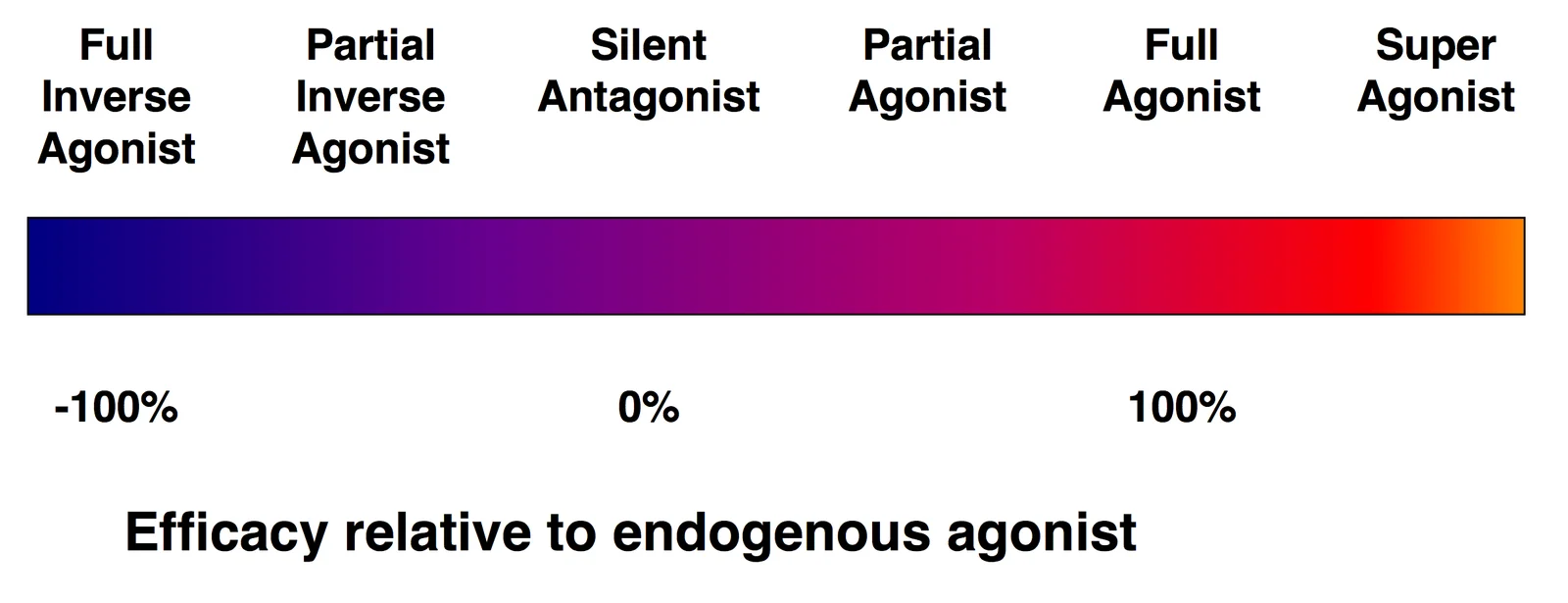
Long description
A horizontal colour bar shows the efficacy of receptor ligands relative to the body's own agonist, from -100% to 100%. Left to right it marks a full inverse agonist, a partial inverse agonist, a silent antagonist at 0%, a partial agonist, a full agonist at 100% and a super agonist beyond it.

In receptor pharmacology, the interaction between a drug and its target receptor determines the biological response. Two distinct properties govern this relationship: efficacy and potency. Efficacy refers to the maximum effect a drug can produce once it has bound to its receptor and triggered a cellular response. It is an intrinsic property of the drug-receptor complex, independent of the dose administered. A drug with high efficacy can produce a maximal physiological response, whereas a drug with low efficacy cannot achieve the same peak effect regardless of how much is administered. This concept is critical when comparing different classes of drugs that act on the same receptor system. For instance, in the management of type 2 diabetes, glucagon-like peptide-1 receptor agonists (GLP-1RAs) are evaluated based on their comparative efficacy in improving glycaemic control, reducing body weight, and improving lipid profiles. The therapeutic goal is not just to bind the receptor, but to achieve a specific physiological outcome, such as enhancing glucose homoeostasis and suppressing food intake. [2]
Potency, conversely, is a measure of the amount of drug required to produce a defined effect. It is typically expressed as the concentration or dose that produces 50% of the maximal response (EC50). A more potent drug requires a lower concentration to achieve the same effect compared to a less potent drug. Potency does not determine the maximum effect; it only determines the position of the dose-response curve along the x-axis. In clinical practice, potency influences dosing frequency and the total daily dose required to maintain therapeutic levels. For example, inhaled corticosteroids vary significantly in their glucocorticoid receptor binding affinity, which is a measure of potency. A higher potency means that a lower inhaled dose is required to occupy the same number of glucocorticoid receptors in the airways, resulting in a lower daily dose for equivalent efficacy. This relationship is often depicted as an exponential decline in therapeutic daily dose with increasing potency. Understanding the distinction is vital: a drug can be highly potent but have low efficacy, or have high efficacy but low potency. The therapeutic index, which separates desired local effects from systemic adverse effects, can be influenced by potency, but only if there is a differential effect on efficacy or systemic exposure. For inhaled corticosteroids, potency is not always considered to affect the ratio of topical efficacy to systemic activity, as differences can be overcome by adjusting the dose of the less potent drug. [4]
Modern pharmacology has evolved beyond the classical lock-and-key model. We now recognise that receptors often exist as homo- or hetero-dimers, which may function as distinct pharmacological units. This structural complexity can lead to unexpected interactions, such as the cross-inhibition reported between AT1R and β-adrenergic receptors. Such phenomena provide a vital note of caution when interpreting the outcomes of "selective" receptor antagonism in clinical practice, as the presence of dimer partners may alter the expected physiological response. [6]
A major focus in current drug development is biased agonism, where a ligand selectively activates specific downstream signalling pathways while ignoring others. This is well-demonstrated by the AT1R, where experimental tools—such as a panel of mutant receptors—allow for selective uncoupling from G proteins while maintaining other functions like arrestin recruitment and internalisation. Furthermore, specific substituted ligands, such as Sar1Ile4Ile8-AngII, can bind the receptor but fail to activate G proteins (specifically Gq/11), yet still promote receptor phosphorylation and arrestin recruitment. This decoupling is instrumental in elucidating G protein-independent signalling events. [6]
Genetic variability also influences receptor pharmacology. While alternative splicing and SNP variations exist, their prevalence and impact on RAS activity remain under-appreciated. Currently, reported variants are primarily loss-of-function, though gain-of-function variants could theoretically exist. For instance, variants in the carboxyl-terminus at position threonine336 alter a well-established motif for receptor phosphorylation, arrestin binding, and internalisation. Such mutations might be expected to show enhanced receptor activation as a consequence of diminished receptor desensitisation. [6]
DefinitionBiased Agonism
A pharmacological phenomenon where a ligand preferentially activates specific signalling pathways (e.g., arrestin recruitment) over others (e.g., G protein activation) through a single receptor.
Clinical pearlEfficacy vs. Potency
Efficacy is the maximum response a drug can produce, whereas potency is the concentration required to produce a specific effect. In vivo efficacy depends not on direct potency alone but is also subject to influence by other parameters, in particular pharmacokinetics. [9]
Agonists are drugs that bind to a receptor and activate it, producing a biological response. Full agonists have high efficacy and can produce the maximal possible response of the tissue. In contrast, partial agonists have lower efficacy; they bind to the receptor and activate it, but they cannot produce the maximal response even at high concentrations. Instead, they produce a sub-maximal response. This property makes partial agonists unique because they can act as agonists in the absence of a full agonist, but as antagonists in the presence of a full agonist. This dual behaviour is particularly useful in addiction medicine. Nicotine receptor partial agonists, such as varenicline and cytisine, bind to the α4β2 nicotinic acetylcholine receptor. When bound, they prompt the receptor to release dopamine in a manner similar to nicotine, which helps counteract withdrawal symptoms by maintaining moderate levels of dopamine. Simultaneously, they prevent nicotine from tobacco from binding to the receptor, thereby reducing the rewarding effects of smoking. This combination of maintaining moderate dopamine levels and reducing smoking satisfaction makes them effective for smoking cessation. Varenicline and cytisine are the two main agents in this class, although a third drug, dianicline, was developed but withdrawn due to unfavourable results. [3]
The concept of efficacy is also evident in the development of newer multi-agonist therapies. In type 2 diabetes, dual and triple agonists such as tirzepatide, mazdutide, CagriSema, and retatrutide have shown better efficacy than regular GLP-1RA drugs in reducing HbA1c concentrations, fasting blood glucose, and body weight. These agents target multiple receptors to enhance glucose homoeostasis and suppress appetite. Additionally, GLP-1R agonists have been shown to reduce systolic and diastolic blood pressure and total cholesterol, demonstrating a broader therapeutic profile. The efficacy of these drugs is not just about binding affinity (potency) but about the magnitude of the physiological response they can elicit. For inhaled corticosteroids, the therapeutic dose is inversely related to potency. A drug with higher receptor binding affinity requires a lower dose to achieve the same receptor occupancy. The therapeutic index is defined as the dose that produces 20% cortisol suppression divided by the therapeutic dose. A higher therapeutic index indicates a greater separation between systemic adverse effects and desired local effects. [1] [2][4]
| Property | Definition | Clinical Example [5] |
|---|---|---|
| Efficacy | Maximum effect achievable by a drug | GLP-1RAs reducing HbA1c and body weight |
| Potency | Dose required to achieve a specific effect | Inhaled corticosteroid dose inversely related to binding affinity |
| Partial Agonist | Drug with sub-maximal efficacy | Varenicline binding to α4β2 nicotinic receptor |
DefinitionPartial Agonist
A partial agonist binds to a receptor and produces a sub-maximal response, acting as an antagonist when a full agonist is present.
Agonist Action
- Drug binds to receptor
- Question: Is it a full agonist?
Yes
- Produces maximal response
No
- Produces sub-maximal response
- May act as antagonist if full agonist present
Clinical pearlTherapeutic Index
For inhaled corticosteroids, the therapeutic index is the dose causing 20% cortisol suppression divided by the therapeutic dose.
DefinitionAntagonists and intrinsic activity
An antagonist occupies a receptor without activating it, so it blocks the response to an agonist. A competitive antagonist is surmountable: enough agonist can overcome it. A non-competitive antagonist is not surmountable and lowers the maximum response an agonist can produce.
Potency and efficacy are different properties. Potency is the dose needed for a given effect and depends on binding affinity and receptor coupling; efficacy is the maximum response a drug can produce. For the glucocorticoid receptor, binding affinity relates exponentially to therapeutic dose, so more potent molecules can be given at much lower doses for similar clinical efficacy. [4]
Exam trapPotency alone does not widen the index
It is a widely held assumption that the therapeutic index of synthetic glucocorticoids cannot be improved by increasing potency through enhanced glucocorticoid receptor binding affinity. This probably holds for systemically administered corticosteroids, unless selectivity for glucocorticoid receptors over non-target receptors is greatly increased, because efficacy and safety both follow from circulating drug concentrations and shared receptor interactions. [4]
DefinitionTherapeutic index
The therapeutic index (TI, or therapeutic ratio) compares the blood concentration producing a therapeutic effect with the concentration causing death in animal studies or toxicity in human studies. In animals, TI = LD50/ED50. [5]
Drugs in which small differences in dose or concentration may lead to serious therapeutic failure or serious drug reactions are called critical dose drugs; other terms are narrow therapeutic window, narrow therapeutic range and narrow therapeutic ratio. Such drugs need small within-subject variability, otherwise patients routinely experience toxicity and lack of efficacy. [5]
| Regimen | Therapeutic index | Comment |
|---|---|---|
| CIC, FP, MF, FF | greater than 1 | highest group |
| FF 100 µg per day | 5.8 | highest value [4] |
| Oral prednisolone 5 mg per day | 0.32 | systemic comparator [4] |
| Oral prednisolone 20 mg per day | 0.08 | systemic comparator [4] |
| Mid/high doses of BDP, BUD, TAA | under 1 | low group [4] |
| FLU | approximately 1 | lower potency, higher dose, greater systemic exposure |
With increasing potency, the therapeutic index increases, and low-mid doses have a better therapeutic index than mid/high doses. The molecules with the highest potency, longest lung retention, lowest oral bioavailability and highest systemic clearance (FF, MF, FP, CIC) have the highest therapeutic index. Eight inhaled corticosteroid molecules are approved for clinical use. Airway topical potency is the most important determinant of efficacy. [4] [5]
Enhanced potency brings greater lipophilicity, slower dissolution and pulmonary absorption, longer retention in the airways, longer duration of action and less frequent dosing; once absorbed, more potent molecules have higher plasma protein binding, lower unbound fractions and larger volumes of distribution. HFA metered-dose inhalers emit smaller particles and give a small improvement in therapeutic index, but not enough to reclassify them from low- to high-therapeutic-index. BDP is a prodrug whose efficacy relies on conversion to the active metabolite BMP in the airways; ultrafine particles from HFA inhalers dissolve and absorb faster, so less is converted in the airways and more unchanged BDP reaches the systemic circulation. [4]
Because higher potency can improve the therapeutic index, both efficacy and safety should be considered when classifying inhaled corticosteroid regimens in terms of dose equivalence. Current asthma guidelines rely on a simple historical approach to dose equivalence that is not appropriate for the wider range of molecules, potencies and devices now available; a more fit-for-purpose method is needed that incorporates pharmacological principles. [4]
DefinitionLD50 defined
LD50 (lethal dose 50) is the single dose that kills half of a defined test population, usually laboratory animals, under stated conditions of species, route and observation period.
LD50 is a population statistic, not a personal threshold. By definition half of the animals survive it, so it cannot tell you whether an individual patient will die from a given dose. It is derived by giving groups of animals graded doses, recording deaths, and reading the median from the curve. Because the value moves with species, strain, sex, age, route, formulation and duration of observation, an LD50 from one laboratory is seldom comparable with another, and none transfers directly to human beings. [3]
Human lethal doses cannot be measured ethically, so LD50 plays little direct part in prescribing. Its useful clinical descendants are the median effective dose, the median toxic dose and the therapeutic index, which expresses how far apart the effect and toxicity curves lie: therapeutic index = median toxic dose / median effective dose. A drug with a low median lethal dose may still be safe if effective concentrations sit far beneath it; a drug becomes dangerous when the curves draw together, because modest changes in absorption, metabolism or renal excretion then carry plasma levels from therapeutic to harmful.
The steepness of the dose-response curve matters as much as the median. Flecainide shows this clearly: its therapeutic-toxic window runs from 381 ng/mL, where the probability of efficacy is at least 50%, up to 710 ng/mL, where the probability of cardiovascular side effects is under 10%. Above that concentration the risk of cardiovascular side effects increases, and the probability of a cardiovascular event begins to rise sharply once PR and QRS intervals lengthen by approximately 40 ms from baseline. Flecainide dosing is therefore complicated by the steepness of the dose-response for both safety and efficacy. [5]
NoteWhat LD50 cannot tell you
A median lethal dose summarises acute lethality only. It says nothing about organ-specific injury, chronic harm, carcinogenicity or dependence, and animal values are shifted by species differences in absorption, distribution and metabolism.
Interpretation also depends on the patient. Children, older adults and pregnant patients frequently differ in clearance, body composition and receptor responsiveness, so a dose that sits comfortably below the lethal range in healthy adults may drift towards toxic concentrations in these groups. Renal or hepatic impairment raises exposure by slowing elimination, and impaired cardiac conduction lowers the threshold at which a sodium-channel blocker such as flecainide becomes harmful.
Illustrative example. Picture a drug whose lethal dose in animals lies many times above the dose that relieves symptoms: its therapeutic index is wide and small dosing errors change little. Now picture the opposite, where relief and toxicity occupy neighbouring concentrations; a modest fall in kidney function can move a patient across the boundary, the precise hazard illustrated by flecainide's narrow window.
| Index | Definition | Bedside meaning |
|---|---|---|
| LD50 | Dose killing half of a test population | Ranks acute animal toxicity; not transferable to individuals |
| Median effective dose | Dose producing the desired effect in half of a population | Basis for choosing a starting dose |
| Median toxic dose | Dose causing toxicity in half of a population | Upper reference point for monitoring |
| Therapeutic index | Median toxic dose divided by median effective dose | Wider is safer, though steepness still matters |
| Margin of safety | Gap between the smallest toxic and largest effective concentrations | Guides how closely a drug needs monitoring |
Clinical pearlPearl
A low LD50 describes acute toxicity in animals, not safety in humans; the bedside question is how steeply harm rises as dose or plasma concentration increases.
Exam trapCommon trap
Never compare LD50 values obtained by different routes, formulations or species and conclude that one drug is safer; absorption and first-pass handling differ so widely that such numbers are not comparable.
The median effective dose (ED50) is the dose that produces a specified, predefined effect in half of the individuals studied. It is read from a quantal, all-or-none dose–response curve and describes potency: the lower the ED50, the less drug is needed for the same effect. Efficacy, by contrast, is the maximum response a drug can produce, and one drug tested at only one or a few doses cannot show where the curve plateaus. Dose–response across agents is therefore compared by network meta-analysis, which evaluated almost all available GLP-1 receptor agonists (GLP-1RAs) at various doses, ranked their efficacy and safety, and explored the pattern between dosage and efficacy. [2]
In type 2 diabetes, tirzepatide proved the most effective in glycaemic control, and subgroup analysis identified a dose-dependent fashion in tirzepatide reducing HbA1c and fasting blood glucose, with the dose of 15 mg once weekly via subcutaneous injection showing the best efficacy. That is a ranked dose–response, not a claim that every patient needs the highest dose. GLP-1RAs differ in pharmacokinetics, efficacy, adverse reaction rates, and dosing requirements, so each must be evaluated independently; orforglipron, retatrutide, and CagriSema (semaglutide with cagrilintide) have emerged. Several GLP-1RAs produced weight loss, especially CagriSema, tirzepatide, and retatrutide, and GLP-1RAs can be used to reach the desired short term outcome in diabetes management: effective glucose lowering without weight gain. [2]
DefinitionED50 versus Kd
ED50 describes a dose in the whole patient; the dissociation constant (Kd) describes a concentration at the receptor. Both are half-maximal quantities, but they are measured in different units and answer different questions.
For inhaled corticosteroids the receptor-scale quantity is the glucocorticoid receptor dissociation constant (Kd, in nmol/l), the concentration of the inhaled corticosteroid needed to occupy 50% of the receptors. If a daily dose is spread evenly through the entire ≈900 g of human lung tissue, these inhaled corticosteroid concentrations far exceed the Kd values. The molecular structural features that increase glucocorticoid receptor binding affinity and selectivity also result in physicochemical and pharmacokinetic changes that may enhance airway targeting and reduce systemic exposure. A more potent molecule is therefore not simply a stronger one; its whole profile shifts. [4]
Low-, mid- and high-dose regimens of inhaled corticosteroids show a distinct exponential decline in therapeutic daily dose with increasing potency, so one might expect all dose regimens in the low-, mid- or high-dose categories to have equivalent efficacy; however, the extent to which each product's recommended doses are based on comprehensive dose ranging in all severities of asthma is variable. Clinically, most of the benefit in improving lung function is achieved with low–mid doses, with fewer patients benefiting from higher doses, and it is difficult to demonstrate a clear dose response for clinical endpoints within the efficacious dose range. The major determinants of inhaled corticosteroid therapeutic equivalence are potency and the efficiency of the device used for lung delivery. [4]
Clinical pearlPotency needs a device
For inhaled drugs, potency without delivery efficiency is an incomplete comparison; the efficiency of the device used for lung delivery is a co-determinant of therapeutic equivalence.
The range between the ED50 and TD50 can be considerable, depending on the medication, and the larger the TI, the safer the drug is. It is generally considered that a drug has a good safety profile if its TI exceeds the value of 10. The opposite extreme is the narrow-TI drug (NTID), where there is only a very small range of doses at which the drug produces a beneficial effect without causing severe and potentially fatal complications, so small variations in plasma concentration can produce an insufficient therapeutic response or toxic effects. [5]
| Concept | What it describes | Where it is measured |
|---|---|---|
| ED50 | Dose giving the predefined effect in half the population | Whole patient, quantal curve |
| Kd | Concentration occupying 50% of receptors | Receptor, in nmol/l |
| Efficacy | Maximum response achievable | Whole patient |
| Therapeutic index | Margin between ED50 and TD50 | Whole patient |
From ED50 to a dose decision
- Define the effect you needfor example HbA1c lowering or improvement in lung function
- Question: Has the dose–response been mapped across the efficacious range?
Yes
- Read the ED50 and the plateauchoose the lowest dose on the flat part of the curve
No
- Compare agents by potency and deliveryremember device efficiency for inhaled drugs
- Question: Is the therapeutic index narrow?
Yes
- Monitor closelysmall concentration changes can cause failure or toxicity
No
- Standard dosing is reasonablea TI exceeding 10 is generally considered a good safety profile
Quantifying receptor pharmacology requires mathematical models that account for binding, occupancy, and downstream signalling. When evaluating novel compounds, such as acylated GLP-1R ligands, researchers often observe that structural modifications significantly alter both binding affinity and signalling potency. For example, the binding affinity of [F1,G40,K41.C16 diacid]exendin-4 was approximately 3 times greater than that of non-acylated exendin-F1, yet its cAMP signalling potency was between 5 and 20 times lower. This discrepancy suggests that the acyl chain may orientate the ligand in a way that permits binding but fails to optimally engage the receptor core for activation. [8]
| Ligand Comparison | Observation |
|---|---|
| Binding affinity ([F1,G40,K41.C16 diacid]exendin-4 vs non-acylated) | 3 times greater |
| cAMP potency ([F1,G40,K41.C16 diacid]exendin-4 vs non-acylated) | 5 to 20 times lower |
| Potency difference ([F1,G40,K41.C16 diacid] vs [D3,G40,K41.C16 diacid]) | 100-fold difference |
Mathematical models are essential for unifying complex data sets, such as those describing the kinetically-controlled dynamics of IL-2 receptor agonism by NKTR-214. These models allow for the calculation of anticipated in vivo receptor occupancy and relate it to the downstream pharmacodynamic response.
In the case of NKTR-214, the model calculates the concentration-time profiles of various conjugated-IL2 species. Because of the fast clearance and slow rate of formation of free-IL2, the theoretically calculated Cmax of free-IL2 derived from NKTR-214 is approximately 20,000-fold lower than that of PEG-conjugates. [7]
- Calculation of relative concentration: If Cmax(PEG-conjugate) = 20,000 ng/mL and Cmax(free-IL2) = 1 ng/mL. Ratio = Cmax(PEG-conjugate) / Cmax(free-IL2) = 20,000.
This demonstrates that the conjugated species dominate the activation of the IL2Rβγ pathway through greater and prolonged occupancy of this receptor over IL2Rαβγ. This mechanism explains why NKTR-214 mobilises CD8 T cells while Treg numbers remain unchanged or decline.
Pharmacological Assessment
- Identify LigandDetermine if ligand is acylated or modified.
- Question: Assess Potency
High Potency
- Check EfficacyMeasure max response (e.g., cAMP or arrestin).
Low Potency
- Check BindingEvaluate affinity vs. signalling.
- Efficacy is the maximum response; potency is the dose or concentration needed for a set fraction of that response.
- A partial agonist has lower efficacy than a full agonist at the same receptor, so its effect plateaus.
- Cytisine helps stopping for at least 6 months and works by the same mechanism as varenicline, but may be not quite as helpful. [3]
- Standard courses differ: cytisine 25 days, varenicline 12 weeks.
- Most inhaled corticosteroid benefit occurs at low–mid doses; not all patients benefit from high doses.
- A 20% fall in serum cortisol marks the cut-off above which unwanted effects become more likely.
- Narrow therapeutic index drugs have effective and toxic concentrations close together, as with flecainide.
- Flecainide exposure varies with CYP2D6 genotype; 7–10 % of Caucasians and 1–3 % of Asians are poor metabolisers.
Answer each one in your head first, then open the answer.
What is the difference between efficacy and potency?
Show answerHide answer
Efficacy is the maximum response a drug can produce; potency is the dose or concentration needed to produce a given fraction of that response.Why does doubling the dose of a partial agonist not double its effect?
Show answerHide answer
Because receptors become occupied and the response plateaus at the partial agonist maximum, so extra drug adds unwanted effects rather than benefit.How long is a standard course of cytisine compared with varenicline?
Show answerHide answer
Cytisine is given for 25 days and varenicline for 12 weeks.Above what serum cortisol reduction is a wider range of unwanted effects considered more likely?
Show answerHide answer
A 20% reduction in serum cortisol is the cut-off used.Why does flecainide illustrate a narrow therapeutic index?
Show answerHide answer
Its effective and toxic concentrations are close together, and its half-life ranges from 7 to 30 hours with CYP2D6 genotype affecting exposure.
DefinitionPotency and efficacy are different things
A drug's potency is how much of it you need to produce a given effect; its efficacy is how large an effect it can produce at all. A potent drug is not necessarily a better drug, and a highly efficacious drug may be too toxic to use.
Clinical pearlWhy receptor pharmacology matters in real patients
Receptor-level reasoning explains the clinical problems you meet at the bedside: why one drug controls a disease better than another, why a dose that works for one patient fails in another, and why a drug that helps one organ damages another. The passages below anchor three of those problems in evidence.
The clearest clinical correlation in this topic is the treatment of type 2 diabetes. Meeting glycaemic targets is compromised by the limitations of available treatments, with some antidiabetic drugs, such as insulin, associated with weight gain. This is a genuine therapeutic dilemma: the treatment that lowers glucose most powerfully pushes the patient towards weight gain, which itself worsens insulin resistance. GLP-1 receptor agonists (GLP-1RAs) can address this dilemma by promoting glycaemic homeostasis while reducing weight gain. They act on the glucagon-like peptide-1 receptor, which couples glucose-dependent insulin secretion, so the potency of the effect is tied to the receptor mechanism rather than to a fixed dose. However, the same drug class carries a safety concern: gastrointestinal adverse events are induced by GLP-1RAs, and this concern is especially warranted for high dose administration. Receptor pharmacology therefore sets the ceiling on dosing, because pushing dose up in search of more efficacy eventually collides with receptor-mediated toxicity. [2]
Exam trapDo not judge a drug class by one trial
Efficacy claims should rest on the pooled evidence, not on a single study. In the type 2 diabetes literature, the searches for one update found 810 studies from 885 records, leaving 682 after duplicates were removed; 544 were ruled out at title and abstract screening, leaving 138 for full-text screening. From this, 45 new included studies and 20 new ongoing studies were identified, and combined with studies from previous updates this gave 75 included studies of 45,049 people, with 28 ongoing studies. That is the scale of evidence that should inform a first-line or efficacy statement, not a single trial. [3]
A second correlation concerns smoking cessation. There is high-certainty evidence that varenicline increases the chances of successful smoking cessation by more than two-fold compared with placebo. This is a receptor-level drug acting at the nicotinic acetylcholine receptor, and the estimate has remained stable since the previous version of the review was published, despite the growing inclusion of pragmatic trials in real-world settings and in disease-specific populations. [3]
NoteThe therapeutic index is the clinical expression of efficacy versus toxicity
In clinical practice, the therapeutic index (TI) is the range of doses at which a medication appeared to be effective in clinical trials for a median of participants without unacceptable adverse effects. For most drugs this range is wide enough that the maximum plasma concentration (Cmax) and the area under the plasma concentration-time curve (AUC) achieved at recommended doses lie sufficiently above the minimum therapeutic concentration and sufficiently below the toxic concentration, so drugs present clinical efficacy with an adequate safety margin. [5]
A third correlation is the lung retention of glucocorticoids. A feature of glucocorticoids with 21-hydroxyl groups has been proposed as an alternative mechanism of prolonged tissue retention in the lung, although it is unclear whether this prolongs the duration of action. This is a potency and duration question: tissue retention, not receptor affinity alone, determines how long the effect lasts. [4]
Clinical pearlNarrow therapeutic index drugs demand tighter standards
For drugs with a narrow therapeutic index, small differences in exposure can mean the difference between efficacy and toxicity. The FDA's Advisory Committee for Pharmaceutical Science and Clinical Pharmacology recommended in its 2010 meeting that the agency should develop a list of narrow therapeutic index drugs with clear, specialised criteria for including drugs on the list, made public, dynamic and constantly monitored, and focused on bioequivalence issues. The committee also suggested that replication studies are important and that the requirements for confidence intervals should perhaps be narrower, at 90.00-111.11%, and should include 100% (or 1.0). [5]
Exam trapAverage bioequivalence is performed in the wrong population
This population is quite different from that in whom the average bioequivalence is performed. Extrapolating from the average to the individual patient is unsafe when efficacy and toxicity sit close together. [5]
In pharmacology, distinguishing between efficacy and potency is fundamental to understanding drug response. Efficacy refers to the maximum effect a drug can produce, whereas potency describes the dose required to achieve a specific effect. These concepts are critical when interpreting laboratory data and clinical trial outcomes. For instance, in the evaluation of GLP-1 receptor agonists for type 2 diabetes, researchers used Stata to create network diagrams and ranked agents based on the surface under the cumulative ranking curve (SUCRA) to evaluate their relative efficacy. This statistical approach allows for the comparison of multiple treatments simultaneously, providing a robust framework for assessing which agents offer superior therapeutic benefits. [2]
When investigating receptor pharmacology, particularly with inhaled corticosteroids, potency is often determined by molecular properties such as lipophilicity and receptor binding affinity. The available inhaled corticosteroid molecules are listed in order of potency, with flunisolide being the least potent and fluticasone furoate the most potent. The furoate ester in fluticasone furoate is responsible for its greater lipophilicity, lower solubility, and enhanced glucocorticoid receptor binding affinity compared with fluticasone propionate. These physicochemical differences directly influence the drug’s potency and tissue distribution, which are key parameters in laboratory assays designed to measure receptor interaction. [4]
For narrow therapeutic index drugs (NTIDs), such as flecainide, the relationship between dose and response is steep, meaning small changes in dosage can lead to significant pharmacodynamic responses. This characteristic necessitates rigorous laboratory monitoring. The European Medicines Agency (EMA) has indicated that for specific NTIDs, the acceptance interval for the area under the curve (AUC) should be tightened from the conventional 80.00–125.00 % to 90.00–111.11 %. This stricter criterion ensures that bioequivalence studies can detect subtle differences in drug exposure that might otherwise be missed, thereby safeguarding efficacy and safety. [5]
DefinitionNarrow Therapeutic Index
A class of drugs where small differences between effective and toxic doses can lead to significant changes in pharmacodynamic response, requiring individualised dosing and regular monitoring.
Laboratory investigations for these drugs often involve therapeutic drug monitoring based on pharmacokinetic or pharmacodynamic measures to ensure safe and effective use. In the context of smoking cessation therapies, such as varenicline, laboratory and clinical analyses must account for specific patient populations. Analyses have presented inconclusive evidence for patients with asthma, substance use disorder, and alcohol dependence, with relative risks of 1.25, 3.72, and 3.01 respectively. However, point estimates favoured varenicline in all groups, suggesting that while confidence intervals were wide due to low event numbers, the drug’s efficacy remained consistent across these subgroups.
| Molecule | Potency Rank | Key Property |
|---|---|---|
| Flunisolide | Least Potent | Lower Lipophilicity |
| Fluticasone Furoate | Most Potent | Higher Lipophilicity |
The steep dose–response curve of flecainide means that a 20 % difference between products commonly used to define bioequivalence can lead to small variations in drug exposure, potentially reducing antiarrhythmic efficacy or causing adverse effects. Therefore, laboratory protocols for NTIDs must be designed with these narrow margins in mind, ensuring that any variation in drug levels is clinically insignificant. [5]
NTID Bioequivalence Assessment
- Identify Drug ClassCheck if drug is a Narrow Therapeutic Index Drug
- Question: Is it an NTID?
Yes
- Apply Tighter LimitsUse 90.00–111.11 % for AUC and Cmax
No
- Apply Standard LimitsUse 80.00–125.00 % for AUC and Cmax
Understanding these distinctions allows medical students to interpret laboratory results with greater precision, recognising that potency and efficacy are not interchangeable terms but distinct pharmacological attributes that guide therapeutic decision-making.
Glucagon-like peptide-1 (GLP-1) is a gut hormone secreted by the intestine in response to meal ingestion. It plays a crucial role in glucose homeostasis by enhancing endogenous insulin secretion and inhibiting glucagon release. Beyond glucose regulation, GLP-1 significantly suppresses food intake and appetite, making it a valuable target for weight management in patients with type 2 diabetes mellitus. Agonists of the GLP-1 receptor (GLP-1R) have demonstrated beneficial effects on metabolic regulation and can lead to weight loss in overweight or obese individuals. These agents are particularly useful for patients who have not achieved adequate glycaemic control with conventional antidiabetic interventions.
The first long-acting stable GLP-1R agonist was approved by the US Food and Drug Administration in 2005. Currently available products include exenatide and liraglutide, both of which are injectable medications. These drugs can be used in combination with oral antidiabetic agents such as metformin, thiazolidinediones, or sulphonylurea compounds. For exenatide, treatment is initiated at a 5 µg dose given twice daily for at least one month to improve tolerability. The dose can subsequently be increased to a maximum of 10 µg twice daily to improve glycaemic control. [1]
GLP-1R agonists attain glycaemic control through multiple mechanisms, including increasing insulin secretion induced by hyperglycaemia and inhibiting glucagon secretion during hyperglycaemia. They also slow gastric emptying, prevent substantial increases in postprandial glucose, and reduce caloric intake and body weight. Short-acting GLP-1R agonists, such as exenatide and lixisenatide, reduce the effect of nocturnal and fasting glucose but maintain the effect on gastric emptying during long-term treatment. In contrast, long-acting GLP-1R agonists, including liraglutide, exenatide, and dulaglutide, have more profound effects on nocturnal and fasting glucose and glycated haemoglobin (HbA1c). These effects are observed both in the context of oral hypoglycaemic drugs and in combination with basal insulin.
DefinitionGLP-1R Agonists
GLP-1R agonists are drugs that mimic the action of the gut hormone GLP-1, enhancing insulin secretion, inhibiting glucagon, and reducing appetite to improve glucose homeostasis and promote weight loss.
| Class | Examples | Key Pharmacological Effects |
|---|---|---|
| Short-acting | Exenatide, Lixisenatide | Reduce nocturnal and fasting glucose; maintain gastric emptying effects long-term |
| Long-acting | Liraglutide, Dulaglutide | Profound effects on nocturnal/fasting glucose and HbA1c; used with oral drugs or basal insulin |
The development of GLP-1R agonists has been rapid, with 15 drugs compared in recent network analyses, including eight regulatory-approved drugs and seven candidate drugs. One candidate, taspoglutide, was excluded from development due to strong gastrointestinal adverse effects. These drug classes have attracted widespread attention for their cardiovascular and renal benefits in patients with type 2 diabetes. As new drugs continually emerge, there is an urgent need for updated evidence synthesis of the comparative effectiveness of various GLP-1R agonists. [2]
GLP-1RA Dosing Strategy
- Start exenatide at 5 µg twice dailyContinue for at least one month to improve tolerability
- Question: Glycaemic control adequate?
No
- Increase dose to maximum 10 µg twice dailyTo improve glycaemic control
Yes
- Maintain current doseMonitor HbA1c and weight
A drug's average effect in a trial does not guarantee the same effect in every patient who later receives it. The important question is whether efficacy differs between the population studied and the populations seen in practice. This is tested formally: studies in a defined population or setting are treated as subgroups of the main analysis, and the I2 statistic is used to test for differences between those subgroups. [3]
DefinitionSubgroup difference testing
Sensitivity analyses treat each disease-specific population, subgroup or healthcare setting as a subgroup of the main pooled analysis, and the I2 statistic tests whether the subgroups differ beyond what chance would produce.
The subgroup evidence for varenicline is broad but thin.
| Population or setting | Number of studies |
|---|---|
| HIV | three |
| Hospital and perioperative patients | three |
| Cardiovascular disease | three |
| Substance abuse | two |
| Mental health | two |
| Lung cancer, diabetes, COPD, adolescents, e-cigarette users who smoke | one each [3] |
Against placebo or no medication, these studies found no clear evidence that varenicline works differently in these groups than in the general population. [3]
Exam trapAbsence of evidence is not evidence of absence
Most of these subgroups rest on only two or three trials, and several on a single study. Failing to demonstrate a difference is not proof of equivalence, and a clinically important difference can be missed. [3]
The main efficacy signal is large: varenicline at standard dosage (1.0 mg twice a day) increased the chances of successful long-term smoking cessation by more than two-fold compared with placebo, and no evidence was found that it is less effective in any specific population investigated. As further trials, including those not funded by the manufacturer, accumulate, this point estimate has remained unchanged. What remains uncertain is less the drug than the regimen: further trials should test variations in dose and duration and preloading varenicline before the quit date, particularly where a plausible rationale exists for a differing effect. [3] [4]
The same generalisability problem appears in regulation. Bioequivalence studies are performed in young healthy volunteers who take no concurrent medication, and bioequivalence in this homogeneous group is assumed to equate to all patient populations. That assumption fails in patients with tachyarrhythmias, who are generally older, have structural heart disease, take several drugs and show rapid changes in heart rate, creating intraindividual variability in pharmacokinetics and pharmacodynamics. [5]
NoteNarrow therapeutic index drugs
For agents with a steep dose-response relationship for safety and efficacy, regulatory authorities generally recommend reduced bioequivalence limits; some, but not all, specify flecainide as a narrow therapeutic index drug. [5]
Flecainide also shows why population extrapolation must be argued, not assumed. After the CAST trial raised mortality concerns in ventricular arrhythmias, a United States database of 236 patients with supraventricular arrhythmias was compared with the Duke population of 154 patients; 6-year survival did not differ significantly, so the CAST finding cannot be extrapolated to supraventricular arrhythmia. Inherited variation adds a further layer: flecainide clearance is related to CYP2D6 polymorphisms, so caution is warranted when substituting generics for drugs with high interindividual variability. [5]
Efficacy is the maximum response a drug can produce; potency is how much drug is needed to produce a given response. The two are independent. A drug can be highly potent, active at very low concentrations, yet have a low maximum effect, and the reverse is also true. Receptor pharmacology explains why. A full agonist bound to its receptor produces the largest response the tissue can give. A partial agonist bound to the same receptor produces a smaller response even when every receptor is occupied.
DefinitionEfficacy versus potency
Efficacy is the greatest response a drug can achieve. Potency is the concentration or dose needed to achieve a specified fraction of that response. A partial agonist has lower efficacy than a full agonist at the same receptor.
Nicotine receptor partial agonists (NRPAs) are a type of medication used to help people to stop smoking. They help to reduce the withdrawal symptoms people experience when they stop smoking, like cravings and unpleasant mood changes, and they also reduce the pleasure people usually experience when they smoke. Because they are partial agonists, they provide enough receptor activation to relieve withdrawal while capping the maximum response, so the effect does not rise in direct proportion to the dose in the way a full agonist's would. Varenicline is the most widely available treatment in this drug type; cytisine is a similar medication that works by the same mechanism and is available for substantially less cost. [3]
Cytisine can help people to stop smoking for at least 6 months. It may work as well as varenicline, but future evidence may show that while it helps, it is not quite as helpful as varenicline. A practical difference is the length of the course: standard treatment with cytisine lasts 25 days, compared with 12 weeks for varenicline. Cytisine was developed in Bulgaria in the 1960s. [3]
| Feature | Cytisine | Varenicline |
|---|---|---|
| Mechanism | Nicotine receptor partial agonist | Nicotine receptor partial agonist |
| Standard course | 25 days | 12 weeks |
| Evidence of benefit | Helps stopping for at least 6 months | May be not quite as helpful as cytisine [3] |
| Availability | Not licensed in most countries outside Eastern Europe | Most widely available in the class |
| Cost | Substantially less | Higher than cytisine |
Inhaled corticosteroids show why potency and efficacy are so often confused with dose. Current asthma treatment guidelines make assumptions about dose equivalence that position low doses as effective doses without significant risk of adverse effects, and high doses as those achievable with an acceptable systemic adverse-effect profile. Most of the therapeutic benefit is achieved at low–mid doses, and not all patients benefit from high doses. A higher dose is therefore not automatically a more effective dose: beyond the low–mid range, extra drug adds little benefit while systemic exposure keeps rising. [4]
Systemic exposure is estimated from serum cortisol. A 20% reduction in serum cortisol appears small and intrinsically not associated with adverse effects, but it is close to the lower boundary of detectable systemic exposure for an exogenous corticosteroid and was therefore used as the cut-off above which a wider range of unwanted effects become more likely. With high doses of glucocorticoids, the extra hormone added to the endogenous pool may become the majority of the daily requirements; if this is maintained for a prolonged period, there is a risk of adrenal insufficiency. [3] [4]
The commonest errors come from treating efficacy, potency and dose as interchangeable.
- Confusing potency with efficacy. Two drugs given at the same milligram dose are not necessarily at the same receptor occupancy or the same response. Cytisine and varenicline work by the same mechanism, so a difference in trial outcome reflects efficacy and trial design rather than a different target.
- Assuming a bigger dose is a better dose. Most of the therapeutic benefit from inhaled corticosteroids is achieved at low–mid doses, and not all patients benefit from high doses. The dose-response curve for benefit flattens long before the dose-response curve for harm does.
- Treating dose equivalence as settled fact. There is little evidence to support the current dose-equivalence approach that includes benchmarking to the now obsolete BDP CFC MDI. Products placed in the same band are not guaranteed to be interchangeable. [4]
- Ignoring a narrow therapeutic index. The concept is that drug doses or plasma concentrations associated with a desired therapeutic response are in close proximity to those associated with adverse reactions. For such drugs, a small change in dose or clearance can move a patient from under-treated to toxic.
- Ignoring pharmacogenetics. Flecainide is a substrate and an inhibitor of cytochrome P450 CYP2D6, and its disposition is partly dependent on the CYP2D6 genetic polymorphism. Approximately 7–10 % of Caucasians and 1–3 % of Asians are poor metabolisers of drugs metabolised by CYP2D6, so the same dose can produce very different exposure. [5]
- Forgetting that efficacy is judged alongside harm. NRPAs may cause nausea, stomach problems, difficulties sleeping, abnormal dreams and headache, and may lead to suicidal thoughts, heart problems and raised blood pressure.
- Misreading heterogeneity. The I2 statistic is [(Q - df) / Q] × 100% and describes the percentage of variability in effect estimates due to heterogeneity rather than sampling error. A high value should make you ask whether the trials are measuring the same thing. [3]
- Overlooking supply and licensing. In 2021 Pfizer announced a recall of varenicline because it exceeded acceptable intake limits of a nitrosamine impurity, which led to shortages. Cytisine is not licensed and available for use as a smoking cessation aid across most countries outside Eastern Europe. [3] [4]
Exam trapThe partial agonist ceiling
Doubling the dose of a partial agonist does not double the effect. Once receptors are occupied, extra drug adds little efficacy and mainly adds unwanted effects.
Illustrative example: if Q = 12 and df = 4, then I2 = [(12 - 4) / 12] × 100% = 66.7%. This is an arithmetic illustration only; the interpretive bands are not reproduced here.
In smoking cessation, the receptor pharmacology drives the choice. Both cytisine and varenicline are NRPAs, so both reduce cravings and mood disturbance and blunt the reward from smoking. Cytisine is given for 25 days and varenicline for 12 weeks. Cytisine is available for substantially less cost but is not licensed in most countries outside Eastern Europe. Varenicline has been subject to a recall and shortages since 2021. The practical question is not which drug is more potent but which is available, affordable and tolerable for the individual patient.
In asthma, the low–mid dose range is where most of the benefit lies, and guidelines classify inhaled corticosteroids into low, mid and high doses. Because most of the therapeutic benefit is achieved at low–mid doses and not all patients benefit from high doses, escalation should be guided by response rather than by a fixed potency table. The systemic safety signal used in assessment is a 20% reduction in serum cortisol, the cut-off above which a wider range of unwanted effects become more likely.
For drugs with a narrow therapeutic index, efficacy and toxicity sit close together, so potency matters in a different way: the dose that works and the dose that harms are nearly the same. Flecainide is the worked example. It is rapidly and nearly completely absorbed, with a bioavailability of 90–95 %, reaching peak concentrations within 2–3 h and steady state within 3–5 days. Its apparent plasma half-life averages approximately 20 h but ranges from 7–30 h after multiple oral doses. That variability, driven in part by CYP2D6 genotype, is exactly the situation the NTI concept warns about. [5]
From receptor mechanism to the bedside
- Identify the receptor targetNicotine receptor partial agonism for smoking cessation
- Question: Is the drug a partial agonist?
Yes
- Expect a ceiling on efficacyExtra dose adds unwanted effects rather than benefit
No
- Use standard agonist reasoningResponse rises with receptor occupancy
- Question: Is the therapeutic index narrow?
Yes
- Monitor concentration or responseDose for effect and toxicity sit close together
No
- Standard dosing with routine reviewRecheck efficacy and unwanted effects
- Review at an agreed intervalFor smoking cessation, benefit is measured at 6 months
The unifying lesson is that potency tells you how much drug to give, efficacy tells you how much benefit to expect, and the therapeutic index tells you how carefully to watch.
- Vilsbøll T, Christensen M, Junker AE, et al. Effects of glucagon-like peptide-1 receptor agonists on weight loss: systematic review and meta-analyses of randomised controlled trials. BMJ (Clinical research ed.) 2012;344:d7771. doi:10.1136/bmj.d7771. Accessed .
- Yao H, Zhang A, Li D, et al. Comparative effectiveness of GLP-1 receptor agonists on glycaemic control, body weight, and lipid profile for type 2 diabetes: systematic review and network meta-analysis. BMJ (Clinical research ed.) 2024;384:e076410. doi:10.1136/bmj-2023-076410. Accessed .
- Livingstone-Banks J, Fanshawe TR, Thomas KH, et al. Nicotine receptor partial agonists for smoking cessation. The Cochrane database of systematic reviews 2023;5:CD006103. doi:10.1002/14651858.cd006103.pub8. Accessed .
- Daley-Yates PT. Inhaled corticosteroids: potency, dose equivalence and therapeutic index. British journal of clinical pharmacology 2015;80(3):372-380. doi:10.1111/bcp.12637. Accessed .
- Tamargo J, Le Heuzey JY, Mabo P. Narrow therapeutic index drugs: a clinical pharmacological consideration to flecainide. European journal of clinical pharmacology 2015;71(5):549-567. doi:10.1007/s00228-015-1832-0. Accessed .
- Oro C, Qian H, Thomas WG. Type 1 angiotensin receptor pharmacology: signaling beyond G proteins. Pharmacology & therapeutics 2007;113(1):210-226. doi:10.1016/j.pharmthera.2006.10.001. Accessed .
- Charych D, Khalili S, Dixit V, et al. Modeling the receptor pharmacology, pharmacokinetics, and pharmacodynamics of NKTR-214, a kinetically-controlled interleukin-2 (IL2) receptor agonist for cancer immunotherapy. PloS one 2017;12(7):e0179431. doi:10.1371/journal.pone.0179431. Accessed .
- Lucey M, Pickford P, Bitsi S, et al. Disconnect between signalling potency and in vivo efficacy of pharmacokinetically optimised biased glucagon-like peptide-1 receptor agonists. Molecular metabolism 2020;37:100991. doi:10.1016/j.molmet.2020.100991. Accessed .
- Lønning PE. The potency and clinical efficacy of aromatase inhibitors across the breast cancer continuum. Annals of oncology : official journal of the European Society for Medical Oncology 2011;22(3):503-514. doi:10.1093/annonc/mdq337. Accessed .
Figure credits
Educational content for medical students and doctors. It is not a substitute for clinical judgement or local guidelines.