Homeostasis
Homeostasis is the maintenance of a stable internal environment through regulated variables, negative feedback and biological rhythms.
Homeostasis is the activity of cells throughout the body to maintain the physiological state within a narrow range that is compatible with life. The concept rests on three ideas: a defined internal environment, a set of regulated variables each defended around a target value, and control loops that correct any drift away from that target. Claude Bernard's "milieu intérieur" and Walter Cannon's "homeostasis" are the historical names; the modern formulation adds that stability is dynamic, not fixed, because values constantly fluctuate around their targets. [1]
DefinitionInternal environment
The internal environment is the extracellular fluid that bathes all cells; its composition, temperature, volume and pressure must be kept within narrow limits for enzymes, membranes and organ function to work.
DefinitionSet point and normal range
The set point is the physiological value around which the normal range fluctuates; the normal range is the restricted set of values that is optimally healthful and stable. [1]
Each regulated variable is controlled by a loop built from the same four components: a stimulus, a sensor, a control center and an effector. A stimulus is any deviation from the set point, detected by sensors such as thermoreceptors, baroreceptors or chemoreceptors. Control centers in the brain and other parts of the body monitor and react to deviations from homeostasis using negative feedback. An effector is the organ or tissue that acts to reverse the deviation — sweat glands, skeletal muscle, the heart or the kidney, for example. [1]
DefinitionNegative feedback
Negative feedback is a mechanism that reverses a deviation from the set point, restoring the variable toward its target rather than amplifying it. [1]
Positive feedback is much less frequent and does the opposite: it intensifies the response until an end point is reached, as in the Ferguson reflex of labour or the surge of oxytocin that completes delivery. It is used only where an event must run to completion, not where stability is required. [1]
The sensitivity of a control system is expressed as gain, the amount by which a deviation is corrected relative to the size of the disturbance. High-gain systems hold a variable tightly near its set point; low-gain systems permit wider swings. Body temperature is high gain: the set point for normal human body temperature is approximately 37°C (98.6°F), and physiological parameters tend to fluctuate within a normal range a few degrees above and below that point. [1]
Figure 1105 Negative Feedback Loops
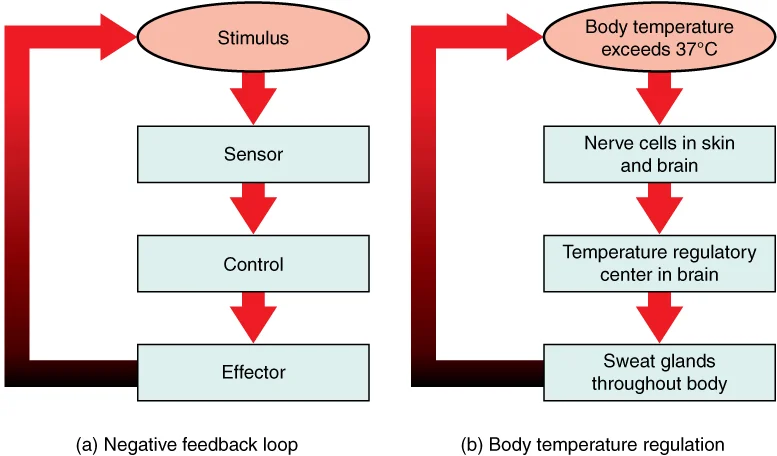
Long description
In a negative feedback system, a stimulus—a deviation from a set point—is resisted through a physiological process that returns the body to homeostasis. (a) A negative feedback system has five basic steps. (b) Body temperature is regulated by negative feedback.

Figure 1: In a negative feedback system, a stimulus—a deviation from a set point—is resisted through a physiological process that returns the body to homeostasis.
Disease can disturb homeostasis at any level of the loop. Loss of sensors, failure of the control center, loss of effectors or loss of negative feedback all produce sustained deviation. A useful clinical framework is: sensor failure, controller failure, effector failure, and set-point shift. Fever illustrates a set-point shift: pyrogens raise the hypothalamic set point, so the body actively generates heat to reach a new target, which is why the patient feels cold despite a raised core temperature.
Exam trapRaised value does not mean failed control
A variable far outside its normal range may reflect a reset set point with intact control, as in fever, rather than a broken feedback loop; distinguish the two before calling the control mechanism abnormal.
Homeostasis is not the same as constancy. Many variables show predictable oscillations superimposed on the defended mean, driven by biological clocks. Circadian rhythms, with a period of about 24 hours, govern cortisol, body temperature, sleep-wake behaviour and blood pressure; ultradian rhythms repeat several times a day, as with the pulsatile secretion of luteinising hormone; infradian rhythms run over longer cycles, including the menstrual cycle. These rhythms are endogenous — they persist without external cues — but they are entrained by zeitgebers, of which light is the dominant one. The suprachiasmatic nucleus of the hypothalamus is the master circadian pacemaker, receiving retinal light input and synchronising peripheral clocks throughout the body. [2]
DefinitionHomeostasis
Homeostasis is the maintenance of the body's internal environment within a narrow, healthy range, achieved chiefly through negative feedback.
Negative feedback is the fundamental mechanism: a parameter drifts from its set point, a sensor detects the drift, and the response acts to push the parameter back toward the set point[1]. This process runs continuously in every tissue, so understanding negative feedback is essential to understanding human physiology as a whole[1].
Clinical pearlSet point, not fixed value
Homeostasis does not mean a constant value. It means a defended range: the parameter oscillates around a set point, and the control system limits how far it can wander.
Copper illustrates the same principle at the level of a single cell. Intracellular copper content is regulated by a network of copper-dependent proteins — cuproenzymes, copper chaperones and membrane transporters — that coordinate copper import, export and intracellular use, keeping cellular copper within a specific range and preventing both overload and deficiency. [2]
NoteImport, distribution, export
The same three tasks appear in every homeostatic system: entry, distribution to where it is needed, and removal of the excess.
The high-affinity copper transporter CTR1 (also called SLC31A1) is structurally and functionally conserved from yeast to humans and is responsible for the majority of copper uptake into cells. Its expression is regulated in a copper-dependent manner: it is down-regulated under copper-overload conditions and up-regulated under copper-depleted conditions. This is a textbook negative-feedback loop — the signal (copper load) adjusts the abundance of the transport machinery that moves the signal. [2]
Inside the cytoplasm, copper is handed on by high-affinity chaperones. ATOX1 transfers copper to ATP7A and ATP7B in the trans-Golgi network and supports the synthesis of cuproenzymes such as lysyl oxidase, tyrosinase and ceruloplasmin. CCS delivers copper to superoxide dismutase 1 (SOD1), which detoxifies reactive oxygen species. Both CCS and SOD1 are found in the cytoplasm and the mitochondrial intermembrane space, where they deal with mitochondria-derived superoxides. [2]
Exam trapChaperone regulation is bidirectional
CCS expression rises when cellular copper falls and falls when copper is high; the excess CCS is degraded. Homeostatic control acts on protein abundance as well as on protein activity.
The copper-ATPases ATP7A and ATP7B are the major transporters exporting cellular copper. Under physiological copper levels they sit in the trans-Golgi network, pumping copper from the cytosol into its lumen. When intracellular copper rises, they translocate to vesicular compartments and fuse with the plasma membrane to export copper; when copper returns to physiological levels they are recycled back to the trans-Golgi network. [2]
This is the effector arm of the loop: the same proteins that load copper into the secretory pathway switch to a disposal role when the load rises, then return to their resting position once the disturbance is corrected.
DefinitionMenkes disease
Menkes disease is an X-linked recessive disorder caused by mutations in the ATP7A gene, so functional ATP7A is lost. [2]
Loss of ATP7A in the intestine reduces copper efflux into the blood, copper accumulates in enterocytes, and the result is generalised severe systemic copper deficiency. The disease is fatal, and affected children usually die in early childhood, with severe symptoms including mental retardation, hypothermia, neuronal degeneration, bone fractures, hair and skin abnormalities, and widespread vascular abnormalities. [2]
Clinical pearlAccumulation at one site, deficiency elsewhere
A transport defect can produce overload in the tissue that cannot export and deficiency in the tissues that need the nutrient. The laboratory picture depends on which compartment you sample.
| Component | Role |
|---|---|
| CTR1 (SLC31A1) | High-affinity uptake of copper into cells; expression falls when copper is high and rises when copper is low |
| ATOX1 | Chaperone delivering copper to ATP7A and ATP7B in the trans-Golgi network; supports cuproenzyme synthesis |
| CCS | Chaperone delivering copper to SOD1; abundance rises when copper is low |
| ATP7A / ATP7B | Export copper; translocate to the plasma membrane when intracellular copper rises, then recycle back |
The anatomy of the organs that handle copper — intestinal enterocytes, the liver and the blood–brain barrier — is covered on the anatomy page; this page deals with how those structures are controlled.
DefinitionWhat homeostasis means
Homeostasis is the maintenance of a physiological parameter within its normal range, rather than at a fixed point. A control system senses the departure, corrects it, and then switches itself off. [1]
No corrective system works until something moves the parameter out of its normal range; that disturbance is the stimulus. The stimulus is detected by a specific sensor, which in the control of blood glucose is an endocrine cell in the pancreas that detects excess glucose in the bloodstream. The sensor then acts through an effector that removes the excess. [1]
In the blood glucose example, pancreatic beta cells respond to the increased blood glucose by releasing insulin into the bloodstream, which signals skeletal muscle fibers, fat cells and liver cells to take up the excess glucose and remove it from the bloodstream. The system then has to be turned off, otherwise the parameter overshoots in the other direction. [1]
So each loop has four parts: a variable that is monitored, a sensor that reads it, a correcting effector, and a signal that is the opposite of the disturbance.
Positive feedback does not restore the original value; it drives the change further in the same direction, and it is useful only where a process must be completed quickly. After a penetrating wound, the most immediate threat is excessive blood loss, and less blood circulating means reduced blood pressure and reduced perfusion of the brain and other vital organs. Substances released in the injured vessel wall begin the process of blood clotting, and as each step of clotting occurs it stimulates the release of more clotting substances, accelerating the sealing of the damaged area. The same self-amplifying logic applies to the surge of oxytocin in labour and to the rapid depolarisation of a nerve axon. [1]
Clinical pearlWhy positive feedback is safe here
The clotting cascade is contained in a local area by the tightly controlled availability of clotting proteins, so the amplification does not run away through the whole circulation. [1]
The same principles operate at cell level. Copper entering the cytoplasm is either delivered by copper chaperones to specific proteins or chelated by metallothionein for storage; the principal chaperones are COX17, which delivers copper to cytochrome c oxygenase, CCS, which delivers copper to superoxide dismutase 1, and ATOX1, which delivers copper to ATP7A and ATP7B. Copper is also part of redox homeostasis, and the copper-ATPase ATP7B in hepatocytes pumps copper from the liver back into the blood, where it binds soluble chaperones for transport to other tissues. [2]
Exam trapHomeostasis is not the same as equality
Feedback loops keep a variable near a set point while the body's activities continue; they do not freeze it. Recognising which loop applies — correcting or amplifying — tells you whether the output will return to baseline or run to completion.
The body keeps its internal environment stable through three overlapping mechanisms. Neural control is fast and precisely targeted: sensory neurones report a disturbance to the central nervous system, and motor output corrects it within seconds. Hormonal control is slower to begin but longer lasting and more widely distributed, because a hormone released into the blood reaches many tissues at once. Local control acts within a single tissue, without nerves or hormones, through substances released by nearby cells that diffuse only a short distance. All three can act on the same variable; the regulation of blood flow to an exercising muscle, for instance, combines sympathetic nerve activity, circulating adrenaline and locally produced metabolites.
DefinitionHomeostasis
Homeostasis is the maintenance of a relatively constant internal environment despite changes in the outside world. It depends on control systems that detect a deviation and act to correct it.
Negative feedback is the dominant pattern. A negative feedback system has three basic components: a sensor, a control centre and an effector. The sensor, also called a receptor, monitors a physiological value and reports it to the control centre; the control centre compares the value with the normal range and, if it deviates too far from the set point, activates an effector, which causes a change that reverses the situation and returns the value to the normal range. Because the response opposes the original change, the loop self-limits. [1]
Positive feedback intensifies a change in the body’s physiological condition rather than reversing it. A deviation from the normal range therefore produces more change, and the system moves farther from the normal range. Such loops are normal only when there is a definite end point; childbirth and the body’s response to blood loss are two examples. In childbirth the events, once begun, must progress rapidly to a conclusion: uterine contractions push the fetus against the cervix, the cervix stretches, and the stretch drives further contraction until delivery ends the loop. [1]
Feedforward control anticipates a change before it happens, so that correction begins in advance rather than after the error has appeared. Seeing, smelling or chewing food triggers salivation and gastric secretion before any nutrient reaches the stomach; the rise in insulin after a meal begins before blood glucose has climbed far. Feedforward loops reduce the size of the disturbance but cannot abolish it, so they work alongside negative feedback. [1]
| Component | Role |
|---|---|
| Sensor (receptor) | Detects the value and reports it to the control centre |
| Control centre | Compares the value with the normal range and decides on a response |
| Effector | Produces the change that returns the value to the normal range |
| Afferent pathway | Carries information from sensor to control centre |
| Efferent pathway | Carries the command from control centre to effector |
Homeostasis is quantified by comparing the actual value of a variable with its defended set point:
Error = Set point - Actual value
A negative-feedback controller produces a response proportional to, and opposing, the error:
Response = -k × Error
where k is the gain (correction / disturbance). At steady state, input equals output. For body temperature:
Heat production - Heat loss = Change in body heat content
For the circulation:
Mean arterial pressure = Cardiac output × Total peripheral resistance
Cardiac output = Heart rate × Stroke volume
For blood glucose:
Rate of change of glucose = Rate of appearance - Rate of disappearance
DefinitionNegative feedback
A control loop in which the effector response opposes the deviation from the set point and drives the variable back toward its defended value.
Every controlled variable has a lower and an upper reference limit, and the value wanders between them. The shape of the response matters as much as the limits:
- Negative feedback: a deviation followed by a damped, exponential return toward the set point.
- Positive feedback: amplification away from the set point; this is not homeostatic.
- Baroreflex: a sigmoid curve with a threshold, a steep middle segment, and saturation at the top.
- Core temperature: a shallow sinusoidal diurnal rhythm.
- Blood glucose: small postprandial excursions followed by recovery.
| Variable | Manipulated by | Restoring response |
|---|---|---|
| Core temperature | Heat production: shivering, thyroid hormone, epinephrine-driven glycogenolysis | Skin vasoconstriction; diversion of limb blood into deep veins |
| Mean arterial pressure | Heart rate, stroke volume, total peripheral resistance | Baroreceptor reflex |
| Blood glucose | Insulin and glucagon | Cellular uptake and storage versus release |
Temperature. Cold activates the heat-gain centre: skin blood flow falls, blood from the limbs is diverted into deep veins so heat is trapped near the core, and if heat loss is severe the brain triggers shivering. Shivering releases heat while consuming ATP. Thyroid hormone increases metabolic activity and heat production in cells throughout the body, and epinephrine causes the breakdown of glycogen into glucose; glycogen breakdown also results in increased metabolism and heat production. Heat production is the manipulated variable that cancels the error. [1]
Illustrative worked example: heat loss of 100 arbitrary units, matched by a shivering response of 100 units, returns the error to zero (numbers for practice only).
Blood pressure. Baroreceptors report pressure to the brainstem, which adjusts heart rate and peripheral resistance:
Change in heart rate = -G × Change in mean arterial pressure
Illustrative worked example: a 10 mmHg rise in mean arterial pressure evokes a reflex fall in heart rate that opposes it (numbers for practice only).
Glucose. After a meal, appearance exceeds disappearance; insulin promotes uptake and storage while glucagon promotes release, restoring the set point.
Illustrative worked example: appearance of 60 units and disappearance of 60 units give a net change of zero (numbers for practice only).
Copper balance is maintained by matching duodenal absorption to biliary excretion, so no single measurement captures it. In practice the assessment combines a blood test, a timed urine collection and, when the result is still unclear, a liver biopsy. The pattern of results matters more than any one value, because caeruloplasmin is an acute-phase protein and pregnancy, inflammation and oestrogen-containing medicines all shift it.
Most circulating copper is carried by caeruloplasmin, a protein made in the liver. Serum copper and serum caeruloplasmin are usually reported together. In Wilson's disease, caeruloplasmin is characteristically low and the serum copper may be low even though total body copper is high; in acute copper overload the serum copper can rise. In deficiency, both tend to fall. Because caeruloplasmin rises with inflammation, a normal value does not exclude deficiency in a sick patient.
A timed urine collection measures the copper that has been absorbed and then excreted by the kidney. It is most useful when the blood tests are equivocal and in monitoring treatment. Biliary excretion is the major route of copper loss, so urinary copper is a secondary, indirect marker.
Hepatic copper concentration is the most direct measure of total body copper and remains the reference method when the diagnosis is uncertain. The biopsy also shows the histological damage.
Slit-lamp examination looks for Kayser–Fleischer rings, copper deposited in Descemet's membrane. Genetic testing identifies ATP7B mutations in Wilson's disease and ATP7A mutations in Menkes disease.
Reference intervals differ between laboratories and are affected by age, sex, pregnancy and inflammation, so results should be read against the local range and the clinical picture.
Illustrative example: a laboratory reports serum copper of 7 µmol/L with a local adult range of 12 to 25 µmol/L and caeruloplasmin of 0.10 g/L with a range of 0.20 to 0.60 g/L. The combination of a low caeruloplasmin and a low serum copper in a patient with liver disease would prompt a timed urine collection and slit-lamp examination. These values are illustrative only.
DefinitionCopper homeostasis
Copper homeostasis is the balance between duodenal absorption and biliary excretion, so that deficiency and accumulation are both avoided.
Exam trapCaeruloplasmin is an acute-phase protein
A normal caeruloplasmin does not exclude copper deficiency in a patient with infection, inflammation or pregnancy, because the protein rises independently of copper status.
| Investigation | What it reflects | Typical pattern in overload | Typical pattern in deficiency |
|---|---|---|---|
| Serum copper | Circulating copper | May be high | Low |
| Serum caeruloplasmin | Main copper carrier | Low in Wilson's disease | Low |
| Timed urinary copper | Renal excretion of absorbed copper | Raised | Low |
| Hepatic copper | Total body copper store | Raised | Low |
| Slit-lamp examination | Corneal copper deposition | Kayser–Fleischer rings | Normal |
| Genetic testing | ATP7B or ATP7A mutation | Detects mutation | Detects mutation |
Approach to suspected copper imbalance
- Take a historyDiet, supplements, family history, liver disease, neurological symptoms.
- Question: Are serum copper and caeruloplasmin abnormal?
Yes
- Measure timed urinary copperA raised value supports overload.
No
- Consider inflammation or pregnancyCaeruloplasmin may be raised for non-copper reasons.
- Confirm with liver biopsy or genetic testingUse when the diagnosis remains uncertain.
Homeostasis is never the work of one organ system acting alone. The nervous and endocrine systems provide the rapid and the sustained arms of control, the kidneys and lungs provide the effector organs for fluid, electrolyte and acid–base balance, and the skin and immune system contribute to temperature and defence. Understanding how these systems interact is more useful than memorising any single reflex in isolation.
DefinitionNegative feedback loop
A sensor detects a deviation from the set point, a control centre compares it with the reference, and an effector restores the value; the correction then feeds back to reduce the error.
Arterial baroreceptors in the carotid sinus and aortic arch fire in proportion to vessel wall stretch. Their afferents travel in the glossopharyngeal and vagus nerves to the medulla, which adjusts sympathetic and parasympathetic outflow to heart and resistance vessels. A fall in pressure produces tachycardia and vasoconstriction within seconds. Renin generates angiotensin, which constricts arterioles and drives aldosterone secretion from the adrenal cortex. A separate posterior pituitary hormone, antidiuretic hormone, inserts water channels into the collecting duct so that water follows the osmotic gradient, while thirst drives intake. Haemorrhage illustrates the integration: the baroreflex acts first, then the renin–angiotensin–aldosterone system, then antidiuretic hormone and thirst, each adding to the correction.
Core temperature is defended by the hypothalamus. Heat is lost through cutaneous vasodilation and sweating, and conserved through vasoconstriction and shivering. The immune system is therefore also a homeostatic system: inflammation changes vascular tone, temperature, and the concentration of many plasma proteins.
Children have a larger body surface area relative to mass and limited cardiovascular reserve, so they lose heat and fluid quickly. Older adults have a blunted baroreflex, a diminished thirst drive and a reduced ability to concentrate urine, so dehydration and postural hypotension are common. In pregnancy, plasma volume and aldosterone secretion rise to meet the demands of the uteroplacental circulation. In low-resource settings, oral rehydration solution and simple cooling measures are effective because they work with these same physiological mechanisms.
Homeostasis is the active maintenance of the internal milieu: a disturbance is sensed, compared with a set point, and corrected by effectors; the correction removes the stimulus, so the loop is self-limiting. Gain describes how completely the error is corrected. Feedforward (salivation before swallowing, insulin release before a glucose peak) anticipates change, while positive feedback (oxytocin in labour, platelet aggregation, the action potential upstroke, the vicious cycle of haemorrhage) amplifies it. Disease follows failure of a sensor, integrator or effector, or a load that exceeds the loop's capacity.
DefinitionHomeostasis
The maintenance of a stable internal environment within narrow physiological limits by negative feedback control involving sensors, integrating centres and effectors.
Insulin is the only hormone that lowers blood glucose; glucagon, catecholamines, cortisol and growth hormone raise it. Autoimmune beta-cell destruction causes absolute deficiency (type 1); insulin resistance with progressive beta-cell failure causes type 2. Without insulin, glucose exceeds the renal threshold and spills into urine, dragging water and electrolytes with it: polyuria, polydipsia, dehydration and weight loss. Unopposed lipolysis generates ketone bodies, producing a high-anion-gap metabolic acidosis with Kussmaul breathing and ketotic breath. Children often present with ketoacidosis and risk cerebral oedema; in pregnancy placental hormones antagonise insulin, and fetal hyperinsulinaemia causes macrosomia and neonatal hypoglycaemia; older adults more often develop hyperosmolar hyperglycaemic state, triggered by infection, with profound dehydration and altered consciousness.
Exam trapGlycosuria is a threshold phenomenon
Glucose appears in urine only when the filtered load exceeds tubular reabsorption, so glycosuria shows that the threshold has been crossed, not the exact blood glucose.
Hypothalamic osmoreceptors drive vasopressin release from the posterior pituitary, which acts on V2 receptors to insert aquaporin-2 channels in the collecting duct, and drive thirst. Excess vasopressin (small-cell lung cancer, pneumonia, SSRIs, carbamazepine, pain, nausea) retains water and dilutes sodium, giving euvolaemic hyponatraemia with inappropriately concentrated urine. Deficiency (cranial diabetes insipidus after head injury or pituitary surgery) or renal resistance (lithium, hypercalcaemia) causes polyuria, polydipsia and, when thirst is impaired, hypernatraemia. Older adults are especially vulnerable because thirst and renal concentrating ability are blunted.
Parathyroid hormone raises serum calcium and lowers phosphate, with calcitriol and calcitonin completing the loop. Hypercalcaemia comes from primary hyperparathyroidism, malignancy, granulomatous disease, vitamin D excess, thyrotoxicosis, immobilisation, thiazides and lithium, producing stones, bones, groans, thrones and psychiatric overtones. Children with deficiency develop rickets; calcium demand rises in pregnancy; osteomalacia and falls are common in older adults.
| Pattern | Typical causes | Compensation |
|---|---|---|
| High anion gap metabolic acidosis | Lactate, ketones, renal failure, toxic alcohols | Hyperventilation |
| Normal anion gap metabolic acidosis | Diarrhoea, renal tubular acidosis, saline | Hyperventilation |
| Metabolic alkalosis | Vomiting, diuretics, mineralocorticoid excess | Hypoventilation |
| Respiratory acidosis | Opioids, chronic obstructive pulmonary disease | Renal bicarbonate retention |
The hypothalamus defends a set point through shivering and non-shivering thermogenesis, vasoconstriction, vasodilatation and sweating. Pyrogens raise the set point via prostaglandin E2, producing fever. Heat stroke, malignant hyperthermia (volatile anaesthetics, suxamethonium), neuroleptic malignant syndrome and thyrotoxic storm are hyperthermia: a normal set point with failed heat loss, unresponsive to antipyretics.
Clinical pearlFever versus hyperthermia
Fever is a raised set point with intact thermoregulation; hyperthermia is heat gain or impaired heat loss exceeding capacity at a normal set point.
Baroreceptors in the carotid sinus and aortic arch adjust heart rate, contractility and vascular tone through the vasomotor centre, while renin-angiotensin-aldosterone activation and vasopressin retain salt and water.
Negative feedback in glucose control
- Blood glucose fallsSensed by the pancreatic beta cell
- Insulin falls and glucagon risesHepatic glycogenolysis and gluconeogenesis increase
- Glucose returns towards the set pointThe stimulus wanes, so the response is self-limiting
DefinitionCopper homeostasis
Copper homeostasis is the matched control of intestinal absorption, plasma transport, hepatic storage and biliary excretion that keeps an essential cofactor supplied while preventing free copper from accumulating.
Copper is a double-edged metal: it is an essential cofactor for many enzymes, yet in excess it drives oxidative stress and cell death. Homeostasis therefore exists to deliver copper to enzymes such as cytochrome c oxidase, superoxide dismutase and lysyl oxidase while keeping the free, unbound pool tiny. The body has no regulated excretory route other than bile, which is why hepatic excretion is the control point.
| Feature | Ferroptosis | Cuproptosis |
|---|---|---|
| Triggering metal | Iron | Copper |
| Defining lesion | Lipid peroxide accumulation in membranes | Lipoylation of mitochondrial enzymes |
| Key organelle | Mitochondria | Mitochondria |
Exam trapDo not merge the two pathways
Ferroptosis and cuproptosis are both metal-driven and both mitochondrial, but the trigger and the lethal lesion differ: iron gives lipid peroxidation, copper acts through lipoylated mitochondrial enzymes. [2]
DefinitionHomeostasis
Homeostasis is the defence of a stable internal environment: physiological variables are held within a narrow range around a set point, not pinned to a single unchanging value.
- "Homeostasis means everything stays constant." Variables oscillate within a defended range: a sensor detects a deviation, a control centre compares it with the set point, and an effector corrects it. The range, not a fixed number, is the goal.
- "Every feedback loop is negative." Positive feedback is normal and runs to a defined endpoint. In labour the first contractions push the baby toward the cervix, stretch-sensitive nerve cells monitor the stretching, and the brain makes the pituitary release oxytocin, which drives stronger contractions and still more stretching; the cycle stops only when the baby is born. [1]
- "The sensor, control centre and effector sit in one organ." In labour they are separate: the sensor is the stretch-sensitive nerve cells of the cervix, the control is the brain, and the effector is the smooth muscle of the uterus. [1]
- "Oxytocin is the sensor." Oxytocin is the messenger released by the pituitary; the sensor is the cervical stretch receptor and the effector is the uterine muscle.
- "Positive feedback is a failure of control." It is controlled and self-limiting: in labour, removal of the stimulus at birth switches the loop off.
- "Copper is only a poison." Copper is essential for enzymes of the electron transport chain and other proteins; the liver excretes the surplus through ATP7B. Wilson's disease is an autosomal recessive disorder caused by ATP7B mutations that impair excretion, so copper accumulates in brain, liver and other tissues. [2]
- "One normal hepatic copper result excludes Wilson's disease." In health, hepatic copper is generally below 55 μg/g dry weight; in Wilson's disease it can exceed 250 μg/g dry weight. Interpret the number alongside the clinical picture. [2]
- "Homeostasis is only about temperature and glucose." It governs trace elements too: copper balance is defended by matching excretion to need, and failure of that defence causes disease.
| Component | Structure | Role |
|---|---|---|
| Stimulus | First contractions of labour | Push the baby toward the cervix |
| Sensor | Stretch-sensitive nerve cells in the cervix | Monitor the degree of stretching |
| Control | Brain | Causes the pituitary to release oxytocin |
| Effector | Smooth muscle of the uterus | Contracts more forcefully, pushing the baby down the birth canal |
| Messenger | Oxytocin | Carries the signal from the pituitary to the uterus |
Negative and positive feedback compared
- A variable drifts from its set pointA sensor detects the deviation and signals the control centre.
- Question: Which pattern is operating?
Negative feedback
- Control centre activates the effectorThe effector opposes the original change.
- The variable settles back to the set pointThe response fades as the deviation is corrected.
Positive feedback
- Control centre reinforces the changeThe effector amplifies the original change.
- The response grows until a defined endpointIn labour, birth removes the stimulus and the loop stops.
Wilson's disease is the classic bedside lesson in copper homeostasis. Suspect it in a patient who presents with hepatic and/or neuropsychiatric symptoms: a young person with unexplained liver disease, or with tremor, dysarthria or a change in behaviour, should have copper status assessed. Hepatic copper measurement provides the threshold values: in healthy individuals it is generally below 55 μg/g dry weight, and in Wilson's disease it can exceed 250 μg/g dry weight. Because the disorder is autosomal recessive and results from mutations in the ATP7B gene, family screening and genetic testing form part of the work-up. Treatment then aims to keep copper within the defended range for life, with the clinical picture and copper measurements guiding therapy. [2]
Clinical pearlBedside pearl
Copper overload is systemic: the same ATP7B defect deposits copper in brain, liver and other tissues, so hepatic and neuropsychiatric features often coexist.
Surgery and anaesthesia repeatedly disturb homeostasis: heat loss, hyperglycaemia, fluid shifts, acid–base change and coagulation all move away from their set points. The anaesthetist acts as the control centre, reading sensors such as temperature probes, blood glucose and blood gas analysis, and deploying effectors such as forced-air warming, insulin, intravenous fluids and blood products to pull the variables back. The logic is the same feedback loop met in physiology, only run deliberately and continuously.
In neuropsychiatric Wilson's disease, magnetic resonance imaging of the brain shows characteristic change in the basal ganglia and supports the diagnosis when copper studies and genetics are equivocal. Hepatic imaging, usually ultrasound or computed tomography, assesses the liver, and cerebral imaging helps separate copper-related movement disorder from other causes.
Examiners test homeostasis through the labour loop and through copper balance. Expect questions asking you to name the sensor, control centre and effector in labour, to state why the cycle stops, and to distinguish negative from positive feedback. Expect interpretation of a hepatic copper result against the 55 and 250 μg/g dry weight thresholds, and recall of the autosomal recessive ATP7B defect.
Exam trapExamination trap
Do not label the labour loop as negative feedback, and do not call oxytocin the sensor: the loop is positive feedback, and the sensor is the stretch-sensitive nerve cell in the cervix.
- Homeostasis defends a range around a set point through negative feedback; values are not fixed.
- Positive feedback amplifies a change and ends at a defined endpoint; labour is the classic example.
- In labour the sensor is the stretch-sensitive nerve cells of the cervix, the control is the brain, and the effector is the uterine smooth muscle.
- The labour cycle stops when birth halts cervical stretching and oxytocin release stops.
- Copper is an essential trace element; ATP7B excretes the surplus, and its autosomal recessive failure causes Wilson's disease.
- Healthy hepatic copper is generally below 55 μg/g dry weight; in Wilson's disease it can exceed 250 μg/g dry weight.
- Wilson's disease presents with hepatic and/or neuropsychiatric symptoms.
- The same feedback logic underlies bedside monitoring on the ward, in theatre and in examinations.
Answer each one in your head first, then open the answer.
In the labour feedback loop, which structure is the sensor?
Show answerHide answer
Stretch-sensitive nerve cells in the cervix.Name the control centre and the effector in the labour loop.
Show answerHide answer
The brain, which triggers pituitary oxytocin release, is the control centre; the smooth muscle of the uterus is the effector.Why does the labour cycle stop?
Show answerHide answer
Birth removes the stimulus: cervical stretching halts, so oxytocin release stops.What hepatic copper values separate health from Wilson's disease?
Show answerHide answer
Generally below 55 μg/g dry weight in health; can exceed 250 μg/g dry weight in Wilson's disease.State the inheritance pattern and the gene defect in Wilson's disease.
Show answerHide answer
Autosomal recessive; mutations in ATP7B impairing copper excretion.
- Betts JG, Young KA, Wise JA, et al. Homeostasis. OpenStax, Anatomy and Physiology 2e (CC BY-NC-SA 4.0). Accessed .
- Chen L, Min J, Wang F. Copper homeostasis and cuproptosis in health and disease. Signal transduction and targeted therapy 2022;7(1):378. doi:10.1038/s41392-022-01229-y. Accessed .
Figure credits
Educational content for medical students and doctors. It is not a substitute for clinical judgement or local guidelines.