Diuretics
Classes of diuretics, their sites and mechanisms in the nephron, indications, dosing, adverse effects, resistance and how to choose.
- Diuretics are drugs that increase renal excretion of sodium and, with it, water. They are the cornerstone of treating volume overload and an important part of treating hypertension.
- Different classes act at different sites along the nephron: carbonic anhydrase inhibitors in the proximal tubule, loop diuretics in the thick ascending limb, thiazides in the distal convoluted tubule, and potassium-sparing diuretics and aldosterone antagonists in the collecting duct. Osmotic diuretics act in the proximal tubule and descending limb.
- The faster and more powerful the natriuresis required, the further "upstream" (proximally) the drug acts in practice the opposite holds: loops are most potent, thiazides moderate, and mannitol and acetazolamide alone are weaker.
- The most important adverse effects are electrolyte and acid-base disturbances. Loops waste potassium, magnesium and calcium; thiazides waste potassium but retain calcium; aldosterone antagonists and potassium-sparing drugs raise potassium; acetazolamide causes metabolic acidosis.
- In heart failure, loop diuretics are first-line for congestion in both US and European guidance, and thiazides are added as sequential nephron blockade when resistance develops. [2]
By the end of this page you should be able to:
- Name each diuretic class, its representative drugs and its site of action along the nephron.
- Explain how a loop, thiazide, potassium-sparing, aldosterone antagonist and carbonic anhydrase inhibitor produce natriuresis.
- Match a clinical situation (oedema, hypertension, ascites, hypercalcaemia, raised intracranial pressure, altitude sickness, glaucoma) to a sensible diuretic choice and dose.
- Recognise and explain the characteristic electrolyte and acid-base changes of each class.
- Explain diuretic resistance and the principle of sequential nephron blockade.
- State the effect of loop and thiazide diuretics on urinary calcium.
Diuretics are among the oldest and most widely used drugs in medicine. The modern era began with carbonic anhydrase inhibitors and thiazides in the 1950s, loop diuretics in the 1960s and potassium-sparing agents shortly afterwards. Every class works by blocking sodium reabsorption at a specific segment of the renal tubule; because water follows sodium osmotically, more sodium in the urine means more urine. The class, dose and route needed depend on how much salt and water must be removed, how quickly, and on the patient's kidney function. This page covers the drug class as a whole and is not a substitute for local formularies or guidelines.
The table lists the main classes, the drugs within each class, where each acts, what it blocks, and how potent it is.
| Class | Representative drugs | Site of action | Molecular target | Relative natriuretic potency |
|---|---|---|---|---|
| Osmotic diuretics | Mannitol | Proximal tubule and descending limb of the loop of Henle | Raises tubular fluid osmolarity; retains water in the tubule | Weak; water diuresis |
| Carbonic anhydrase inhibitors | Acetazolamide, methazolamide | Proximal convoluted tubule | Carbonic anhydrase (reduced proton availability for the Na+/H+ exchanger) | Weak alone |
| Loop diuretics | Furosemide, bumetanide, torsemide, ethacrynic acid | Thick ascending limb of the loop of Henle | Na+-K+-2Cl- co-transporter (NKCC2) | Potent; excretes 20 to 25% of filtered sodium [2] |
| Thiazide and thiazide-like diuretics | Hydrochlorothiazide, chlorthalidone, indapamide, metolazone, chlorothiazide | Distal convoluted tubule | Na+/Cl- co-transporter (NCC) | Moderate; excretes 3 to 5% of filtered sodium |
| Potassium-sparing diuretics | Amiloride, triamterene | Late distal tubule and collecting duct (principal cells) | Blockade of epithelial sodium channels (ENaC) | Weak |
| Aldosterone antagonists (mineralocorticoid receptor antagonists) | Spironolactone, eplerenone (and finerenone) | Collecting duct (and non-renal tissues) | Competitive blockade of the mineralocorticoid (aldosterone) receptor | Weak |
| Aquaretic (vasopressin) antagonists | Tolvaptan, conivaptan | Collecting duct | V2 vasopressin (aquaporin) receptor | Water diuresis only; not covered further here |
In practice the term "thiazide" is used loosely for hydrochlorothiazide, chlorthalidone and indapamide, even though their kinetics differ. Loop diuretics are the drugs of choice when rapid or large natriuresis is needed; thiazides suit mild volume overload and hypertension; potassium-sparing drugs and aldosterone antagonists are mainly add-ons or treatments of specific states. [1][2]
Figure 1Renal Diuretics
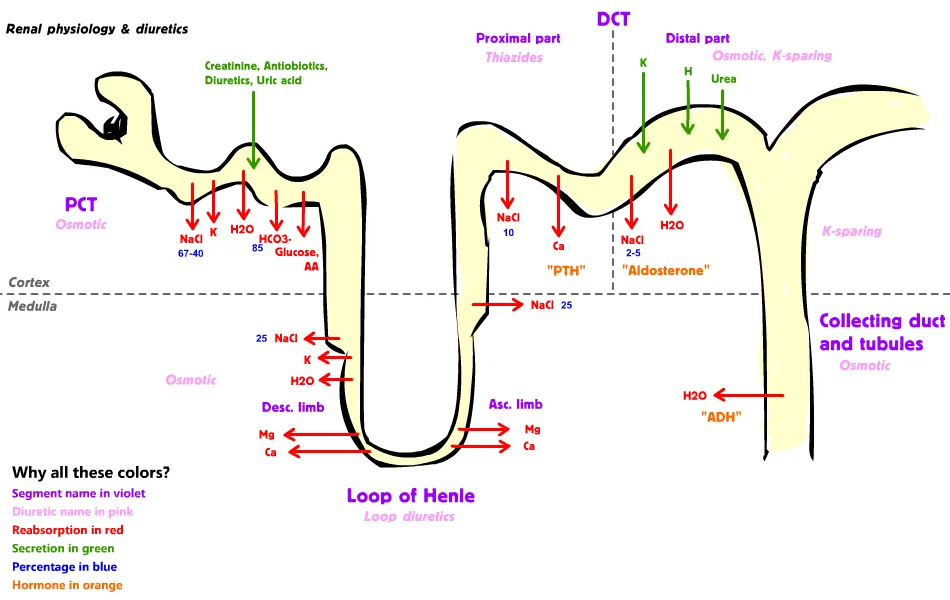
Long description
Wikimedia Commons image whose English summary states that it shows where each type of diuretic acts and what it does, in the renal physiology/nephron context.

All of the clinically important diuretics that dehydrate the extracellular fluid share one trick: they reduce sodium reabsorption. Because water follows by osmosis, blocking sodium reabsorption increases both sodium and water in the urine. Differences between classes are explained by which transporter each drug blocks and how much of the filtered sodium that segment normally reabsorbs.
Loop diuretics block NKCC2 in the thick ascending limb, where roughly a quarter of filtered sodium is normally reabsorbed. This segment is also water-impermeable, so blocking it produces a large volume of dilute urine. The same co-transporter exists in the stria vascularis of the inner ear, which is the basis of loop ototoxicity. Loop diuretics also remove the positive luminal potential that drives paracellular reabsorption of calcium and magnesium in this segment. [3]
Thiazides block the sodium-chloride co-transporter (NCC) in the early distal tubule, where only 3 to 5% of filtered sodium is reabsorbed. Their natriuresis is milder, but an additional fall in vascular resistance adds an antihypertensive effect that outlasts the diuresis. Thiazides also reduce urinary calcium, because blocking sodium reabsorption here lowers intracellular sodium and strengthens the basolateral sodium-calcium exchanger. [1][2]
Carbonic anhydrase inhibitors block carbonic anhydrase in the proximal tubule. Proximal sodium reabsorption here depends on the Na+/H+ exchanger, which needs hydrogen ions generated from carbonic acid. Blockade reduces bicarbonate and sodium reabsorption, alkalinises the urine and produces a mild diuresis. Most of the escaped sodium is reabsorbed downstream, so the effect alone is modest, but these drugs correct metabolic alkalosis and are useful adjuvants. [1][2]
Potassium-sparing diuretics (amiloride, triamterene) block ENaC in the principal cells of the late distal tubule and collecting duct. Sodium reabsorption here is coupled to potassium and hydrogen secretion, so blocking it wastes little sodium but spares potassium. Their natriuretic effect is weak on its own.
Aldosterone antagonists (spironolactone, eplerenone) occupy the mineralocorticoid receptor in the collecting duct. Aldosterone normally drives transcription of ENaC and the basolateral Na+/K+-ATPase, so blocking it reduces sodium retention and potassium excretion, lowers blood pressure in primary aldosteronism and resistant hypertension, and has anti-fibrotic and anti-inflammatory effects in the heart, which is why spironolactone improves outcomes in heart failure with reduced ejection fraction. [1][2]
Osmotic diuretics (mannitol) are filtered but not reabsorbed; they raise tubular fluid osmolarity and hold water in the tubule. They do not block a transporter, and they can initially draw water into the vascular space, which is why they are not used in heart failure. [2]
The loop diuretics differ in ways that matter at the bedside. Furosemide has highly variable oral bioavailability, 10 to 100%, and it falls further in oedematous states such as heart failure or cirrhosis. Bumetanide and torsemide are more reliably absorbed (80 to 100%), torsemide has a longer half-life, and bumetanide is 20 to 40 times more potent than furosemide by weight. Ethacrynic acid is fully absorbed and is the only non-sulphonamide loop diuretic. [2][3]
Diuretics are used in three broad situations: rapid removal of excess salt and water, control of chronic volume overload and oedema, and blood pressure lowering.
Oedema and heart failure. Loop diuretics are first-line for congestion in heart failure in both US (ACC, AHA and HFSA, 2022) and European (ESC, 2021) guidance, with individualised dosing by volume status and renal function. They improve breathlessness and exercise tolerance by reducing preload, although they do not reduce mortality on their own. Thiazides can be used alone for mild congestion. A target weight between clinic visits helps outpatient diuretic adjustment. [2]
Hypertension. Thiazide and thiazide-like diuretics are widely used in hypertension and have reduced cardiovascular events in randomised trials. Their blood-pressure-lowering effect comes from both volume reduction and a sustained fall in vascular resistance. Chlorthalidone has the longest half-life and the strongest effect; hydrochlorothiazide is the most widely prescribed. When an aldosterone-driven mechanism is present, such as primary aldosteronism or resistant hypertension, spironolactone is added. [1][2]
Ascites (cirrhosis). Spironolactone is the drug of choice because sodium retention in cirrhosis is aldosterone-mediated. Start with spironolactone alone (100 mg daily, increasing stepwise to 400 mg). For recurrent or severe ascites, or when faster diuresis is needed, combine with furosemide from the outset (100 mg spironolactone plus 40 mg furosemide daily, increasing in parallel to a maximum of 400 mg and 160 mg respectively). Daily weight loss should not exceed about 0.5 kg without peripheral oedema or about 1.0 kg with oedema. [9]
Hypercalcaemia. The first treatment is restoration of extracellular volume with intravenous 0.9% saline, about 4 to 6 litres in 24 hours in severe cases. Current endocrine guidance is that loop diuretics are rarely needed for this indication and are not effective at lowering serum calcium on their own; they are reserved for patients who develop fluid overload, especially with renal impairment or cardiac disease. Bisphosphonates such as zoledronic acid treat the underlying bone resorption. [7]
Raised intracranial or intraocular pressure. Mannitol is used to reduce intracranial pressure in cerebral oedema or neurosurgical crises. A commonly used concentration is 20% given intravenously. Doses of 0.25 to 1.0 g per kg are typical in routine practice, while 0.5 to 1.5 g per kg is recommended in modern reviews, with temporarily higher doses (at least 1.5 g per kg) reserved for an intracranial pressure crisis. Avoid very high doses, which risk nephrotoxicity, and watch serum osmolality. Mannitol can first expand intravascular volume, so it must be used with care in patients with heart failure. [6] [4]
Altitude sickness. Acetazolamide is the standard chemoprophylaxis for acute mountain sickness: 125 mg by mouth twice daily, starting one day before ascent and continuing for two days at the highest sleeping altitude. Patients with sulphonamide allergy should take a test dose before travel. Dexamethasone is an alternative; combinations can be used for rapid or very high ascent. [5]
Glaucoma. Oral acetazolamide (250 mg four times daily, or 500 mg sustained-release every 12 hours) lowers intraocular pressure by reducing aqueous humour production. It is useful in acute angle-closure and as a bridge, but is not a chronic treatment because of systemic side effects. Topical carbonic anhydrase inhibitors are preferred long term. [8]
Other uses. Acetazolamide speeds diuresis in acutely decompensated heart failure when added to loop diuretics (500 mg intravenously once daily in a randomised trial), corrects metabolic alkalosis, and is used for intracranial hypertension. Thiazides are used in nephrogenic diabetes insipidus and for calcium stone prevention. Spironolactone is used for primary hyperaldosteronism, hirsutism and acne in women. Loop diuretics are used for forced diuresis in some poisonings. [1][2]
Doses are typical adult starting ranges from current reviews and guidelines; titrate to response and always check the local formulary, weight, renal function and electrolytes. [1][2][3]
- Mannitol: 20% solution intravenously; 0.25 to 1.0 g per kg in routine use, 0.5 to 1.5 g per kg recommended in modern reviews, with doses of at least 1.5 g per kg reserved for an intracranial pressure crisis. [6]
- Acetazolamide: glaucoma 250 mg four times daily orally, or 500 mg sustained release 12-hourly; altitude sickness 125 mg by mouth twice daily from one day before ascent for two days at the top; decompensated heart failure 500 mg intravenously once daily when added to loop diuretics. [1][5][8]
- Furosemide: heart failure 20 mg by mouth once or twice daily to start, escalating to 80 mg two to three times daily as near-maximal oral dose; switch to torsemide or bumetanide if absorption or response is poor (oral torsemide at about 50% of the furosemide dose; bumetanide at about 1 mg per 20 mg of furosemide). Intravenous bolus 10 to 20 mg initially, up to 80 to 600 mg daily by infusion in critical care. [2][3]
- Thiazides: hydrochlorothiazide 12.5 to 25 mg once daily in hypertension (from a meta-analysis of blood pressure trials); chlorthalidone 12.5 to 25 mg, titrated up to 50 mg in resistant hypertension or stage 4 chronic kidney disease; chlorothiazide is available intravenously for rapid effect. [1][4]
- Potassium-sparing drugs: amiloride and triamterene are used in small doses and almost always combined with a loop or thiazide rather than used alone. Check the local formulary.
- Aldosterone antagonists: spironolactone 100 to 400 mg daily in cirrhotic ascites (see above); lower doses are used for heart failure and hypertension. Eplerenone is used similarly and is preferred when gynaecomastia is a concern. Final dose and titration should follow local cardiology and nephrology guidance.
Adverse effects are shared to a degree by all classes: excessive diuresis dehydrates; electrolyte shifts cause symptoms. The table summarises the class-specific problems and their mechanisms.
| Class | Common or important adverse effects | Why it happens |
|---|---|---|
| Loop diuretics | Hypokalaemia, hyponatraemia, hypomagnesaemia, hypocalcaemia; dehydration, raised uric acid (gout), reversible ototoxicity, allergic interstitial nephritis with sulfa-containing drugs; hyperglycaemia less common | Block NKCC2; loss of the positive luminal potential that drives calcium and magnesium reabsorption; massive distal sodium and water delivery; high peak plasma levels damage the stria vascularis of the inner ear |
| Thiazides | Hyponatraemia (often profound in older women), hypokalaemia, hypomagnesaemia; hypercalcaemia, hyperuricaemia and gout, hyperglycaemia, dyslipidaemia, sexual dysfunction, photosensitivity | Block NCC in the distal tubule; renal sodium and water loss; metabolic effects most marked with higher doses of hydrochlorothiazide |
| Carbonic anhydrase inhibitors | Metabolic acidosis, paraesthesiae, drowsiness, kidney stones, nausea, tinnitus, taste disturbance | Bicarbonate wasting in the proximal tubule; urinary alkalinisation reduces citrate and favours calcium phosphate stones |
| Potassium-sparing diuretics | Hyperkalaemia, metabolic acidosis (especially amiloride), renal impairment if renal function is already poor | ENaC blockade reduces potassium and hydrogen secretion |
| Aldosterone antagonists | Hyperkalaemia, hyponatraemia, menstrual irregularities, decreased libido; spironolactone is anti-androgenic and can cause gynaecomastia (about 10% at 25 mg daily and up to 52% at 150 mg daily), breast tenderness and impotence; usually reversible on stopping | Competitive receptor blockade; spironolactone metabolites have weak activity at androgen and progesterone receptors [10] |
| Osmotic diuretics (mannitol) | Initial volume expansion, hyponatraemia followed by hypernatraemia if water is not replaced, pulmonary oedema, thirst, headache; nephrotoxicity at high doses | Osmotic retention of water; volume expansion; direct tubular toxicity at very high plasma levels |
| All classes combined | Excessive diuresis, postural hypotension, prerenal uraemia, acute kidney injury; arrhythmias from potassium shifts | Loss of extracellular fluid leading to underfilling |
Gout is a particular trap: loop and thiazide diuretics reduce renal urate excretion and can precipitate gouty arthritis, so use them with care in people with gout. Sulphonamide allergy matters because furosemide, bumetanide, thiazides and acetazolamide all contain a sulphonamide group; ethacrynic acid is the choice when a non-sulphonamide loop diuretic is needed. [3][4][10]
Ototoxicity is described in detail with loop diuretics: hearing loss tends to occur 10 to 20 minutes after rapid intravenous administration, is usually reversible within 1 to 24 hours, and is more likely with very high doses (more than 1 g, or infusion rates above 250 mg per hour), with estimated glomerular filtration rate under 20 ml per min per 1.73 m2, and when the drug is given alongside other ototoxins such as gentamicin or cisplatin. Ethacrynic acid has greater ototoxicity risk than other loops. [3]
Hyperglycaemia and new-onset diabetes have been linked most strongly to hydrochlorothiazide at higher doses, although the size of the effect is debated and lower doses appear relatively safe. Loop diuretics have less consistent metabolic effects. [4]
- Anuria and severe dehydration: diuretics will not help and may worsen; treat the underlying cause.
- Severe hyponatraemia and hypokalaemia: correct deficits carefully first; rapid correction risks neurological injury (sodium) and arrhythmia (potassium).
- Sulphonamide allergy: avoid sulpha-containing diuretics; use ethacrynic acid as the loop agent and seek alternatives for other classes.
- Pregnancy: see below.
- Severe aortic stenosis or hypertrophic cardiomyopathy with outflow obstruction: over-diuresis reduces filling and can cause syncope.
- Gout: avoid or use with great caution; monitor urate.
- Liver disease: use spironolactone-based regimens; furosemide alone is less effective.
- Chronic kidney disease with glomerular filtration rate under 30 ml per min per 1.73 m2: loop diuretics first line; thiazides as sole agents are unlikely to work, although chlorthalidone may still lower blood pressure. [2]
The important interactions are:
- NSAIDs blunt the natriuretic action of loop diuretics by blocking prostaglandin-mediated renal vasodilation and can precipitate acute kidney injury, especially with dehydration.
- ACE inhibitors and angiotensin receptor blockers combined with potassium-sparing drugs or aldosterone antagonists carry a real risk of hyperkalaemia, particularly in chronic kidney disease and diabetes; monitor potassium closely.
- Digoxin and severe hypokalaemia (often from loops or thiazides) together increase arrhythmia risk.
- Aminoglycosides and cisplatin potentiate loop ototoxicity.
- Lithium levels rise with thiazides and loops (reduced clearance) and can cause toxicity.
- Other protein-bound drugs (such as warfarin and highly protein-bound antibiotics) may be displaced in extreme hypoalbuminaemia, but this is uncommon.
Every patient on a diuretic needs periodic checks of volume status, kidney function and electrolytes. In hospital this means daily weights, strict fluid balance and urine volumes, plus creatinine, sodium, potassium, magnesium, bicarbonate and uric acid. Outpatients need weight, blood pressure and a basic electrolyte panel after starting or escalating doses, then periodically. In heart failure, guidelines recommend a target weight to guide outpatient adjustment and avoidance of both under- and over-diuresis. Aldosterone antagonists need potassium and creatinine checks after starting and after each dose change. [2]
Diuretic toxicity is usually the toxicity of excessive diuresis: severe hypovolaemia, orthostatic hypotension and prerenal uraemia. Electrolyte complications (hyponatraemia, hypokalaemia or hyperkalaemia with potassium-sparing drugs) dominate. Loop-specific toxicity includes deafness and tinnitus at very high doses or rapid intravenous rates, which is usually reversible if the infusion is stopped promptly, and interstitial nephritis. Thiazide overdose can cause severe hyponatraemia. Mannitol overdose causes hypertonic hyponatraemia and acute kidney injury; treatment is supportive, with haemodialysis effective for mannitol itself. Antidotes are not used; management is to stop the drug, rehydrate and correct electrolytes carefully. [3][6]
Diuretics in pregnancy are generally reserved for severe volume overload, such as pulmonary oedema in pre-eclampsia or heart failure, and are not first-line for pregnancy hypertension (where labetalol, nifedipine and methyldopa are preferred). Loop diuretics cross the placenta but are used when clearly needed. Spironolactone's anti-androgen activity makes it generally avoided in pregnancy; eplerenone has less anti-androgenic activity and may be safer when an aldosterone antagonist is truly needed. Amiloride has been used for primary aldosteronism in pregnancy. Thiazides can reduce placental perfusion and are usually avoided. Most diuretics enter breast milk in small amounts and are considered compatible with breastfeeding at low doses, but individual decisions need obstetric or renal advice.
The two clinically important classes have opposite effects on urinary calcium:
- Loop diuretics increase urinary calcium excretion (hypercalciuria) by removing the positive luminal potential that drives paracellular calcium (and magnesium) reabsorption in the thick ascending limb. Sustained or high-dose use can lower serum calcium and may contribute to bone loss and kidney stone risk. [3]
- Thiazides reduce urinary calcium (hypocalciuria) by stimulating calcium reabsorption in the distal tubule. This is why thiazides are useful for preventing calcium kidney stones and are associated with reduced risk of osteoporosis and fracture in observational studies. [1][2]
Aldosterone antagonists and potassium-sparing drugs have no important direct effect on calcium, and mannitol produces an osmotic diuresis without altering calcium handling meaningfully.
Diuretic resistance is the failure of oedema to resolve despite high-dose diuretic therapy. It is common in advanced heart failure and chronic kidney disease and carries a worse prognosis.
Mechanisms include altered pharmacokinetics (reduced tubular secretion of loops in kidney failure, competing organic anions, hypoalbuminaemia letting drug bind tubular protein), salt loading ahead of the shortened effect of short-acting loops (16 to 21 hours of no diuretic effect with furosemide), and the pharmacodynamic braking phenomenon, in which chronic loop use remodels the distal nephron (hypertrophy and hyperplasia of distal tubular cells), increasing reabsorption there and counteracting the loop effect. Non-steroidal anti-inflammatory drugs worsen resistance by blocking prostaglandin-mediated renal vasodilation and loop secretion. [2][3]
Strategies to overcome resistance:
- Optimise delivery of the same drug: use the intravenous route when gut absorption is impaired; double the dose because the dose-response curve is steep; switch from furosemide to torsemide or bumetanide, which are better absorbed; give doses early and consider divided or continuous infusion in critical illness. [2][3]
- Sequential nephron blockade: add a second drug that blocks a different segment. The common combination is a loop plus a thiazide (metolazone is the preferred add-on when a loop is the backbone); a loop plus acetazolamide is useful when metabolic alkalosis is present. Combining drug classes is more effective than dose escalation of one class. [2][3]
- Remove inhibitors and correct physiology: stop NSAIDs, correct hypoalbuminaemia or nephrotic syndrome, and treat intercurrent renal (cardiorenal) dysfunction. Albumin given before furosemide may help in hypoalbuminaemic patients, particularly with nephrotic syndrome, though benefit is not consistent when high loop doses are used. [3]
- Assess adherence and dietary salt (often the commonest cause of apparent resistance), then refer for ultrafiltration when diuretics fail.
Choosing a diuretic in common scenarios (adults)
- What is the clinical problem?
- Question: Is there pulmonary oedema or an intracranial pressure crisis?
Yes
- Loop diuretic intravenously (furosemide, or torsemide/bumetanide if refractory)Add vasodilator and oxygen as indicated; mannitol 0.5 to 1.5 g/kg IV for raised intracranial pressure
- Reassess volume and oxygenationMonitor electrolytes and kidney function; avoid excessive diuresis
No
- Question: Is it hypertension without significant fluid overload?
Yes
- Thiazide or thiazide-like diureticHydrochlorothiazide 12.5 to 25 mg, or chlorthalidone 12.5 to 25 mg daily; add spironolactone in primary aldosteronism or resistant hypertension
No
- Question: Is it cirrhotic ascites?
Yes
- Spironolactone 100 mg daily, stepwise to 400 mgAdd furosemide 40 mg daily, stepwise to 160 mg, if response is inadequate; keep the dose ratio about 100:40
No
- Question: Is diuretic resistance present despite an adequate loop dose?
Yes
- Sequential nephron blockadeLoop plus thiazide or metolazone; loop plus acetazolamide if alkalosis; stop NSAIDs; check salt intake
No
- Loop diuretic by mouth, individualised doseFurosemide 20 mg once or twice daily to 80 mg two to three times daily; IV or alternative loop if absorption poor
- Monitor weight, blood pressure, creatinine, electrolytesAdjust dose to a target weight; avoid over-diuresis
Older adults. Hyponatraemia from thiazides is most common and most dangerous in older women. Doses at the bottom of the range, with a basic electrolyte check after each change, are safer.
Children. Diuretics are used at weight-based doses not detailed here; spironolactone and furosemide are the main agents. Mannitol and acetazolamide are used in paediatric emergencies with specialist input.
Heart failure with reduced ejection fraction. Loop diuretics relieve congestion, while spironolactone (low dose) and SGLT2 inhibitors are disease-modifying. Up-titrate both arms together, monitoring potassium and renal function.
Renal failure. Loop diuretics are the usable class at low glomerular filtration rate; metolazone can be added. Thiazides as sole agents are unlikely to work below a glomerular filtration rate of about 30 ml per min per 1.73 m2, although chlorthalidone may still lower blood pressure.
- One reliable drug goes a long way: oral furosemide is widely available and cheap; start with 20 to 40 mg in the morning, reassess by symptoms and daily weight before increasing. If there is no response at a reasonable dose, give the next dose earlier in the day rather than just pushing the amount.
- Weigh to titrate. A simple bathroom scale, daily weights and a written target weight allow safe outpatient adjustment where laboratory tests are scarce.
- Protect potassium. Green leafy foods and bananas help where supplements are unavailable; thiazides and loops deplete potassium, so add spironolactone where available for patients who need prolonged diuresis (ascites, heart failure).
- Avoid NSAIDs in anyone on diuretics; they are a common, preventable cause of treatment failure and kidney injury.
- Estimate, rather than measure, electrolytes when testing is unavailable: weakness, constipation and palpitations after a week on a loop or thiazide suggest hypokalaemia; hold the diuretic and recheck when possible.
- Mannitol for raised intracranial pressure is only useful if intravenous access and a way to monitor osmolality exist; give as a slow bolus and ensure hydration.
- Acetazolamide for altitude (125 mg twice daily) may be unavailable locally; dexamethasone or descent remain the alternatives, and it should not be given to people with known sulphonamide allergy without a supervised test dose.
- Gout and stones: advise hydration, limit purine-rich foods where gout is a risk, and remember that thiazides protect against calcium stones while loops may promote them.
- Diuretics increase sodium and water excretion by blocking sodium transporters at specific nephron segments.
- Loop diuretics (furosemide, bumetanide, torsemide, ethacrynic acid) block NKCC2 in the thick ascending limb and are the most potent class; they waste potassium, magnesium and calcium.
- Thiazides block the sodium-chloride co-transporter in the distal convoluted tubule; they are first-line for hypertension, waste potassium but retain calcium.
- Carbonic anhydrase inhibitors (acetazolamide) block proximal tubular carbonic anhydrase; they are weak alone but useful for metabolic alkalosis, altitude sickness, glaucoma and raised pressure, and they cause metabolic acidosis.
- Potassium-sparing diuretics (amiloride, triamterene) block ENaC; aldosterone antagonists (spironolactone, eplerenone) block the mineralocorticoid receptor; both raise potassium.
- Mannitol is an osmotic diuretic used for raised intracranial or intraocular pressure; 0.5 to 1.5 g per kg intravenously is recommended, with higher doses only for a crisis.
- First-line for congestion in heart failure is a loop diuretic; thiazides are added as sequential nephron blockade for resistance.
- Ascites is treated first with spironolactone, up to 400 mg daily, plus furosemide up to 160 mg daily, targeting weight loss of 0.5 kg daily (1 kg if oedematous).
- Severe hypercalcaemia is treated first with intravenous saline 4 to 6 litres in 24 hours; loop diuretics are reserved for fluid overload and do not themselves lower serum calcium.
- Gynaecomastia from spironolactone is dose- and duration-dependent, up to 52% at 150 mg daily but about 10% at 25 mg daily.
- Loop diuretics increase urinary calcium; thiazides reduce it.
- Avoid NSAIDs with diuretics: they blunt efficacy and cause kidney injury.
Answer each one in your head first, then open the answer.
Where does furosemide act and what transporter does it block?
Show answerHide answer
Furosemide acts in the thick ascending limb of the loop of Henle, blocking the Na-K-2Cl co-transporter (NKCC2). This is the nephron segment that normally reabsorbs about 20 to 25% of filtered sodium, which is why loop diuretics are the most potent class.
Why do thiazide diuretics lower urinary calcium while loop diuretics raise it?
Show answerHide answer
Thiazides block NaCl reabsorption in the distal tubule, lowering intracellular sodium and strengthening the basolateral sodium-calcium exchanger, so more calcium is reabsorbed and less is excreted. Loop diuretics remove the positive luminal potential in the thick ascending limb that drives paracellular calcium reabsorption, so more calcium is lost in the urine.
A patient with cirrhotic ascites has not responded to 100 mg of spironolactone. How should the regimen be adjusted?
Show answerHide answer
Add furosemide 40 mg daily while increasing spironolactone stepwise toward 400 mg and furosemide toward 160 mg daily, keeping the dose ratio about 100:40. Target weight loss of about 0.5 kg daily (1 kg if oedematous) and monitor electrolytes.
What is diuretic resistance and what is the principle behind sequential nephron blockade?
Show answerHide answer
Diuretic resistance is failure of oedema to resolve despite high-dose diuretic therapy, partly from chronic loop-induced remodelling of the distal nephron that increases reabsorption there. Sequential nephron blockade adds a drug acting on a different segment (for example a thiazide or metolazone to a loop, or acetazolamide when metabolic alkalosis is present), which is more effective than simply doubling the dose of one drug.
A climber asks for prophylaxis against acute mountain sickness. What is the acetazolamide regimen?
Show answerHide answer
Acetazolamide 125 mg by mouth twice daily, starting one day before ascent and continuing for two days at the highest sleeping altitude. Avoid or use with a supervised test dose in people with sulphonamide allergy.
Which loop diuretic contains no sulphonamide and when is it preferred?
Show answerHide answer
Ethacrynic acid is the non-sulphonamide loop diuretic. It is reserved for patients who are suspected to be allergic to sulphonamide, because furosemide, bumetanide, thiazides and acetazolamide all contain a sulphonamide group.
A patient on spironolactone develops breast tenderness. How likely is gynaecomastia and is it reversible?
Show answerHide answer
Gynaecomastia is dose- and duration-dependent: about 10% at 25 mg daily, up to 52% at 150 mg daily. It is usually reversible after the drug is stopped, and eplerenone can be substituted if an aldosterone antagonist is still needed.
How should severe hypercalcaemia be treated first?
Show answerHide answer
Restore extracellular volume with intravenous 0.9% saline, about 4 to 6 litres in 24 hours (with care in renal impairment or heart failure), then bisphosphonates. Loop diuretics are reserved for fluid overload and are not effective at lowering serum calcium on their own.
Related topics (plain text, to be linked once the discipline is complete): acute kidney injury; hypokalaemia; hyperkalaemia; hypocalcaemia; hypercalcaemia; hyponatraemia; acid-base disorders; heart failure; hypertension; primary aldosteronism (Conn syndrome); Bartter and Gitelman syndromes; cirrhosis and ascites; raised intracranial pressure; glaucoma; gout; chronic kidney disease.
- Fuchs FD, et al. Optimizing Nephron Performance: The Old, the New, and the New-Old Diuretic Therapies. Biomedicines 2025;13(6):1413.. Accessed .
- Nassar G, Jameson R. Diuretic Use in Heart Failure. Rev Cardiovasc Med 2025;26(10):39547.. Accessed .
- Ferrari F, et al. Clinical Pharmacology of Loop Diuretics in Critical Care. Clin Pharmacokinet 2025;64(7):987-997.. Accessed .
- Di Fulvio M, et al. Diuretics: a review of the pharmacology and effects on glucose homeostasis. Front Pharmacol 2025;16:1513125.. Accessed .
- Flaherty GT, Kennedy KM. Preparing patients for travel to high altitude: advice on travel health and chemoprophylaxis. Br J Gen Pract 2016;66(642):e62-4.. Accessed .
- Kim JH, et al. Optimizing Mannitol Use in Managing Increased Intracranial Pressure: A Comprehensive Review of Recent Research and Clinical Experiences. Korean J Neurotrauma 2023;19(2):162-176.. Accessed .
- Walsh J, et al. SOCIETY FOR ENDOCRINOLOGY ENDOCRINE EMERGENCY GUIDANCE: Emergency management of acute hypercalcaemia in adult patients. Endocr Connect 2016;5(5):G9-G11.. Accessed .
- Tsikas D. Acetazolamide and human carbonic anhydrases: retrospect, review and discussion of an intimate relationship. J Enzyme Inhib Med Chem 2024;39(1):2291336.. Accessed .
- Aithal GP, et al. Guidelines on the management of ascites in cirrhosis. Gut 2021;70(1):9-29.. Accessed .
- Haynes BA, Mookadam F. Male gynecomastia. Mayo Clin Proc 2009;84(8):672.. Accessed .
Figure credits
Educational content for medical students and doctors. It is not a substitute for clinical judgement or local guidelines.