Rheumatoid arthritis
Chronic autoimmune synovitis of small joints: pathophysiology, diagnosis, DMARD and biologic treatment, and prognosis.
- Rheumatoid arthritis (RA) is a chronic systemic autoimmune disease in which the synovial membrane of peripheral joints becomes inflamed, producing a symmetric polyarthritis that starts in the small joints of the hands and feet and can destroy cartilage and bone if untreated.
- The laboratory signature is antibodies to citrullinated proteins (anti-CCP, also called ACPA) and rheumatoid factor (RF); roughly four out of five patients are seropositive. About 0.2 to 1% of adults are affected, women roughly 2 to 3 times more often than men. [1][2]
- Diagnosis is clinical and laboratory: a patient with synovitis in at least one joint, no better explanation, and a 2010 ACR/EULAR score of 6 or more out of 10 is classified as definite RA.
- Treatment follows a treat-to-target strategy: methotrexate is first-line, escalated to about 25 mg weekly with folic acid; biologics or JAK inhibitors are added when the target (remission or low disease activity) is not met.
- Active RA also injures the lungs, heart and vessels, and overall survival is shortened, so management includes infection screening before biologics, cardiovascular risk reduction and regular monitoring.
By the end of this page you should be able to:
- Define RA and distinguish seropositive from seronegative disease.
- Explain the pathophysiology from autoimmunity through pannus to erosions.
- Recognise the symmetric small-joint pattern and the main extra-articular features.
- Apply the 2010 ACR/EULAR classification criteria and interpret DAS28.
- Plan initial, second-line and targeted therapy, including prerequisite screening, using ACR 2021, EULAR 2022 and NICE NG100.
- List the key complications and indicators of poor prognosis.
DefinitionRheumatoid arthritis
RA is a chronic systemic autoimmune disease characterised by persistent inflammatory synovitis, pannus formation and erosion of cartilage and bone. It typically presents as a symmetric polyarthritis of the peripheral joints, most often beginning in the small joints of the hands and feet.
Two clinically important forms are distinguished by serology. Seropositive RA, the more common form, is defined by the presence of rheumatoid factor (RF, an autoantibody directed at the Fc portion of IgG) and/or anti-citrullinated protein antibodies (ACPA, often reported as anti-CCP). Seronegative RA has neither. [1][2] Classification as "definite RA" is made using the 2010 ACR/EULAR criteria, but the diagnosis itself is a clinical judgement. [4]
Early RA means symptom duration under 6 months; established RA means 6 months or more. [4]
RA affects roughly 0.2 to 1% of adults worldwide, with an age-adjusted prevalence of about 0.21% in the 2020 Global Burden of Disease study. [1][2] Around 17.6 million people were living with RA in 2020, and numbers are projected to rise. [2]
Women are affected 2 to 3 times more often than men. [1] Heritability is strong (about 53 to 68%, especially in ACPA-positive disease), and the HLA-DRB1 shared epitope is the single strongest genetic risk factor. [1][2]
RA shortens life. Standardised mortality ratios are around 1.5 to 1.6 times those of the general population, largely from cardiovascular and respiratory disease and infection. [1] Extra-articular disease is a major predictor of premature death. [3]
RA arises from an interaction between genetic susceptibility and environmental triggers. The shared epitope HLA-DRB1 alleles account for about 20% of the genetic risk; other loci include PTPN22, PADI4, STAT4 and CTLA4. [1][2]
Modifiable risk factors include the following. [1][2]
- Tobacco smoking, the best-established environmental risk factor, especially for seropositive RA; risk rises with intensity and duration and remains elevated after stopping smoking.
- Silica and occupational dust exposure.
- Periodontal disease and infection with Porphyromonas gingivalis.
- Low vitamin D status and Western diet patterns (high salt, red meat); Mediterranean diet and moderate alcohol may be protective.
- Obesity.
- Female sex and hormonal factors; disease often improves during pregnancy and worsens postpartum.
Protective or modifying factors include breastfeeding, use of oral contraceptives and, in some studies, moderate alcohol. [1]
The disease process begins with loss of immune tolerance to citrullinated proteins. Peptidylarginine deiminase enzymes convert arginine residues to citrulline, generating neoantigens that are presented on HLA-DR molecules (especially shared-epitope alleles). Anti-citrullinated protein antibodies (ACPA) and rheumatoid factor appear years before symptoms. [2]
These autoantibodies form immune complexes and activate macrophages, dendritic cells, T cells, B cells and mast cells in the synovium. Cytokines dominate: tumour necrosis factor (TNF), interleukin (IL)-1, IL-6, IL-17 and granulocyte-macrophage colony stimulating factor drive synovial inflammation, while osteoclast activation through RANKL causes bone resorption. [2]
The result is synovial hyperplasia (pannus), a destructive, invasive tissue that grows over cartilage and into bone. Pannus produces matrix metalloproteinases and cathepsins that digest cartilage, while osteoclasts erode subchondral bone producing marginal erosions visible on radiographs. [2] Joint inflammation over time therefore leads to destruction of the joint, with loss of cartilage and bone erosions. [6]
Clinically, autoimmunity and inflammation develop in stages: genetic and environmental predisposition, ACPA/RF seropositivity without symptoms, early inflammatory arthritis, and finally established erosive RA. This sequence explains the value of treating early.
Patients describe insidious onset of pain, swelling and prolonged morning stiffness in several joints. [4] The symmetric small-joint pattern is the hallmark: metacarpophalangeal (MCP), proximal interphalangeal (PIP), wrists and the metatarsophalangeal (MTP) joints are typically affected; the distal interphalangeal (DIP) joints are usually spared. [2][4] Large joints (knees, ankles, elbows, shoulders) may join as disease progresses. [4]
Systemic symptoms include fatigue, low-grade fever, weight loss and myalgia, driven by IL-6. [2][3]
Look for symmetric soft-tissue swelling (synovitis), tenderness on palpation and warmth, with limitations of movement. [5] Chronic changes include ulnar deviation at the MCP joints, swan-neck and boutonniere deformities, Z-thumb and volar subluxation. [4] In the feet, MTP subluxation and hallux valgus are common. [4]
Rheumatoid nodules (firm, non-tender nodules on extensor surfaces, especially the proximal ulna/olecranon and finger pulps) are the most common extra-articular feature, present in up to 30% of patients. [3]
Extra-articular disease occurs in about 40% of patients at some point and includes: [3]
- Skin and vessels: rheumatoid nodules, small-vessel vasculitis with digital infarcts, leg ulcers, pyoderma gangrenosum.
- Eyes: keratoconjunctivitis sicca, episcleritis, scleritis.
- Lungs: pleuritis, pleural effusion, interstitial lung disease, pulmonary nodules.
- Heart: pericarditis, myocarditis; increased risk of atherosclerosis and myocardial infarction.
- Blood: anaemia of chronic disease, thrombocytosis, neutropenia (Felty syndrome).
- Nervous system: peripheral neuropathy, cervical myelopathy from atlantoaxial subluxation or pannus.
- Kidneys: amyloidosis, drug-related interstitial disease.
- Sjogren syndrome: secondary, in 6 to 10%. [3]
Joint involvement plus systemic inflammation, symmetric small-joint distribution and seropositivity distinguish RA from its mimics.
| Condition | Features that favour it over RA |
|---|---|
| Osteoarthritis | Older onset, DIP and first CMC involvement, bony nodes, brief stiffness, no systemic upset, normal inflammatory markers. [4] |
| Psoriatic arthritis | Asymmetry, DIP involvement, dactylitis, enthesitis, psoriasis or nail changes, negative RF/anti-CCP. |
| Crystal arthritis (gout, CPPD) | Acute monoarthritis, crystals on synovial fluid, normal intervals, different joint distribution. |
| Viral arthritis (parvovirus, hepatitis B/C, chikungunya) | Short, self-limited course; viral serology. |
| Systemic lupus erythematosus | Rash, oral ulcers, serositis, cytopenias, anti-dsDNA/Sm, different joint pattern. |
| Reactive arthritis | Acute, asymmetric, lower-limb, post-infectious, enthesitis, often HLA-B27. |
| Polymyalgia rheumatica | Shoulder/hip girdle stiffness, very high ESR, responds to low-dose steroids, minimal synovitis. |
| Ankylosing spondylitis / axial spondyloarthritis | Axial pain, spinal stiffness, sacroiliitis on imaging; peripheral arthritis usually asymmetric. |
A monoarthritis in an RA patient (especially a prosthetic joint) always raises septic arthritis and needs urgent joint aspiration and culture.
Figure 1ARerosiones
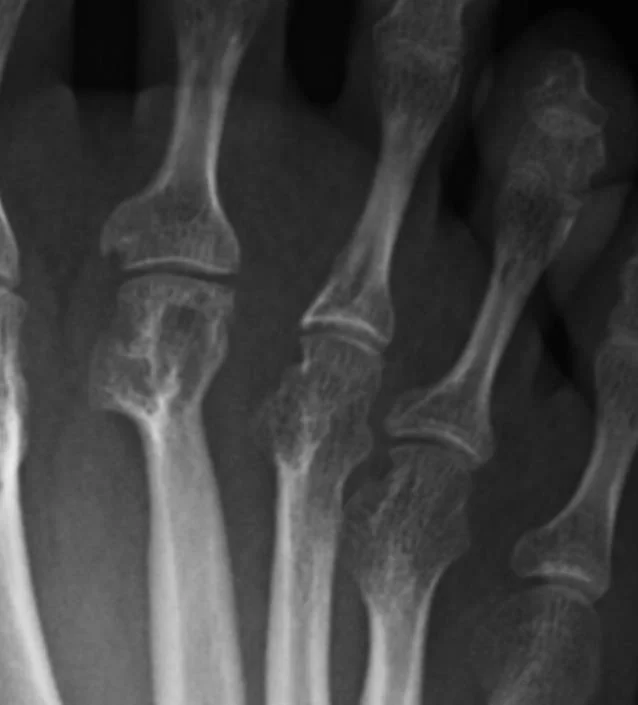
Long description
A radiograph described as showing typical erosions of rheumatoid arthritis.

Figure 2Severely deformed hands from Rheumatoid Arthritis
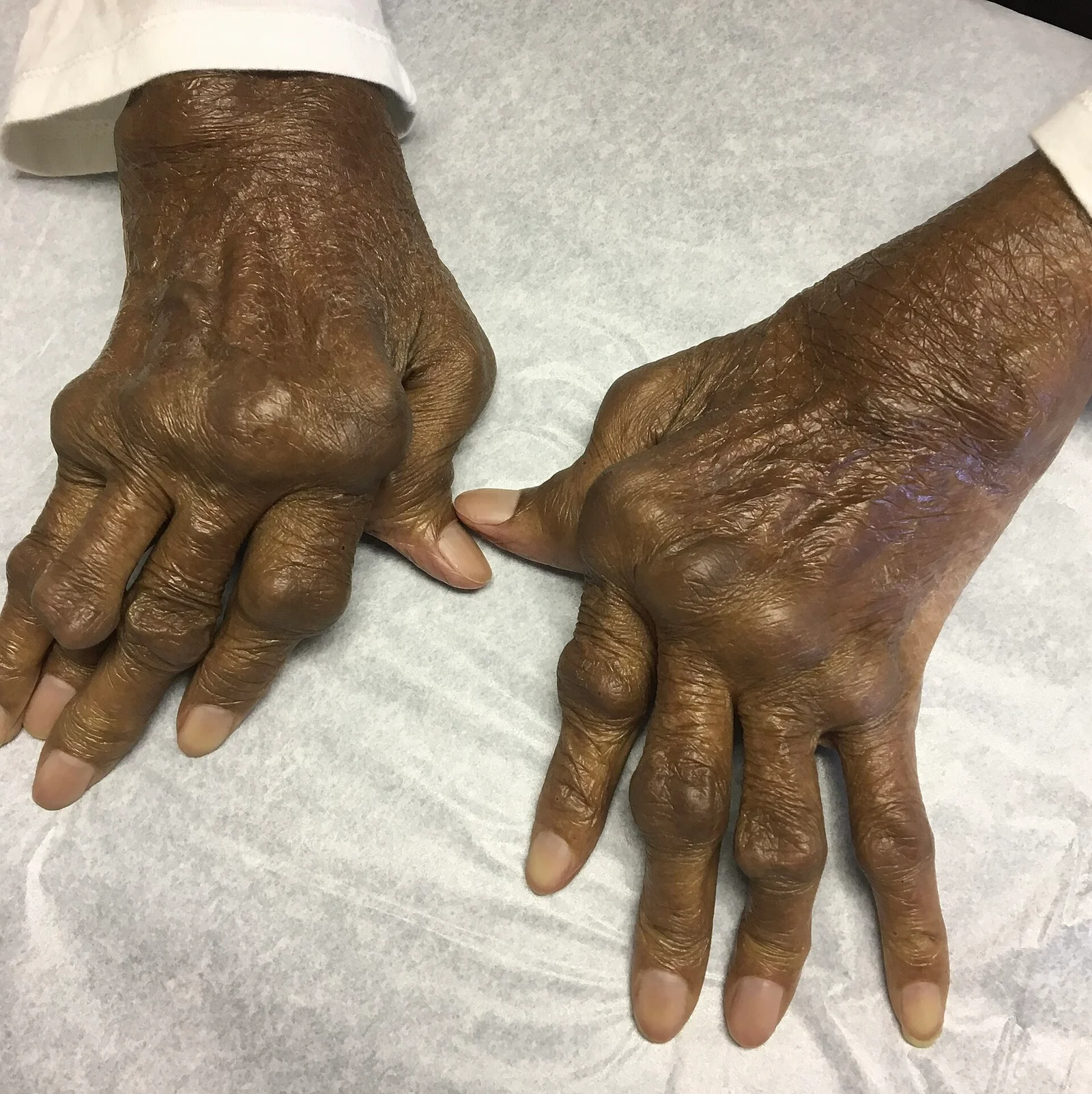
Long description
Clinical photograph titled 'Severely deformed hands from Rheumatoid Arthritis', showing both hands of a person with rheumatoid arthritis.

First-line tests are chosen to confirm inflammation and serology and to establish a baseline. [5]
| Test | What it shows | Typical finding / cut-off |
|---|---|---|
| Rheumatoid factor (RF) | IgM autoantibody against IgG Fc | Seropositive disease (RF and/or anti-CCP) accounts for about 80% of RA patients. High-titre/seropositive carries worse prognosis. [2][4] |
| Anti-CCP / ACPA | Antibody to citrullinated peptides | Higher specificity than RF; high-positive means more than 3 times the laboratory upper limit of normal. [4] |
| ESR and CRP | Acute-phase reactants | Raised in active disease; normal in some patients. ESR/CRP are used in the classification score and DAS28. [4][9] |
| Full blood count | Anaemia of chronic disease, thrombocytosis | Normochromic normocytic anaemia common in active disease. [3] |
| Renal and liver function | Baseline before DMARDs | Required for drug safety monitoring. [5] |
| Plain X-rays of hands and feet | Baseline erosions and joint space narrowing | Establish erosions; not needed to start treatment if clinical diagnosis is clear, but recommended after diagnosis. [5] |
| Ultrasound (greyscale + power Doppler) | Synovitis and tenosynovitis | More sensitive than clinical examination for active inflammation. [5] |
| MRI hands/wrists | Early erosions and bone oedema | Sensitive for early disease and pre-erosive change. |
Anti-CCP testing is more specific than RF, and the two together raise diagnostic confidence. [4] RF and anti-CCP positivity, together with erosions and symptom duration of 6 weeks or more, are the domains scored in the 2010 criteria.
These criteria apply to adults with at least one joint with definite clinical synovitis that is not better explained by another disease, aiming to classify patients at an earlier stage. [4]
- Target population: at least one swollen joint, with synovitis not better explained by another disease.
- Score four domains; a total of 6 or more out of 10 classifies "definite RA".
- Joint involvement (0 to 5): 1 large joint 0; 2-10 large joints 1; 1-3 small joints 2; 4-10 small joints 3; more than 10 joints with at least one small joint 5. [4]
- Serology (0 to 3): both RF and ACPA negative 0; low-positive RF or ACPA 2; high-positive RF or ACPA 3. Low-positive is above the laboratory upper limit of normal but not more than 3 times; high-positive is more than 3 times the upper limit. [4]
- Acute-phase reactants (0 to 1): normal CRP and ESR 0; abnormal CRP or ESR 1. [4]
- Symptom duration (0 to 1): fewer than 6 weeks 0; 6 weeks or more 1. [4]
Patients with typical rheumatoid erosions can be classified as RA regardless of score, and a score under 6 can be reassessed and fulfilled later. [4]
The Disease Activity Score based on 28 joints (DAS28) combines tender joint count, swollen joint count, patient global assessment and an acute-phase reactant (ESR or CRP). [9] It is the standard score for treat-to-target in RA.
- Remission: less than 2.6 [9]
- Low disease activity: 2.6 to 3.2
- Moderate: 3.2 to 5.1
- High: above 5.1 [9]
Formula (ESR version): 0.56 x square root of tender 28-joint count + 0.28 x square root of swollen 28-joint count + 0.70 x natural log(ESR) + 0.014 x patient global health (0-100). The CRP version uses 0.36 x natural log(CRP + 1) + 0.96. [9]
NICE NG100 recommends measuring CRP and disease activity (using a composite score such as DAS28) monthly in specialist care until the target of remission or low disease activity is achieved. [5]
The overall strategy is treat-to-target: define a target (remission, or low disease activity if remission is not achievable), monitor disease activity regularly and escalate treatment until the target is met. [5][6]
Approach to newly diagnosed rheumatoid arthritis
- Synovitis (swollen joint) presentConfirm clinical synovitis; exclude gout, psoriatic arthritis, SLE
- Baseline testsRF, anti-CCP, ESR/CRP, FBC, renal and liver tests, hand and foot X-rays
- Classify2010 ACR/EULAR score: 6 or more out of 10 = definite RA
- Question: Is disease active?
Low disease activity
- Start csDMARDHydroxychloroquine, sulfasalazine or methotrexate based on patient factors
Moderate to high disease activity
- Start methotrexateOral methotrexate 7.5 mg weekly, escalate to at least 15 mg within 4 to 6 weeks
- Add folic acid5 mg weekly, not on the methotrexate day
- Consider bridging glucocorticoidShort-term oral, intramuscular or intra-articular steroid while methotrexate takes effect
- Treat to targetMeasure DAS28 and CRP monthly until remission or low activity achieved
- Question: At target after 3 to 6 months?
Yes
- Maintain; review every 6 to 12 months; consider cautious step-down after 1 year in sustained remission
No
- Optimise methotrexateUp to 20-25 mg weekly; switch to subcutaneous if poor absorption
- Question: Still not at target?
No poor prognostic factors
- Step up: add a second csDMARD (triple therapy) or switch to another csDMARD
Poor prognostic factors or established disease
- Add a biologic or targeted synthetic DMARD; if inadequate response switch class
- Screen before biologicsTuberculosis (TST or IGRA plus chest X-ray), hepatitis B/C, HIV as indicated
- Non-pharmacological carePhysiotherapy, occupational therapy, podiatry, patient education, analgesia
NICE NG100 recommends a multidisciplinary team approach: physiotherapy for fitness and hand exercises, occupational therapy for hand function and daily activities, podiatry for foot health, psychological support, and patient education. [5] NSAIDs (with a proton pump inhibitor) and short glucocorticoid courses may be used for symptom control when disease-modifying therapy is already in place. [5]
Methotrexate is the anchor csDMARD and the usual first-line. ACR 2021 strongly recommends methotrexate monotherapy over hydroxychloroquine or sulfasalazine, and over biologic or targeted-synthetic DMARD monotherapy, for DMARD-naive patients with moderate-to-high disease activity; it is conditionally recommended over leflunomide and over dual/triple csDMARD therapy. [6] For low disease activity, hydroxychloroquine is preferred, then sulfasalazine, then methotrexate. [6]
EULAR 2022 likewise supports early methotrexate-based treatment with rapid dose escalation and a treat-to-target strategy. [7]
NICE NG100 offers first-line cDMARD monotherapy with oral methotrexate, leflunomide or sulfasalazine, ideally within 3 months of persistent symptoms, considering hydroxychloroquine for mild or palindromic disease. [5] Short bridging glucocorticoids are recommended when starting a cDMARD. [5]
- Methotrexate: start 7.5 mg orally once weekly; increase by 2.5 mg weekly to at least 15 mg within 4 to 6 weeks, and further to 20 to 25 mg weekly as needed and tolerated. Switch to subcutaneous methotrexate if oral absorption or tolerability is poor. Co-prescribe folic acid, 5 mg weekly, not on the methotrexate day. A weekly dose above 20 mg carries higher toxicity risk and 25 mg weekly should not be exceeded. [6][10][11]
- Leflunomide: 20 mg daily. [10]
- Sulfasalazine: escalate to 2 to 3 g daily, keeping 2 g or under during pregnancy. [10]
- Hydroxychloroquine: based on body weight, 5 mg/kg daily (roughly 200 to 400 mg). [10]
MTX, leflunomide and biologics are teratogenic or unsafe in pregnancy; sulfasalazine and hydroxychloroquine are compatible with pregnancy and breastfeeding. [10]
When the target is not met despite optimised csDMARDs, NICE NG100 points to biologic or targeted-synthetic DMARD options for moderate RA (DAS28 3.2 to 5.1, after inadequate response to 2 or more csDMARDs) or severe RA (DAS28 above 5.1, after csDMARD failure), combined with methotrexate unless contraindicated. [5] ACR 2021 conditionally recommends adding a biologic or targeted-synthetic DMARD over triple therapy when maximally tolerated methotrexate is not enough, and switching to a different class when a biologic fails. [6]
Classes used include TNF inhibitors (adalimumab, etanercept, infliximab, golimumab, certolizumab pegol), IL-6 receptor inhibitors (tocilizumab, sarilumab), abatacept (T-cell costimulation blockade), rituximab (anti-CD20), and JAK inhibitors (tofacitinib, baricitinib, upadacitinib, filgotinib). [5][6][10]
The pathogenesis review notes MTX is the first-line initial treatment and DMARDs remain the cornerstone, but about 40% of patients do not reach remission despite modern therapy, so combination and targeted escalation matter. [2]
ACR 2012 (applies to biologic patients) recommends screening for latent tuberculosis in every RA patient being considered for biologic therapy, regardless of risk factors, using TST or IGRA as the initial test, with chest X-ray if positive and appropriate treatment of latent disease. Biologics should not be started until at least 1 month of latent TB treatment has been given. [8]
An annual TB re-test is recommended for those with continued exposure. [8] Hepatitis B and C screening is advised: biologics should not be used in untreated chronic hepatitis B, or treated chronic hepatitis B with Child-Pugh class B or worse; etanercept may be considered in hepatitis C. [8] ACR 2021 notes prophylactic antiviral therapy is strongly recommended over frequent monitoring alone for patients initiating rituximab who are hepatitis B core antibody positive, regardless of surface antigen status. [6] Vaccinations following prior guidelines are advised. [8]
ACR 2021 recommends initiating a csDMARD without short-term (under 3 months) glucocorticoids conditionally, and without longer-term (3 months or more) glucocorticoids strongly, because of toxicity; short courses may still be needed for symptom control. [6] NICE NG100 permits short-term bridging glucocorticoids when starting a cDMARD, short treatment for flares and long-term continuation only after discussing risks and exhausting other options. [5]
NICE NG100 recommends rapid access for flares, ongoing drug monitoring, review 6 months after reaching target, and annual review for all adults with RA including assessment of comorbidities. [5] DMARD tapering is only considered after at least 1 year of sustained remission without glucocorticoids, and should be cautious and reversible. [5][6]
Refer for surgical opinion for persistent pain, worsening function or deformity despite optimal medical therapy, imminent tendon rupture, nerve compression, stress fracture or cervical myelopathy. [5]
- Joint destruction and deformity, tendon rupture, loss of function and disability from untreated pannus and erosions.
- Cervical spine instability and myelopathy.
- Septic arthritis, especially in prosthetic joints.
- Extra-articular disease: pulmonary (ILD, pleuritis), cardiac (pericarditis, premature atherosclerosis), vasculitis, Sjogren, Felty, renal amyloidosis. [3]
- Drug toxicity: methotrexate hepatotoxicity, pneumonitis and cytopenia; leflunomide hepatotoxicity; hydroxychloroquine retinopathy; biologic and JAK inhibitor infections. [10][8]
- Infection, including tuberculosis reactivation with biologics. [8]
Prognosis has improved markedly with early diagnosis and treat-to-target. [5][6] Poor prognostic features include high RF or anti-CCP titre, early erosions, high disease activity, long disease duration and smoking. Seropositive disease and HLA-DRB1 shared epitope alleles predict more aggressive, erosive disease. [1][2][4]
About 40% of patients still fail to reach remission with modern therapy, illustrating the need for individualised escalation. [2]
Primary prevention is not yet possible, but modification of risk factors (stopping smoking, oral health, diet, weight control and vitamin D) may reduce susceptibility. [1] Secondary prevention consists of recognising inflammatory arthritis early and treating within the window of opportunity; NICE NG100 expects referral within 3 months of persistent symptoms and diagnoses to be confirmed promptly. [5]
Screening for tuberculosis, hepatitis B and C and other infections must precede biologic therapy. [8] Cardiovascular and osteoporosis risk should be assessed annually. [5]
- Pregnancy: methotrexate and leflunomide are contraindicated; sulfasalazine and hydroxychloroquine are compatible, and prednisolone can be used at the lowest effective dose. [10] Biologic use in pregnancy follows national guidelines.
- Children: juvenile idiopathic arthritis is a separate entity; school-age onset polyarticular disease may resemble adult RA but is managed according to paediatric guidance.
- Older adults: reduce methotrexate dose in renal impairment (halve or avoid if eGFR under 50 ml/min), monitor closely for toxicity and consider comorbidities. [10]
- Immunocompromised patients and those with chronic viral hepatitis or prior malignancy need specialist risk assessment before biologics. [8]
Key decisions in RA are made early: classify the patient, measure disease activity, start methotrexate promptly and adjust at 3-monthly intervals against a defined target, escalate to targeted therapy if the target is not met, screen for infection before biologics, monitor annually, and taper only after sustained remission.
- RA is a chronic autoimmune synovitis that starts in the small joints of hands and feet and destroys cartilage and bone if untreated.
- Seropositive RA (RF and/or anti-CCP) is the commoner form; about 0.2 to 1% of adults are affected, women 2 to 3 times more often.
- Pannus is the invasive synovial tissue that produces erosions.
- 2010 ACR/EULAR criteria classify definite RA at a score of 6 or more out of 10; joint involvement, serology (RF/anti-CCP), acute-phase reactants and symptom duration are scored. [4]
- Anti-CCP is more specific than RF; RF/anti-CCP and early erosions mark worse prognosis.
- DAS28 targets remission under 2.6, low activity 2.6 to 3.2, moderate 3.2 to 5.1, high above 5.1; measure monthly until target. [9]
- Methotrexate is first-line: start 7.5 mg weekly, escalate to at least 15 mg within 4 to 6 weeks and up to 20 to 25 mg, with 5 mg folic acid weekly. Leflunomide 20 mg, sulfasalazine 2 to 3 g and hydroxychloroquine 200 to 400 mg daily are alternatives. [10]
- Biologics or JAK inhibitors are added (with methotrexate) when the target is not met on optimised csDMARDs.
- Screen for TB, hepatitis B/C and infections before biologics; do not use biologics in untreated chronic hepatitis B.
- Extra-articular disease occurs in about 40% and worsens survival; treat RA early and aggressively.
- Taper DMARDs only after 1 year of sustained remission without steroids.
- Update: ACR 2021, EULAR 2022 and NICE NG100 (published 2018, last updated 2020).
Answer each one in your head first, then open the answer.
A 48-year-old woman has 8 weeks of symmetric swelling and stiffness of the MCP and PIP joints of both hands and both wrists, with 90 minutes of morning stiffness. ESR and CRP are raised. What is the most likely diagnosis and which two antibodies are most useful?
Show answerHide answer
Rheumatoid arthritis. The symmetric small-joint pattern with prolonged morning stiffness is classic. Rheumatoid factor and anti-CCP antibodies should be tested; a high anti-CCP titre is the more specific of the two.
A patient scores 4 for joint involvement (4-10 small joints), 3 for high-positive anti-CCP, 1 for raised CRP, and 1 for symptom duration of 10 weeks. What is the total and does this classify as definite RA?
Show answerHide answer
The total is 9 out of 10, which is 6 or more, so yes, definite RA by the 2010 ACR/EULAR criteria, provided synovitis is present in at least one joint and no alternative diagnosis explains it better.
Why are methotrexate and folic acid prescribed on different days?
Show answerHide answer
Methotrexate is taken once a week and folic acid 5 mg is given on a different day (usually 24 to 48 hours later) to reduce methotrexate toxicity and adverse effects without interfering with its anti-inflammatory action.
What screening is mandatory before starting a biologic DMARD?
Show answerHide answer
Screening for tuberculosis (clinical assessment, TST or IGRA and chest X-ray) and for hepatitis B and C, with treatment of latent TB for at least a month before starting. Biologics are avoided in untreated chronic hepatitis B and in treated chronic hepatitis B with Child-Pugh class B or worse.
What DAS28 value signals remission, and how often should disease activity be monitored until the target is reached?
Show answerHide answer
Remission is a DAS28 of under 2.6. NICE NG100 recommends measuring CRP and DAS28 monthly in specialist care until remission or low disease activity is achieved.
A patient with RA has a new cough and breathlessness on exertion. What extra-articular manifestations should you consider?
Show answerHide answer
Interstitial lung disease, pleuritis, pleural effusion and pulmonary nodules, which are common pulmonary manifestations of RA. In someone with high RF or anti-CCP, possible rheumatoid lung disease or drug toxicity (for example methotrexate pneumonitis) should also be considered.
Ankylosing spondylitis; crystal arthropathies; juvenile idiopathic arthritis; osteoarthritis; psoriatic arthritis; systemic lupus erythematosus; methotrexate; tumour necrosis factor inhibitors.
- Venetsanopoulou AI, Alamanos Y, Voulgari PV, Drosos AA. Epidemiology and risk factors for rheumatoid arthritis development. Mediterr J Rheumatol 2023;34(4):404-413. Accessed .
- Gao Y, Zhang Y, Liu X. Rheumatoid arthritis: pathogenesis and therapeutic advances. MedComm (2020) 2024;5(3):e509. Accessed .
- Cojocaru M, Cojocaru IM, Silosi I, Vrabie CD, Tanasescu R. Extra-articular manifestations in rheumatoid arthritis. Maedica 2010;5(4):286-291. Accessed .
- Aletaha D, Neogi T, Silman AJ, et al. 2010 rheumatoid arthritis classification criteria: an ACR/EULAR collaborative initiative. Arthritis Rheum 2010;62(9):2569-2581 / Ann Rheum Dis 2010;69(9):1575-1589. Accessed .
- National Institute for Health and Care Excellence (NICE). Rheumatoid arthritis in adults: management. NICE guideline NG100, published 11 July 2018, last updated 12 October 2020 (last reviewed 19 November 2024). Accessed .
- Fraenkel L, Bathon JM, England BR, et al. 2021 American College of Rheumatology Guideline for the Treatment of Rheumatoid Arthritis. Arthritis Care Res (Hoboken) 2021;73(7):924-939. Accessed .
- Smolen JS, Landewe RBM, Bergstra SA, et al. EULAR recommendations for the management of rheumatoid arthritis with synthetic and biological disease-modifying antirheumatic drugs: 2022 update. Ann Rheum Dis 2023;82(1):3-18. Accessed .
- Singh JA, Furst DE, Bharat A, et al. 2012 Update of the 2008 American College of Rheumatology recommendations for the use of disease-modifying antirheumatic drugs and biologics in the treatment of rheumatoid arthritis. Arthritis Care Res (Hoboken) 2012;64(5):625-639. Accessed .
- Anderson J, Caplan L, Yazdany J, et al. Rheumatoid arthritis disease activity measures: American College of Rheumatology recommendations for use in clinical practice. Arthritis Care Res (Hoboken) 2012;64(5):640-647. Accessed .
- Padjen I, Crnogaj MR, Anic B. Conventional disease-modifying agents in rheumatoid arthritis: a review of their current use and role in treatment algorithms. Reumatologia 2020;58(6):390-400. Accessed .
- Jylamvo. Jylamvo (methotrexate) 2 mg/ml oral solution: Summary of Product Characteristics. Medicines.org.uk (emc). Accessed .
Figure credits
Educational content for medical students and doctors. It is not a substitute for clinical judgement or local guidelines.