Muscarinic antagonists
Competitive blockade of muscarinic acetylcholine receptors, producing parasympatholytic effects across multiple organ systems.
Figure 1Muscarinic antagonist
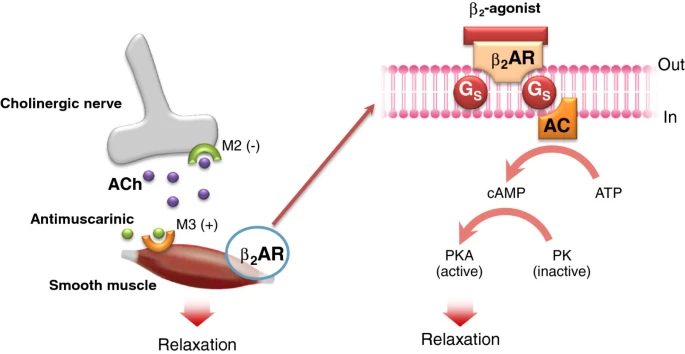
Long description
A cholinergic nerve releases acetylcholine onto airway smooth muscle, where M3 receptors cause contraction and presynaptic M2 receptors reduce further release; an antimuscarinic drug blocks these receptors. Beside it, a beta-2 agonist acts on the beta-2 adrenoceptor, which signals through Gs and adenylyl cyclase to raise cAMP and activate protein kinase A, so the muscle relaxes.

Muscarinic antagonists are drugs that compete with acetylcholine at muscarinic receptors, preventing the neurotransmitter from binding and triggering its usual downstream signalling cascades. Unlike nicotinic antagonists, these agents do not block the ionotropic actions of acetylcholine at skeletal muscle endplates or autonomic ganglia; their effects are confined to the metabotropic muscarinic receptor family, which is widely distributed on smooth muscle, cardiac tissue, glandular cells and within the central nervous system.
The fundamental mechanism is competitive antagonism: the drug occupies the orthosteric binding site on the muscarinic receptor, but fails to activate the associated G-protein. The clinical consequence depends entirely on the prevailing parasympathetic tone in the tissue concerned. Where vagal tone is high—such as in the sinoatrial node of the heart—antagonists produce tachycardia; where cholinergic drive is minimal, the effects may be barely perceptible. This explains why atropine is more effective at increasing heart rate in a healthy young adult than in a patient with a denervated transplanted heart.
Beyond their classical actions, muscarinic antagonists exhibit notable pharmacological promiscuity. Atropine and scopolamine both possess micromolar affinity at 5-HT3 receptors, a finding that has implications for their use as research tools and for understanding off-target effects. The structural basis for this cross-reactivity lies in shared pharmacophore features: both drugs contain an aromatic group coupled to an azabicyclic ring via a carbonyl linker, which conforms to the requirements for 5-HT3 receptor binding. However, their affinities at 5-HT3 receptors are considerably lower than at muscarinic receptors—atropine has a Kb of 1.89 μM at 5-HT3 receptors, whereas its muscarinic affinity is in the nanomolar range. [2]
DefinitionCompetitive antagonism
A reversible interaction where the antagonist occupies the same binding site as the agonist; increasing agonist concentration can overcome the blockade, shifting the dose–response curve rightward without reducing the maximum response.
The clinical applications of muscarinic antagonists are diverse. They are used as bronchodilators in respiratory disease, where they compete with acetylcholine at muscarinic receptors on airway smooth muscle to induce bronchodilation, and have been postulated to exert anti-inflammatory actions by inhibiting the release of pro-inflammatory cytokines from epithelial and immune cells. This mechanistic rationale supports their use in poorly controlled asthma. They also find roles in ophthalmology, cardiology, gastroenterology and anaesthesia, as detailed below. [1]
The adverse effect profile of muscarinic antagonists arises from the systemic nature of cholinergic signaling. While the therapeutic goal is to target M3 receptors in the bladder or airways, muscarinic receptors are ubiquitous, regulating functions in inflammatory cells, airway epithelial cells, goblet cells, and submucosal glands. When evaluating the safety of these agents, clinicians must consider the quality of the evidence; for instance, a systematic review found that 50.00% of clinical studies were of medium quality (Jadad score = 3), while the other 50.00% were of low quality (Jadad score less than 3). [4]
Toxicity management often involves understanding the specific receptor subtypes involved in physiological responses. In the bladder, attenuation of beta-adrenoceptor-mediated relaxation involves both M2 and M3 receptors. The M3 component of this attenuation is mediated by phospholipase C (PLC) or protein kinase C (PKC) pathways. Consequently, systemic blockade can interfere with these regulatory pathways, potentially leading to adverse effects in non-target tissues. [3]
Illustrative example: A patient receiving high-dose muscarinic antagonists for OAB may experience "dry mouth" or "blurred vision" due to the blockade of M3 receptors in salivary glands and the ciliary muscle of the eye. In cases of severe toxicity, management is primarily supportive, focusing on the reversal of systemic anticholinergic effects.
When considering combination therapies, such as LAMA/LABA, the potential for additive adverse effects must be monitored. Although the combination of a LAMA and a LABA is considered a possible option, the efficacy and safety of such combinations have not been fully evaluated. Furthermore, while blockade of M3 receptors by a LAMA might result in anti-inflammatory effects, these effects might be increased by the concomitant activation of beta2 receptors by a LABA, but this requires further clinical validation. In older adults or those with comorbidities, the risk of urinary retention or cognitive impairment must be weighed against the therapeutic benefits, particularly given the lack of long-term outcome data in many clinical trials. [4]
Clinical pearlReceptor Selectivity
Although M2 receptors are more highly expressed in the bladder, the direct contractile effects of muscarinic agonists are mediated primarily, if not exclusively, by the minor population of M3 receptors. [3]
Muscarinic Antagonist Management
- Assess IndicationOAB or Obstructive Airway Disease
- Question: Is it a LAMA/LABA combination?
Yes
- MonitorSafety not fully evaluated
No
- Standard TherapyUse approved monotherapy or SAMA/SABA
Atropine is the prototypical muscarinic antagonist and is derived from the same biosynthetic pathway as scopolamine. It is a naturally occurring alkaloid obtained from plants of the nightshade family, notably Atropa belladonna. Its pharmacological profile is characterised by competitive blockade of all muscarinic receptor subtypes, though with varying potency depending on the tissue.
Exam trapAtropine and heart rate
Atropine causes tachycardia at therapeutic doses by blocking vagal tone at the sinoatrial node. However, at very low doses (under 0.5 mg), it can paradoxically cause bradycardia—this is thought to result from central vagal stimulation or presynaptic autoreceptor blockade, and is not clinically exploited.
In ophthalmology, atropine is used as a cycloplegic and mydriatic. By blocking muscarinic receptors on the iris sphincter muscle and the ciliary body, it causes pupillary dilation (mydriasis) and paralysis of accommodation (cycloplegia). These effects are long-lasting compared with shorter-acting agents, which is useful for treating uveitis and for refractive assessment in children, but inconvenient for routine fundoscopy where a brief mydriasis is preferred. [2]
In cardiology, atropine is employed for the treatment of bradycardia. By removing vagal inhibition of the sinoatrial and atrioventricular nodes, it increases heart rate and improves atrioventricular conduction. It is a first-line agent in symptomatic bradycardia, particularly when the cause is increased vagal tone, such as in inferior myocardial infarction or vasovagal syncope. [2]
| Indication | Mechanism | Notable features |
|---|---|---|
| Bradycardia | Blocks vagal tone at SA/AV nodes | Increases heart rate; effective in vagally mediated bradycardia |
| Cycloplegia and mydriasis | Blocks iris sphincter and ciliary muscle | Long duration; used in uveitis and paediatric refraction |
| Antidote to organophosphate poisoning | Competes with excess acetylcholine | Requires high doses; often combined with oximes |
| Pre-anaesthetic medication | Reduces airway secretions | Less commonly used now; glycopyrrolate preferred |
Atropine also has significant actions at 5-HT3 receptors, though these are of micromolar potency. In oocytes expressing 5-HT3 receptors, atropine did not elicit a response when applied alone, but caused concentration-dependent inhibition of the 2 μM 5-HT-evoked response with a pIC50 of 5.76 ± 0.14 (IC50 = 1.74 μM) and a Hill slope of 1.06 ± 0.05. This inhibition was fully reversible after 1 minute of washing and was unaltered by pre-application. The Kb was calculated as 1.89 μM. These values indicate that atropine is a weak, competitive antagonist at 5-HT3 receptors—roughly three orders of magnitude less potent than at muscarinic receptors. [2]
The structural explanation for this lower potency lies in the molecular architecture of atropine. Unlike high-affinity 5-HT3 receptor antagonists, atropine has an aromatic ring that is not directly attached to the ester moiety forming the link with the bicyclic amine. The direct conjugation of the carbonyl group with the aromatic ring provides 5-HT3 receptor antagonists with planarity and rigidity crucial for potent inhibition. Instead, atropine has a linker containing a tetrahedral carbon carrying a polar hydroxymethyl substituent, which disrupts the planar conformation required for high-affinity binding. [2]
Clinical pearlClinical relevance of 5-HT3 cross-reactivity
Although atropine's 5-HT3 actions are weak, they illustrate the principle of ligand promiscuity. This becomes clinically relevant when considering drug interactions or when using scopolamine as a research tool to induce cognitive dysfunction—5-HT3 antagonists can reverse these effects, suggesting overlapping pharmacology. [2]
The adverse effects of atropine are predictable extensions of its mechanism: dry mouth (reduced salivation), blurred vision (cycloplegia), urinary retention (detrusor relaxation), constipation (reduced gastrointestinal motility) and confusion in the elderly. Central nervous system effects are less prominent than with scopolamine, which crosses the blood–brain barrier more readily and is used to treat post-operative nausea and vomiting and motion sickness. At higher doses, scopolamine can produce amnesia and compliance, effects exploited experimentally to model cognitive dysfunction. [2]
Tropicamide is a synthetic muscarinic receptor antagonist used primarily in ophthalmology as a short-acting mydriatic and cycloplegic agent. It acts by competitively blocking muscarinic receptors at the iris sphincter muscle and the ciliary body, thereby preventing acetylcholine from mediating pupillary constriction and accommodation. Because tropicamide is a non-selective antagonist, it blocks all muscarinic receptor subtypes (M1–M5), though its clinical effects in the eye are mediated predominantly through M3 receptors, which are the same receptors that mediate bronchoconstriction and mucus secretion in the airway. [1]
The drug is typically instilled as eye drops at concentrations of 0.5% or 1%. Its onset of action is rapid, with mydriasis occurring within 15–30 minutes, and the effect lasts approximately 4–6 hours. Cycloplegia is less complete than that produced by atropine or cyclopentolate, making tropicamide suitable for routine fundoscopy but less ideal for refraction in children, where more profound cycloplegia is required.
Clinical pearlWhy tropicamide is short-acting
Tropicamide has a relatively short duration of action because it is rapidly hydrolysed by plasma esterases and cleared from the eye. This makes it safer for outpatient use, as patients recover normal vision more quickly than with atropine.
Systemic absorption from the conjunctival sac can occur, particularly in children or the elderly, and may cause antimuscarinic side effects such as dry mouth, tachycardia, and flushing. In rare cases, central nervous system effects such as confusion or agitation may occur, especially in the elderly. This is relevant because muscarinic antagonism in the CNS produces a cholinergic deficit that impairs memory, a mechanism exploited experimentally with scopolamine to model dementia. Although tropicamide penetrates the blood–brain barrier less readily than scopolamine, caution is still advised in vulnerable patients. [2]
| Drug | Onset of mydriasis | Duration | Typical use |
|---|---|---|---|
| Tropicamide 0.5–1% | 15–30 min | 4–6 h | Fundoscopy, routine examination |
| Cyclopentolate 0.5–1% | 30–60 min | 6–24 h | Refraction in children |
| Atropine 1% | 30–120 min | 7–14 days | Uveitis, amblyopia treatment |
Exam trapNot for glaucoma
Tropicamide is contraindicated in patients with narrow-angle glaucoma because pupillary dilation can precipitate acute angle-closure glaucoma. Always check anterior chamber depth before instillation.
Benztropine is a centrally acting muscarinic receptor antagonist, used primarily in the management of Parkinson's disease and drug-induced extrapyramidal symptoms. It combines the tropane ring of atropine with a benzhydryl (diphenylmethoxy) moiety, giving it both antimuscarinic and antihistaminic properties. Its lipophilicity allows it to cross the blood–brain barrier readily, which is essential for its therapeutic effects on central cholinergic pathways.
DefinitionMechanism of action
Benztropine competitively blocks muscarinic acetylcholine receptors in the central nervous system, restoring the balance between dopaminergic and cholinergic activity in the basal ganglia, which is disrupted in Parkinsonism.
The drug is available as tablets (0.5 mg, 1 mg, 2 mg) and as an injection (1 mg/mL). For Parkinson's disease, the usual starting dose is 0.5–1 mg orally once daily, with gradual titration by 0.5 mg every 5–6 days until optimal response or a maximum of 6 mg daily. For acute dystonic reactions, 1–2 mg intramuscularly or intravenously may be given, with rapid relief typically within minutes. [1]
Exam trapAnticholinergic side effects
Benztropine's peripheral antimuscarinic effects include dry mouth, blurred vision, urinary retention, constipation and tachycardia. Central effects may include confusion, hallucinations and sedation, particularly in elderly patients.
The selectivity of muscarinic antagonists is an important consideration. While benztropine is relatively non-selective among the five muscarinic receptor subtypes (M1–M5), its central actions are largely mediated through M1 receptors in the cortex and striatum. The structural basis for receptor selectivity among antimuscarinic drugs is complex; for example, the potent 5-HT3 receptor antagonist granisetron binds with a micromolar affinity at muscarinic receptors, suggesting that while general conformations of these ligands enable them to share common binding sites at both receptors, the linkers are likely to confer the key structural elements that drive receptor selectivity. This cross-reactivity highlights the importance of understanding ligand structure when predicting off-target effects. [2]
| Indication | Route | Dose | Frequency |
|---|---|---|---|
| Parkinson's disease (initial) | Oral | 0.5–1 mg | Once daily |
| Parkinson's disease (maintenance) | Oral | 1–2 mg | 2–3 times daily |
| Acute dystonia | IM/IV | 1–2 mg | Single dose |
| Maximum daily dose | Oral | 6 mg | Divided |
Clinical pearlClinical pearl
Benztropine is often preferred over other antimuscarinics for drug-induced extrapyramidal symptoms because of its longer half-life (approximately 12–24 hours), allowing once-daily dosing in many patients.
Contraindications include narrow-angle glaucoma, myasthenia gravis, prostatic hypertrophy and gastrointestinal obstruction. Abrupt withdrawal may precipitate a cholinergic rebound, so the drug should be tapered gradually.
Glycopyrrolate is a quaternary ammonium muscarinic antagonist, meaning it carries a permanent positive charge and therefore does not readily cross lipid membranes such as the blood–brain barrier or the gastrointestinal mucosa. This property limits its systemic absorption and central nervous system side effects, making it useful both as an inhaled bronchodilator and as an oral agent for reducing secretions.
DefinitionQuaternary ammonium compound
A positively charged nitrogen atom prevents glycopyrrolate from crossing lipid bilayers easily, so it acts locally at the airway surface and is poorly absorbed systemically.
In respiratory medicine, glycopyrrolate is an approved bronchodilator for the treatment of COPD in a number of countries worldwide, including in the European Union. Its role in asthma is less established but under active investigation. In a small crossover study of 10 patients, glycopyrrolate delivered via the DeVilbiss nebuliser significantly prolonged bronchodilation and bronchoprotection compared with both ipratropium and placebo. This suggests that glycopyrrolate may offer a longer duration of action than the short-acting agent ipratropium, which is clinically relevant for once- or twice-daily dosing. [1]
Exam trapNot first-line in asthma
Unlike tiotropium, glycopyrrolate is not yet supported by large phase III trials in asthma; current evidence comes from small studies and ongoing phase II work.
The mechanism of action is competitive antagonism at M3 muscarinic receptors on airway smooth muscle, reducing cholinergic bronchoconstriction and mucus secretion. Because glycopyrrolate is poorly absorbed, systemic antimuscarinic effects such as dry mouth, urinary retention and tachycardia are less prominent than with atropine.
Patient recruitment is currently ongoing for a phase II crossover study of glycopyrrolate add-on therapy in adult patients with mild or moderate asthma (ClinicalTrials.gov identifier NCT02296411), which will help to determine whether glycopyrrolate may provide an additional option for the treatment of asthma. Further data are needed to provide more evidence on glycopyrrolate as a potential treatment option. [1]
Clinical pearlClinical takeaway
For now, glycopyrrolate is a useful bronchodilator in COPD, but in asthma its role remains experimental—await phase II and III results before considering it as add-on therapy.
| Feature | Detail |
|---|---|
| Class | Quaternary ammonium muscarinic antagonist |
| Approved indication | COPD bronchodilator (EU) |
| Asthma evidence | Small crossover study (n=10) |
| Compared with | Ipratropium and placebo |
| Ongoing trial | Phase II, mild–moderate asthma, NCT02296411 |
Hyoscyamine is a naturally occurring tropane alkaloid and the levorotatory (l-) isomer of atropine. It acts as a competitive, non-selective antagonist at muscarinic acetylcholine receptors (M1, M2, M3), blocking parasympathetic neurotransmission at effector organs. Because it is a tertiary amine, it crosses the blood–brain barrier and the placenta, and it is absorbed orally. Its clinical effects are dose-dependent and include reduced salivary, bronchial, and gastric secretions; relaxation of gastrointestinal, biliary, and urinary smooth muscle; pupillary dilation; and tachycardia at higher doses.
DefinitionMuscarinic antagonism
Competitive blockade of acetylcholine at muscarinic receptors, preventing parasympathetic effects without altering acetylcholine synthesis or release.
The drug is used for a range of gastrointestinal and urological indications. It is indicated for the treatment of peptic ulcer disease, irritable bowel syndrome, and other functional gastrointestinal disorders, as well as for reducing symptoms of cystitis and renal colic. It is also used as an adjunct in anaesthesia to reduce secretions and to prevent bradycardia during surgery. The typical oral adult dose is 0.125 to 0.25 mg taken every four hours or as needed, with a maximum of 1.5 mg per day. [1]
Exam trapDose ceiling
Exceeding 1.5 mg daily orally risks severe anticholinergic toxicity; always verify the total daily dose when prescribing as-needed regimens.
Adverse effects are extensions of its pharmacology: dry mouth, blurred vision, photophobia, urinary retention, constipation, and tachycardia. In the elderly, central effects such as confusion, agitation, and hallucinations are more common. Contraindications include narrow-angle glaucoma, myasthenia gravis, obstructive uropathy, and gastrointestinal obstruction. Hyoscyamine should be used with caution in patients with coronary artery disease, hyperthyroidism, or hiatal hernia with reflux oesophagitis.
| Property | Detail |
|---|---|
| Isomer | L-isomer of atropine |
| Receptor action | Competitive non-selective muscarinic antagonist |
| Oral adult dose | 0.125–0.25 mg every 4 h; max 1.5 mg/day |
| CNS penetration | Yes (tertiary amine) | | Main uses | GI spasm, peptic ulcer, IBS, cystitis, adjunct in anaesthesia |
The drug is used for a range of gastrointestinal and urological indications. It is indicated for the treatment of peptic ulcer disease, irritable bowel syndrome, and other functional gastrointestinal disorders, as well as for reducing symptoms of cystitis and renal colic. It is also used as an adjunct in anaesthesia to reduce secretions and to prevent bradycardia during surgery. The typical oral adult dose is 0.125 to 0.25 mg taken every four hours or as needed, with a maximum of 1.5 mg per day.
Approach to hyoscyamine use
- Assess indicationGI spasm, peptic ulcer, IBS, cystitis, or anaesthetic adjunct
- Question: Oral route possible?
Yes
- Start 0.125–0.25 mg q4hMax 1.5 mg/day
No
- Give SC/IM 0.25–0.5 mg q6hMonitor for anticholinergic effects
Ipratropium bromide is a quaternary ammonium compound that acts as a muscarinic receptor antagonist. Because of its quaternary structure, it is poorly absorbed across biological membranes, which is a key pharmacokinetic feature: when inhaled, it acts locally on the airways with minimal systemic absorption. This property reduces the risk of systemic antimuscarinic side effects such as dry mouth, urinary retention, and tachycardia, making it a relatively safe option for inhaled use.
In the context of asthma, ipratropium is classified as a short-acting anticholinergic agent. It has been used in asthma treatment for several years, but it is considered to be less effective than short-acting β2-agonists (SABAs) in achieving acute bronchodilation. This relative lack of potency, combined with its short duration of action, limits its usefulness as a controller medication in chronic asthma management. In other words, it is not a first-line agent for maintenance therapy. [1]
However, there is evidence to suggest that combining a short-acting anticholinergic with a SABA may provide a more effective option than using a SABA alone, particularly in the acute setting. This combination strategy is thought to be especially valuable during severe exacerbations, where the additional bronchodilation from a different mechanism—blocking vagally mediated bronchoconstriction—can complement the direct smooth-muscle relaxation produced by β2-agonists. [1]
Clinical pearlClinical pearl
In acute severe asthma, adding ipratropium to a SABA can improve bronchodilation beyond that achieved with the SABA alone, even though ipratropium is weaker as a standalone bronchodilator.
Exam trapCommon trap
Do not confuse ipratropium with long-acting muscarinic antagonists (LAMAs) such as tiotropium. Ipratropium is short-acting and is not suitable as a controller; LAMAs are used in COPD maintenance.
| Feature | Description |
|---|---|
| Class | Short-acting muscarinic antagonist (SAMA) |
| Efficacy vs SABA | Less effective for acute bronchodilation |
| Duration | Short-acting, limiting controller use |
| Role | Add-on to SABA in acute settings |
Role of ipratropium in acute asthma
- Patient presents with acute asthma exacerbationAssess severity
- Question: Severe exacerbation?
Yes
- Give SABA + ipratropiumCombination may be more effective than SABA alone
No
- SABA aloneIpratropium not routinely needed
Oxybutynin is a tertiary amine muscarinic receptor antagonist that blocks acetylcholine at postganglionic muscarinic receptors, thereby reducing smooth muscle spasm, particularly in the detrusor muscle of the bladder. It is used primarily for overactive bladder syndrome and neurogenic detrusor overactivity.
DefinitionMechanism of action
Oxybutynin competitively antagonises M2 and M3 muscarinic receptors; M3 blockade in the bladder wall reduces involuntary detrusor contractions and increases bladder capacity.
The oral starting dose for adults is 5 mg taken two to three times daily, with a maximum of 20 mg per day. An extended-release formulation is given once daily at 5 mg, titrated up to 30 mg daily if needed. For children over 5 years with neurogenic bladder, the dose is 5 mg twice daily, adjusted according to response and tolerability. [1]
| Formulation | Starting dose | Maximum dose |
|---|---|---|
| Immediate-release | 5 mg two to three times daily | 20 mg/day |
| Extended-release | 5 mg once daily | 30 mg/day |
| Paediatric (over 5 years) | 5 mg twice daily | Individualised |
Because oxybutynin is a tertiary amine, it crosses the blood–brain barrier, which explains its central anticholinergic side effects. The most common adverse effects are dry mouth (occurring in up to 71% of patients at higher doses), constipation, blurred vision, and urinary retention. Cognitive impairment, confusion, and drowsiness are particularly concerning in elderly patients, and oxybutynin is listed among the potentially inappropriate medications for older adults due to this risk. [1]
Exam trapElderly caution
Avoid oxybutynin in frail older patients with dementia or those taking cholinesterase inhibitors, as the anticholinergic burden can worsen cognition and negate the benefits of the dementia treatment.
The transdermal patch and topical gel were developed to reduce first-pass hepatic metabolism and lower the incidence of dry mouth compared with oral formulations. However, application-site reactions occur in some patients using the patch. [1]
Clinical pearlClinical pearl
When a patient reports persistent dry mouth on immediate-release oxybutynin, switching to the extended-release or transdermal formulation often improves tolerability without losing efficacy, as the peak plasma concentration is blunted.
Oxybutynin is contraindicated in patients with uncontrolled narrow-angle glaucoma, myasthenia gravis, severe ulcerative colitis, or significant gastric retention. It should be used with caution in those with hepatic or renal impairment. [1]
Muscarinic antagonists act as competitive inhibitors at muscarinic acetylcholine receptors, preventing the binding of endogenous acetylcholine. In smooth muscle tissues, these agents function as physiological antagonists to β-adrenoceptor agonists[3]. This interaction is critical in managing conditions like obstructive airway disease and overactive bladder (OAB) syndrome, where the pathology is characterised by excessive muscarinic input and insufficient β-adrenergic input[3].
The pharmacodynamic relationship is defined as a "privileged interaction"[3]. While muscarinic receptors and β-adrenoceptors are expressed in distinct locations within the bronchial tree, their combined modulation is necessary to achieve complete dilatation[3]. At the cellular level, direct contractile effects are mediated almost exclusively by the M3 subtype[3]. However, the attenuation of β-adrenoceptor-mediated relaxation involves both M2 and M3 receptors[3]. Specifically, M2 receptors mediate the inhibition of cAMP accumulation, which directly opposes the relaxant signaling pathways activated by β-adrenoceptors[3].
Clinical pearlPrivileged interaction
Muscarinic receptor-induced contraction is more resistant to β2-adrenoceptor-induced relaxation than that induced by agonists acting independent of muscarinic receptors[3].
This resistance is thought to be mediated by protein kinase C (PKC)[3]. Because muscarinic receptor-induced contraction is more resistant to β2-adrenoceptor-induced relaxation than contractions triggered by other stimuli, the addition of a muscarinic antagonist is required to "unlock" the full relaxant potential of β-adrenoceptor agonists[3].
Illustrative example: In a patient with COPD, a long-acting muscarinic antagonist may show minimal effect in isolation, yet it significantly enhances the ability of a long-acting β2-agonist to antagonise histamine-induced bronchoconstriction[3].
This functional antagonism occurs at multiple levels, including mediator release, receptor signal transduction, and receptor regulation[3]. For instance, prejunctional β2-adrenoceptors can enhance neuronal acetylcholine release, while chronic treatment with one drug class may regulate the expression of the target receptor and the opposing receptor[3]. In the bladder, the potency and efficacy of β3-selective agonists, such as mirabegron and solabegron, are similarly enhanced in the presence of muscarinic receptor antagonists[3].
| System | Primary Muscarinic Effect | Interaction with β-agonists |
|---|---|---|
| Airway | M3-mediated contraction | Antagonism of relaxation via M2/M3 |
| Bladder | M3-mediated contraction | Enhanced relaxation with combined therapy |
| Esophagus | Contraction | Stronger inhibition of β-adrenoceptor responses |
| Iris sphincter | Contraction | Stronger inhibition of β-adrenoceptor responses |
The management of obstructive airway disease, such as COPD, relies on inhaled bronchodilators, specifically M3 muscarinic acetylcholine receptor antagonists and β2-adrenoceptor agonists[3]. These remain the mainstay of current management at all stages of the disease[3]. Clinical development has focused on increasing the duration of action and improving selectivity profiles to enhance therapeutic outcomes[3].
Administration is typically via the inhaled route for airway diseases, ensuring high local concentrations at the bronchial smooth muscle. In contrast, systemic administration is often required for OAB. Pharmaceutical companies are increasingly pursuing fixed-dose combination therapies to simplify dosing regimens and improve patient adherence[3].
Exam trapMonotherapy limitations
The full value of such combination as compared to monotherapy can only be determined in clinical studies[3].
Pharmacokinetic considerations must account for the regulation of receptor expression. Chronic treatment with one drug class may regulate the expression of the target receptor, but it also influences the expression of the opposing receptor[3]. This cross-regulation is a key factor in the long-term management of both obstructive airway disease and OAB[3].
Regarding special populations, clinicians must consider that while these agents are effective, their impact on airway inflammation remains a subject of ongoing research. Systematic reviews have examined the impact of muscarinic receptor antagonists on airway inflammation in vitro and in laboratory animals, though these studies often evaluate the antagonists in isolation[3]. Research papers evaluating the anti-inflammatory activity of muscarinic receptor antagonists in combination with other therapeutic agents are typically excluded from such systematic reviews[3].
Clinical Rationale for Combination
- Identify PathologyObstructive airway disease or OAB
- Question: Is there excessive muscarinic tone?
Yes
- Administer Muscarinic AntagonistBlocks M3-mediated contraction
No
- Standard CareMonitor symptoms
- Enhance RelaxationAdd β-adrenoceptor agonist to overcome privileged interaction
In low-resource settings or when treating older adults, the choice of delivery device (e.g., metered-dose inhaler vs. dry powder inhaler) is as important as the pharmacokinetic profile of the drug itself. In pregnancy, the systemic absorption of muscarinic antagonists should be monitored, as the privileged interaction between muscarinic and β-adrenergic pathways is also present in the esophagus, ileum, and colon[3].
Muscarinic antagonists serve as foundational therapies in respiratory and urological medicine, primarily by modulating cholinergic tone. In obstructive airway disease, the clinical utility of these agents is bifurcated into acute relief and long-term maintenance. Short-acting muscarinic receptor antagonists (SAMAs) are frequently combined with short-acting beta-adrenoceptor agonists (SABAs) as acute reliever medication. This combination is well-established and guideline-recommended. The rationale for this synergy is that muscarinic antagonists may overcome the mitigation of direct smooth muscle effects caused by beta-agonists, or provide an inhibitory effect that is stronger than either agent alone. [3]
For chronic maintenance, long-acting muscarinic antagonists (LAMAs) are utilized for their bronchodilator properties. Beyond bronchodilation, LAMAs are characterized by intrinsic enhanced M3/M2 binding properties, acting as mucus-modifying therapies that positively impact airway mucus hypersecretion in COPD patients. While the combination of a LAMA with a long-acting beta-adrenoceptor agonist (LABA) is a potential controller option, its safety and efficacy are still under investigation, and it is not yet an approved use in all contexts. Clinical studies on the anti-inflammatory profile of LAMAs have focused on tiotropium (TIO), which has demonstrated both short- and long-term anti-inflammatory activity in COPD. [3]
In urology, muscarinic antagonists remain the mainstay for treating overactive bladder (OAB), a condition defined by the International Continence Society as the presence of urgency, with or without incontinence, usually accompanied by urinary frequency and nocturia. The physiological basis for this use is that muscarinic receptors are the primary mediator of urinary bladder contraction. Although M2 receptors are more abundant in the bladder, the direct contractile effect is mediated primarily by
DefinitionOveractive Bladder (OAB)
A clinical condition defined by the presence of urgency, with or without incontinence, usually accompanied by urinary frequency and nocturia.
| Delivery Device | Dose | Clinical Context |
|---|---|---|
| HandiHaler | 18 μg | Non-randomized trials showing anti-inflammatory activity |
| Respimat | 5 μg | Investigational dose for small airway delivery |
DefinitionMuscarinic antagonist
A drug that blocks muscarinic acetylcholine receptors, preventing the downstream signalling that normally causes smooth‑muscle contraction.
Muscarinic antagonists used in the airways (e.g. tiotropium, aclidinium) are employed clinically.[3]
| Interaction | Mechanism | Clinical consequence | Example |
|---|---|---|---|
| β‑adrenoceptor agonists | β‑agonists relax airway smooth muscle via potassium‑channel activation, while muscarinic antagonists block contraction pathways. The two classes act synergistically because β‑agonist‑induced relaxation is enhanced when muscarinic‑mediated contraction is removed. | Improved bronchodilation, allowing lower doses of each agent. | Combination inhaler containing tiotropium + formoterol. |
| β‑adrenoceptor agonists in the bladder | β‑agonist‑induced relaxation in bladder also depends on potassium channels; muscarinic antagonism can augment this effect, especially when BKCa channels are deficient. | May increase bladder emptying, useful in over‑active bladder but can precipitate urinary retention in patients with outflow obstruction. | Co‑administration of glycopyrronium with mirabegron. |
| Drugs with anticholinergic burden (e.g. antihistamines, tricyclic antidepressants) | Additive blockade of muscarinic receptors across organ systems. | Exacerbated dry mouth, constipation, urinary retention, and blurred vision. | Tiotropium added to diphenhydramine. |
| Cholinesterase inhibitors (e.g. donepezil) | Increase synaptic acetylcholine, opposing the effect of muscarinic antagonists. | Reduced bronchodilator efficacy; may require dose escalation. | Tiotropium in a patient with Alzheimer’s disease on donepezil. |
-
Bladder outlet obstruction – Muscarinic antagonists block M2 receptors that dominate bladder smooth‑muscle tone (M2 : M3 ≈ 4 : 1)【P12】. In patients with prostatic hypertrophy or urethral stricture, further reduction of detrusor contractility can precipitate acute urinary retention. Contraindicated in severe obstruction; use with caution in moderate cases, monitoring post‑void residual volume.
-
Narrow‑angle glaucoma – Muscarinic blockade reduces pupillary constriction, potentially raising intra‑ocular pressure. Although not quantified in the supplied passages, the mechanistic link warrants avoidance in patients with uncontrolled angle‑closure glaucoma.
-
Severe hepatic impairment – Many long‑acting muscarinic antagonists are metabolised hepatically; accumulation can increase systemic anticholinergic effects. Dose reduction or alternative therapy is advised.
-
Pregnancy and lactation – Systemic absorption may affect fetal muscarinic signalling; data are limited, so these agents are contraindicated unless the benefit clearly outweighs risk.
-
Asthma with predominant eosinophilic inflammation – Muscarinic antagonists target cholinergic pathways; they do not address eosinophil‑driven bronchoconstriction. In such phenotypes, reliance on anticholinergics alone may be insufficient and could delay initiation of corticosteroids.
- Selectivity matters: Agents with high affinity for M1 receptors can paradoxically increase acetylcholine release (non‑selective atropine enhanced release in bladder studies)【P35】, potentially diminishing bronchodilation. Prefer agents with low M1 affinity when treating COPD with co‑existent bladder dysfunction. [3]
- Dose‑related anticholinergic load: Higher inhaled doses increase systemic exposure, raising the risk of dry mouth, constipation, and cognitive effects, especially in the elderly.
- Monitoring: In patients receiving combined β‑agonist and muscarinic antagonist therapy, assess for signs of urinary retention and intra‑ocular pressure at baseline and after dose adjustments.
By recognising these interactions and contraindications, clinicians can tailor muscarinic antagonist therapy to maximise bronchodilation while minimising adverse systemic effects.
- Muscarinic antagonists are competitive blockers at muscarinic receptors; their effect depends on acetylcholine concentration.
- The Schild equation with slope = 1 confirms competitive antagonism; pA2 = −logKb under these conditions.
- Onset and recovery kinetics follow 1/τoff = k−1 and 1/τon = k+1[L] + k−1.
- The Cheng-Prusoff equation converts IC50 to Ki or Kb, but only for competitive antagonists at equilibrium.
- Tiotropium 5 µg and 2.5 µg Respimat have safety comparable to 18 µg HandiHaler in 17,135 COPD patients.
- Scopolamine at 2 mg kg−1 in rodents gives ~1 μM systemically but up to 460 μM centrally, exceeding its 5-HT3 IC50.
- Asthma affects ~235 million people worldwide, projected to reach 400 million by 2025. [1]
- LAMAs like tiotropium are add-on therapy in symptomatic asthma with at least ICS.
Answer each one in your head first, then open the answer.
What does a Schild plot slope of exactly 1 indicate, and what does pA2 equal under this condition?
Show answerHide answer
A slope of 1 indicates purely competitive antagonism, and pA2 equals the negative logarithm of Kb.How is the dissociation rate constant k−1 estimated from recovery kinetics?
Show answerHide answer
From the time constant for recovery: 1/τoff = k−1.What was the patient population and key finding of the TIOSPIR trial?
Show answerHide answer
17,135 patients with COPD; safety of tiotropium 5 µg and 2.5 µg Respimat was comparable to 18 µg HandiHaler.Why might scopolamine at 2 mg kg−1 in rodents affect 5-HT3 receptors?
Show answerHide answer
Because the systemic concentration is ~1 μM, close to its IC50 at 5-HT3 receptors.What is the global burden of asthma and the projected figure for 2025?
Show answerHide answer
Approximately 235 million people are affected, with estimates of 400 million by 2025.
Muscarinic antagonists are competitive inhibitors at muscarinic acetylcholine receptors, meaning they bind reversibly to the orthosteric site and block the actions of acetylcholine without triggering an intracellular response. The key pharmacodynamic concept is that their effect depends on the prevailing concentration of acetylcholine: at high agonist concentrations, more antagonist is required to achieve the same degree of blockade. This is why the clinical effects of these drugs are most pronounced when parasympathetic tone is high, such as in the airways, bladder, and gastrointestinal tract.
A crucial quantitative relationship to understand is the Schild equation, which describes competitive antagonism: log[(EC50′/EC50) − 1] = log[L] − logKb, where EC50′ and EC50 are agonist concentrations in the presence and absence of antagonist, [L] is the antagonist concentration, and Kb is the equilibrium dissociation constant for the antagonist–receptor interaction. When the slope of the Schild plot equals 1, the antagonism is purely competitive, and pA2 (the negative logarithm of the antagonist concentration that doubles the agonist EC50) equals −logKb. For exam purposes, remember that a Schild slope of unity is the hallmark of competitive antagonism; a slope deviating from 1 suggests non-competitive or allosteric mechanisms. [2]
The onset and recovery kinetics of antagonism are governed by association and dissociation rate constants. The time constant for recovery (τoff) relates to the dissociation rate constant by 1/τoff = k−1, while the onset time constant (τon) follows 1/τon = k+1[L] + k−1. [2]
When interpreting binding studies, the Cheng-Prusoff equation converts an IC50 (concentration inhibiting 50% of binding) into a true equilibrium dissociation constant: Ki = IC50 / (1 + [L]/Kd), where [L] is the concentration of the labelled ligand and Kd is its dissociation constant. A related form is used for functional assays: Kb = IC50 / ((2 + ([A]/[A50])nH)1/nH − 1), where [A] is the agonist concentration, [A50] is the agonist EC50, and nH is the Hill slope. In practice, Ki and Kb are measures of antagonist potency; lower values mean higher affinity. [2]
Clinical pearlpA2 and clinical potency
The pA2 value is the negative logarithm of the antagonist concentration that requires doubling the agonist dose to achieve the same response. A higher pA2 means a more potent antagonist. For competitive antagonists, pA2 = −logKb when the Schild slope is exactly 1.
Scopolamine deserves special mention. It has a tetrahedral carbon linker that reduces its affinity at 5-HT3 receptors, but at muscarinic receptors it is a potent antagonist used for motion sickness and as a preoperative antisialagogue. When used experimentally to induce cognitive dysfunction in rodents, intraperitoneal or subcutaneous injections of up to 2 mg kg−1 are employed. As a weight-per-volume this is approximately 1 μM, which is close to its IC50 at 5-HT3 receptors; centrally administered scopolamine can reach focal concentrations as high as 140 μg μl−1 (460 μM), far exceeding its IC50 and causing complete inhibition. This illustrates that drug concentration at the receptor site—not just dose—determines the pharmacological effect. [2]
The transdermal patch and topical gel were developed to reduce first-pass hepatic metabolism and lower the incidence of dry mouth compared with oral formulations. However, application-site reactions occur in some patients using the patch. [1]
Another pitfall is confusing the terms "antagonist" and "inverse agonist." Muscarinic antagonists are neutral competitive antagonists—they block the receptor but do not alter constitutive activity. In contrast, some drugs at other receptors (e.g., certain antihistamines) are inverse agonists that reduce basal signalling. For muscarinic receptors, the clinical implication is that antagonists only work when acetylcholine is present; they do not "switch off" the receptor in the absence of agonist.
Students often misapply the Cheng-Prusoff equation. It is only valid for competitive antagonists at equilibrium, and it requires knowing the concentration of the labelled ligand and its Kd. Using IC50 values directly as a measure of affinity without applying the correction is a common mistake, especially when the labelled ligand concentration is high relative to its Kd. Similarly, the Gaddum-Schild equation (slope = 1) is recommended for estimating pA2, but only when the data meet the assumption of simple competition.
A third pitfall concerns the interpretation of functional assays. The Hill slope (nH) in the concentration–response equation y = Imin + (Imax − Imin) / (1 + 10log(EC50 − x)nH) is often assumed to be 1, but deviations occur with receptor cooperativity or multiple binding sites. If nH differs from 1, the Schild analysis becomes unreliable, and pA2 values may not equal −logKb.
Exam trapDose vs concentration
Do not equate administered dose with receptor-site concentration. Scopolamine at 2 mg kg−1 intraperitoneally gives roughly 1 μM at the receptor, but central administration can produce 460 μM locally. Clinical doses are chosen to achieve therapeutic concentrations at the target organ, not systemic levels.
Finally, students frequently forget that muscarinic antagonists have both therapeutic and adverse effects that stem from the same mechanism. Blocking M3 receptors in the airways causes bronchodilation, but blocking M3 receptors in the bladder causes urinary retention, and blocking M1 receptors in the brain causes cognitive impairment. The therapeutic index is therefore narrow, and drug selection often depends on minimising off-target effects rather than maximising potency.
A frequent error is assuming that all muscarinic antagonists are equivalent. In reality, they differ markedly in receptor subtype selectivity, pharmacokinetics, and tissue penetration. For example, tiotropium is a quaternary ammonium compound that is poorly absorbed and acts topically in the airways, whereas atropine crosses the blood–brain barrier readily and causes central anticholinergic effects such as confusion and hallucinations. The TIOSPIR trial in 17,135 patients with COPD confirmed that the safety profiles of tiotropium 5 µg and 2.5 µg delivered via the Respimat inhaler were comparable with those of tiotropium 18 μg delivered via the Spiriva HandiHaler device. [1] [2]
Choosing a muscarinic antagonist in airway disease
- Patient with asthma or COPDAssess symptoms, spirometry, and exacerbation risk
- Question: Asthma uncontrolled on ICS ± LABA?
Yes
- Add tiotropium Respimat5 µg once daily; safety comparable to 18 µg HandiHaler
No
- Continue current therapyOptimise inhaler technique and adherence
- Question: COPD with dyspnoea or exacerbations?
Yes
- Consider LAMATiotropium 5 µg or 2.5 µg Respimat, or 18 µg HandiHaler
No
- MonitorReassess at each visit
Beyond the airways, muscarinic antagonists are used in gastroenterology for peptic ulcer disease and irritable bowel syndrome, where they reduce gastric acid secretion and gastrointestinal motility. In urology, they are first-line for overactive bladder, relaxing the detrusor muscle. In anaesthesia and emergency medicine, atropine is used for bradycardia and as an antisialagogue, while glycopyrrolate is preferred when central effects are undesirable. Scopolamine patches are used for motion sickness and postoperative nausea, exploiting its central antiemetic action.
The choice of agent depends on the desired route and duration. Tiotropium is inhaled and acts locally on airway M3 receptors with a duration exceeding 24 hours due to slow dissociation. Ipratropium is short-acting and used for acute exacerbations. Atropine is systemic and crosses the blood–brain barrier, limiting its use to acute situations. The safety data from TIOSPIR reassure clinicians that the Respimat device, despite earlier concerns about nebulised delivery, has a comparable safety profile to the HandiHaler.
NoteReceptor subtype matters
M3 receptors mediate bronchoconstriction, bladder contraction, and salivary secretion. M2 receptors are presynaptic autoreceptors that inhibit acetylcholine release; blocking them can paradoxically increase acetylcholine levels. This explains why some antagonists with M3 selectivity (e.g., tiotropium) have a better therapeutic profile than non-selective drugs.
In research and experimental medicine, scopolamine is used to model cognitive dysfunction in rodents at doses up to 2 mg kg−1 intraperitoneally or subcutaneously. This model is widely used to screen for cognitive enhancers, but the concentrations achieved centrally (up to 460 μM) far exceed those needed for muscarinic blockade, meaning that off-target effects at 5-HT3 receptors may confound results. Clinicians should be aware that scopolamine's cognitive effects in humans are dose-dependent and reversible, which is why it is used cautiously in the elderly.
- Busse WW, Dahl R, Jenkins C, Cruz AA. Long-acting muscarinic antagonists: a potential add-on therapy in the treatment of asthma?. European respiratory review : an official journal of the European Respiratory Society 2016;25(139):54-64. doi:10.1183/16000617.0052-2015. Accessed .
- Lochner M, Thompson AJ. The muscarinic antagonists scopolamine and atropine are competitive antagonists at 5-HT3 receptors. Neuropharmacology 2016;108:220-228. doi:10.1016/j.neuropharm.2016.04.027. Accessed .
- Dale PR, Cernecka H, Schmidt M, et al. The pharmacological rationale for combining muscarinic receptor antagonists and β-adrenoceptor agonists in the treatment of airway and bladder disease. Current opinion in pharmacology 2014;16:31-42. doi:10.1016/j.coph.2014.03.003. Accessed .
- Calzetta L, Coppola A, Ritondo BL, et al. The Impact of Muscarinic Receptor Antagonists on Airway Inflammation: A Systematic Review. International journal of chronic obstructive pulmonary disease 2021;16:257-279. doi:10.2147/copd.s285867. Accessed .
Figure credits
Educational content for medical students and doctors. It is not a substitute for clinical judgement or local guidelines.