Pain and Anaesthesia Pharmacology
Pharmacology and stepwise management of acute nociceptive pain for medical students
Figure 1Pain pathway diagram showing transduction, transmission, modulation, and perception
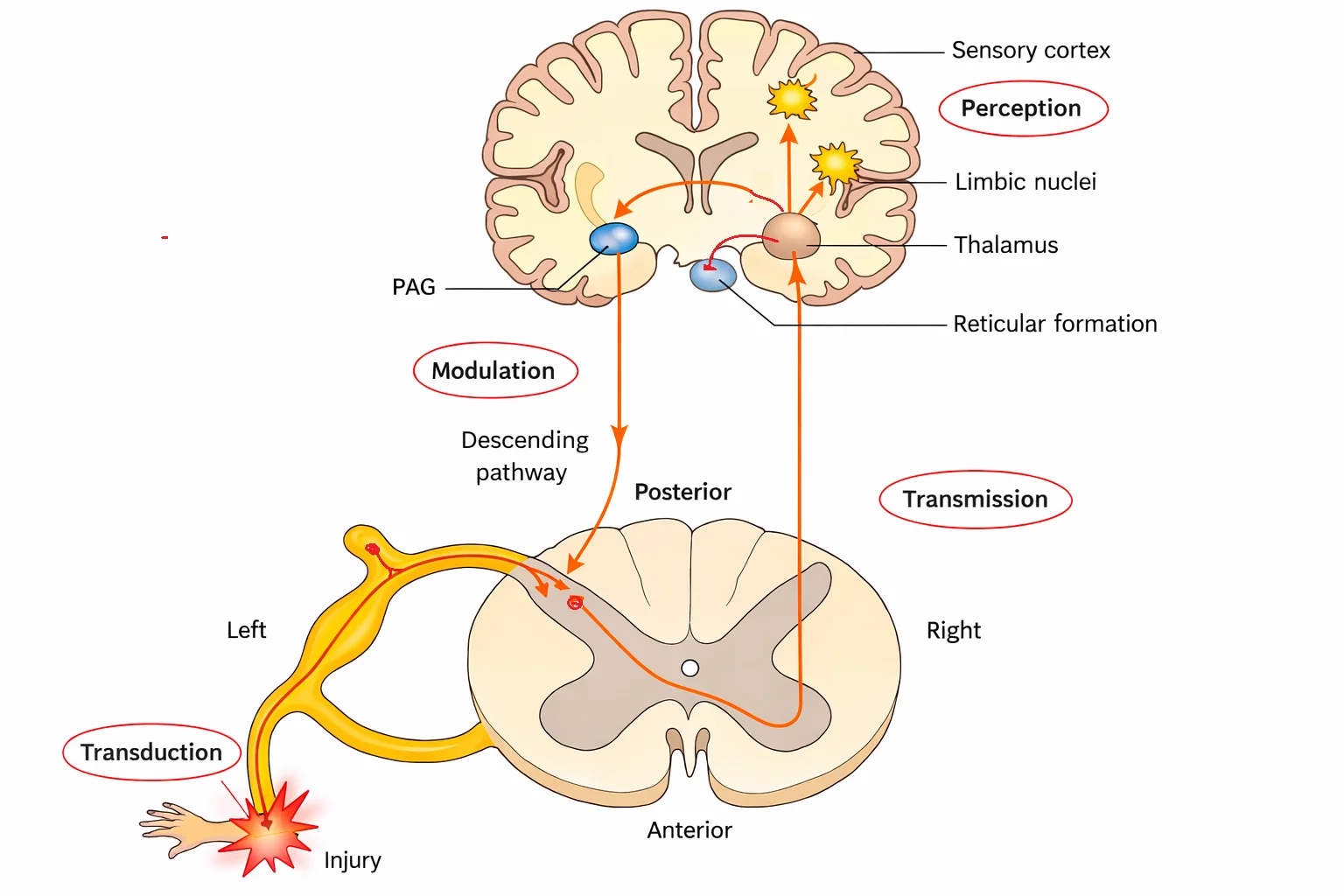
Long description
Educational medical illustration of the pain pathway showing transduction at the site of injury, transmission through the peripheral nerve and spinal cord, modulation via descending pathways and PAG, and perception invol

Pain is fundamentally a sensory and emotional experience linked to actual or potential tissue damage. From a pharmacological standpoint, understanding pain requires examining the pathways of nociception: transduction, transmission, modulation, and perception. Transduction converts noxious thermal, mechanical, or chemical stimuli into electrical action potentials via peripheral nociceptors (A-delta and C fibres). These signals travel along primary afferent neurons to the dorsal horn of the spinal cord, ascend via spinothalamic tracts to the thalamus, and ultimately reach the somatosensory cortex for conscious perception.
When evaluating pain intensity in clinical settings, measuring tools must be reliable and valid. For adults and verbal children, numerical rating scales or visual analogue scales are standard. In neonates and infants unable to self-report, structured assessment relies on validated behavioural measures and physiological parameters. Specific validated instruments in this population include the Neonatal Infant Pain Scale, the Pain Assessment Tool, the Premature Infant Pain Profile, the Premature Infant Pain Profile-Revised, the Comfort Behavioral Scale, and the N-PASS. [3]
Chronic pain syndromes often present with overlapping features, defined broadly as persistent or intermittent discomfort lasting for at least three months, or 12 weeks, across any body site. Chronic low back pain specifically refers to pain persisting for longer than three months situated between the 12th rib and buttock crease. Pain severity grading thresholds categorize baseline scores from zero to one hundred as follows: less than 30 represents mild pain, 30 to 60 represents moderate pain, and more than 60 represents severe pain. Clinical trial outcomes frequently measure the proportion of participants achieving at least a 50 percent pain intensity reduction, or achieving no worse than mild pain, alongside a secondary outcome threshold of at least a 30 percent pain intensity reduction. Mean changes in pain scores alone are insufficient because individual responses to interventions are non-Gaussian, meaning few patients experience the exact mean response. [6] [5]
DefinitionNociceptive vs Neuropathic Pain
Nociceptive pain arises from actual or threatened damage to non-neural tissue and is due to activation of nociceptors, whereas neuropathic pain arises as a direct consequence of a lesion or disease affecting the somatosensory system.
DefinitionAdverse effect
Any harmful, unintended response to a drug at normal doses.
-
Common short‑term adverse effects
- Phlebitis in 9 % of patients
- Transient muscle weakness in 21 %
- Gastro‑intestinal upset in 4 %
- Respiratory compromise in patients with pre‑existing muscle disease
-
Management / antidotes
- Phlebitis – remove or replace the peripheral line, apply warm compresses, consider low‑molecular‑weight heparin if thrombophlebitis develops.
- Transient weakness – supportive ventilation until strength returns; monitor arterial blood gases.
- GI upset – give anti‑emetics (e.g., ondansetron 4 mg IV) and consider a proton‑pump inhibitor if reflux is severe.
- Respiratory compromise – provide supplemental oxygen, consider non‑invasive ventilation or intubation; avoid further muscle‑relaxing agents.
-
Toxicity profile – Minimal when used for short periods; no specific antidote required beyond symptomatic care.
-
Immune‑system suppression – Both agents can reduce host defence through various pathways. Ketamine may suppress natural‑killer (NK) cell activity and lower inflammatory cytokine production; thiopental may inhibit neutrophil function and modulate NF‑κB activation.
-
Clinical consequence – Increased susceptibility to infection, especially in critically ill or immunocompromised patients.
-
Management
- Monitoring – Serial white‑cell counts and inflammatory markers (CRP, pro‑calcitonin).
- Prophylaxis – Consider broad‑spectrum antibiotics if prolonged infusion is required in a high‑risk patient.
- Reversal – No specific pharmacologic antidote; discontinue the offending agent and provide supportive care.
-
Matrix‑metalloproteinase (MMP) modulation – Morphine attenuates MMP secretion via a nitric‑oxide (NO)‑dependent pathway, an effect not reversed by naloxone (NX).
-
Potential toxicity – Excessive MMP inhibition may impair wound healing; however, clinical relevance is limited.
-
Management
- Assessment – Monitor wound healing progress; if delayed, consider reducing opioid dose or switching to a non‑opioid analgesic.
-
Critical‑illness caution – NSAIDs carry a higher risk of immunosuppression and renal injury in ICU patients, including those with ARDS[7].
-
Management
- Renal monitoring – Check serum creatinine and urine output every 12 h.
- Alternative analgesia – Prefer acetaminophen or regional techniques when feasible.
- Identify the offending agent – Review medication chart and timing of symptom onset.
- Support organ systems – Maintain airway, breathing, circulation; treat hypotension with fluids or vasopressors as needed.
- Specific antidotes – Use dantrolene for malignant hyperthermia; otherwise rely on symptomatic treatment.
- Dose adjustment – Reduce or stop the drug in patients with pre‑existing disease that predisposes to the observed toxicity (e.g., muscle disorders with dantrolene‑induced weakness). [7]
Managing acute nociceptive pain relies on a structured, stepwise approach that matches pharmacological potency to pain severity while aiming to minimize adverse effects. The foundational principle involves combining agents with complementary mechanisms of action, frequently integrating non-opioid analgesics with adjuvant medications and reserving potent opioids for severe presentations. Baseline pain severity guides initial drug selection, moving upward through pharmacological tiers if analgesia is inadequate.
| Parameter | Threshold or Criterion |
|---|---|
| Mild pain severity | Less than 30 on a 0 to 100 scale [2] |
| Moderate pain severity | 30 to 60 on a 0 to 100 scale |
| Severe pain severity | More than 60 on a 0 to 100 scale |
| Primary trial response target | At least 50 percent pain intensity reduction |
| Secondary trial response target | At least 30 percent pain intensity reduction |
When treating complex or chronic pain conditions that have proven refractory to standard mono-therapies, multidisciplinary rehabilitation programmes offer superior efficacy compared to usual care and physical treatments. Specifically, multidisciplinary rehabilitation decreases pain and reduces disability, with pooled standardised mean differences corresponding to approximately 0.5 points on a 0 to 10 pain scale and 1.5 points on a 24 point Roland-Morris scale. For occupational outcomes, patients receiving multidisciplinary rehabilitation programmes have roughly double the odds of being at work after 12 months compared to those receiving physical treatments alone. [5]
Clinical pearlMultidisciplinary Care
Combining physical, psychological, and pharmacological interventions addresses the multidimensional nature of persistent pain much more effectively than any single modality in isolation.
Stepwise Pain Management Framework
- Assess Pain SeverityUse numerical scales or validated tools like NIPS or PIPP.
- Question: Severity Score?
Mild (<30)
- Non-opioid analgesicsParacetamol or NSAIDs as baseline.
Moderate (30-60)
- Step 2 analgesicsWeak opioids combined with non-opioids.
Severe (>60)
- Step 3 analgesicsStrong opioids and specialist multidisciplinary input.
Chronic low back pain is formally defined by symptoms that persist for a period of greater than three months. Alongside persistent pain and impaired bodily function, patients frequently experience psychological distress such as anxiety and depression, as well as significant disruptions to their social, recreational, and professional working lives. This widespread impact led to the development of the biopsychosocial model, which ensures that treatment interventions target all facets of the disorder rather than focusing solely on somatic pathology. [5]
Treatment planning should incorporate coordinated multidisciplinary biopsychosocial rehabilitation programmes, which combine physical, psychological, educational, and work-related components delivered by a team of healthcare providers with expertise in different fields. Evidence demonstrates that these multidisciplinary interventions are more effective than usual care and physical treatments alone in decreasing pain and disability for individuals suffering from chronic low back pain. Furthermore, referral for multidisciplinary rehabilitation confers a benefit in terms of reduced pain and disability that endures beyond one year, alongside an increased likelihood of the patient remaining in work a year later when compared against physical treatments alone. [5]
DefinitionBiopsychosocial Model
An approach viewing chronic pain as an interaction of biological, psychological, and social factors requiring coordinated multi-domain care.
Exercise offers specific benefits in reducing chronic pain severity alongside general improvements in mental health and physical functioning.
| Exercise Type | Primary Mechanism | Clinical Benefit |
|---|---|---|
| Aerobic exercise | Weight loss and endogenous opioid production | Reduced joint pressure and transient anti-nociception |
| Resistance exercise or other forms of strength training can improve the person's capacity to support bone and cartilage through improved musculature. [6] | ||
| Balance and flexibility | Fall reduction training | Decreased risk of further pain or injury |
Chronic Pain Management Pathway
- Initial AssessmentEvaluate pain duration (greater than 3 months) and screen for depression and anxiety.
- Question: Duration over three months?
Yes
- Biopsychosocial EvaluationAssess physical, psychological, and occupational impacts.
- Multidisciplinary ReferralEngage coordinated team for combined physical and psychological rehabilitation.
- Encourage ActivityEliminate bedrest and introduce tailored aerobic and resistance exercise.
No
- Acute Pain PathwayStandard short-term analgesia and investigation.
If physical activity and exercise interventions safely reduce pain intensity or frequency, they serve as a preferable alternative or adjunct to long-term pharmacological and surgical treatments. These interventions promote personal involvement, increasing patient self-efficacy and the ability to self-manage, which ultimately improves overall quality of life and reduces healthcare utilisation. [6]
Clinical pearlExercise Endorphins
A single bout of exercise increases endogenous opioid production, yielding transient anti-nociceptive effects in both humans and animals. [6]
Neuropathic pain arises from damage or disease affecting the somatosensory nervous system, distinguishing it from nociceptive pain which results from actual or threatened tissue damage. The pharmacological approach differs fundamentally because the mechanisms—ectopic impulse generation, peripheral and central sensitisation, and altered ion channel expression—require medicines that modulate neuronal excitability rather than simple analgesics.
DefinitionNeuropathic pain
Pain caused by a lesion or disease of the somatosensory nervous system, often described as burning, shooting, or electric-shock-like in quality.
First-line treatments target sodium channels, calcium channels, or GABAergic pathways. Tricyclic antidepressants (e.g. amitriptyline) and serotonin–noradrenaline reuptake inhibitors (e.g. duloxetine) enhance descending inhibitory pathways. Gabapentinoids (gabapentin, pregabalin) bind the α2δ subunit of voltage-gated calcium channels, reducing neurotransmitter release. Topical lidocaine patches and capsaicin are options for localised pain.
Clinical pearlDose titration
Start low and go slow—titrate gabapentinoids and tricyclics gradually to minimise sedation, dizziness, and falls, especially in older adults.
When assessing treatment response, clinically important thresholds guide interpretation. A reduction in pain intensity of at least 30% represents a meaningful improvement, while 50% reduction is considered a robust response. Reporting outcomes dichotomously—the proportion achieving these cut-offs—allows clearer clinical interpretation than mean changes alone. [6]
Exam trapMean changes mislead
A statistically significant mean pain reduction may hide that few individual patients achieved meaningful relief. Always ask what proportion crossed the 30% or 50% threshold.
For refractory cases, combination therapy or specialist referral is appropriate. Tramadol, a weak opioid with SNRI properties, has shown efficacy in procedural pain—one study found intramuscular tramadol 100 mg significantly better than intracervical local anaesthetic block at reducing pain during hysteroscopy (P=0.001). However, tramadol carries opioid-related risks and should be reserved for when first-line agents fail. [2]
NoteMultidisciplinary care
Chronic pain, including neuropathic components, often benefits from non-pharmacological approaches. Multidisciplinary rehabilitation shows comparable effects to surgery for chronic non-specific low back pain, with fewer adverse events. [5]
Patients typically have mild-moderate pain (greater than 30/100 or 3/10), with only some experiencing severe pain (greater than 60/100 or 6/10). This baseline matters when judging whether a treatment effect is clinically worthwhile. [6]
| Drug class | Example | Mechanism | Key consideration |
|---|---|---|---|
| Tricyclic antidepressant | Amitriptyline | Noradrenaline/serotonin reuptake inhibition | Anticholinergic side effects |
| SNRI | Duloxetine | Serotonin–noradrenaline reuptake inhibition | Avoid in hepatic impairment |
| Gabapentinoid | Pregabalin, gabapentin | α2δ calcium channel subunit | Renal dose adjustment needed |
| Topical | Lidocaine 5% patch | Sodium channel blockade | For localised allodynia |
Paracetamol (acetaminophen) and non-steroidal anti-inflammatory drugs (NSAIDs) are the most commonly used first-line analgesics for mild-to-moderate pain. Paracetamol acts centrally, inhibiting cyclooxygenase (COX) enzymes in the brain, which reduces prostaglandin synthesis and thereby modulates pain perception. It has minimal anti-inflammatory effect peripherally and does not irritate the gastric mucosa, making it suitable for patients with peptic ulcer disease or bleeding risk. The usual adult dose is 500 mg to 1 g every 4–6 hours, with a maximum of 4 g daily; overdose causes hepatotoxicity through depletion of glutathione and accumulation of the toxic metabolite N-acetyl-p-benzoquinone imine (NAPQI).
NSAIDs, by contrast, work peripherally by inhibiting COX-1 and COX-2 enzymes, reducing prostaglandin production at sites of tissue injury. This provides both analgesic and anti-inflammatory effects. Examples include ibuprofen (400–600 mg three times daily), naproxen (250–500 mg twice daily), and diclofenac (50 mg three times daily). Selective COX-2 inhibitors (e.g., celecoxib) spare COX-1, reducing gastrointestinal ulceration risk but retaining cardiovascular thrombotic risk. Common adverse effects include dyspepsia, gastritis, renal impairment, and exacerbation of asthma.
Exam trapPain severity threshold
When designing or interpreting trials of analgesics, include people with higher pain severity (greater than 50/100 on a 100-point visual analogue scale) at baseline; those with mild-moderate pain should be analysed separately. [6]
Both drug classes are often combined because they have complementary mechanisms, allowing lower doses of each and potentially fewer side effects. However, combination products containing both paracetamol and an opioid (e.g., codeine) carry additional risks of sedation and dependence. For chronic pain, monotherapy often performs modestly in clinical trials, which has driven interest in multidisciplinary rehabilitation. Physical activity and exercise are attractive adjuncts, being associated with minimal adverse effects compared with pharmaceutical interventions, although simply advising exercise is insufficient to bring about significant change.
| Feature | Paracetamol | NSAIDs |
|---|---|---|
| Site of action | Central (brain) | Peripheral (tissues) |
| Anti-inflammatory effect | Minimal | Strong |
| Gastrointestinal toxicity | Low | High (COX-1 inhibition) |
| Renal effects | Rare | Common (reduced perfusion) |
| Maximum daily dose | 4 g | Varies by agent |
Opioid selection should be guided by the clinical context, the patient's prior opioid exposure, and the expected duration of therapy. For acute severe pain requiring rapid titration, short-acting potent opioids such as morphine or fentanyl are commonly used, with dosing adjusted to individual response. When switching between opioids, equianalgesic conversion is essential to avoid inadvertent overdose, as incomplete cross-tolerance means the calculated dose should generally be reduced by 25–50% in opioid-tolerant patients.
Safe prescribing begins with a clear indication and a defined treatment plan. Before starting an opioid, assess the patient's risk of misuse, respiratory depression, and concurrent sedative use. The World Health Organization analgesic ladder remains a useful framework: start with non-opioids for mild pain, add weak opioids for moderate pain, and use strong opioids for severe pain. However, for cancer pain or acute severe pain, strong opioids may be used earlier.
Exam trapThe 50% threshold trap
When evaluating whether a treatment is effective, a 50% reduction in pain intensity from baseline is often used as the cut-off for a meaningful dichotomous outcome. Do not confuse this with the 30% reduction threshold used in lower-tier evidence—these represent different standards of proof. [6]
For chronic non-cancer pain, opioids should be reserved for selected patients after failure of non-pharmacological and non-opioid treatments. Multidisciplinary rehabilitation programmes, which combine physical and psychological components, have been shown to improve long-term pain and disability outcomes compared with usual care in chronic low back pain. These programmes probably also increase the likelihood of patients returning to work long-term compared with physical treatments alone. [5]
| Consideration | Clinical action |
|---|---|
| Indication | Document the pain type and expected duration |
| Dose | Start low, titrate slowly, use the lowest effective dose |
| Monitoring | Review analgesia, side effects, and function regularly |
| Risk assessment | Screen for substance use history and respiratory risk |
| Exit strategy | Plan tapering before starting long-term therapy |
When prescribing opioids, always provide written information about storage, disposal, and the risks of dependence. Avoid concurrent prescribing of benzodiazepines where possible, as this combination markedly increases the risk of respiratory depression. For procedural pain in ambulatory settings, consider whether local anaesthetic techniques might reduce opioid requirements—though note that the injection itself can be painful and may prolong the procedure. [2]
Clinical pearlEvidence quality matters
When reading trials of pain interventions, check whether the study met top-tier criteria: at least 50% pain reduction, intention-to-treat analysis, duration of eight or more weeks, and at least 200 participants. Lower-tier evidence (30% reduction, 4–8 weeks) is more prone to bias. [6]
Local anaesthetics play a critical role in managing procedural pain, particularly in outpatient gynaecological settings such as outpatient hysteroscopy. Understanding their pharmacological effects and administration routes helps clinicians optimise patient comfort while minimising potential complications from systemic absorption or vagal stimulation.
Systematic reviews evaluate various administration routes, categorising them broadly into injectable techniques (paracervical and intracervical) and topical techniques (transcervical application into the uterine cavity or direct application to the cervix). Meta-analysis of 15 studies demonstrates that overall local anaesthetic use significantly reduces pain during outpatient hysteroscopy, yielding a standardised mean difference of −0.54, with a 95% confidence interval of −0.86 to −0.23 and high heterogeneity represented by an I2 value of 91%. Subgroup evaluations confirm that both poor and high quality studies show a significant benefit, with high quality studies demonstrating a standardised mean difference of −0.43, a 95% confidence interval of −0.73 to −0.12, and an I2 value of 83%. [2]
DefinitionInjectable vs Topical Efficacy
Injectable local anaesthetics provide superior pain relief compared with topical applications, which fail to significantly alleviate intrauterine procedural discomfort.
A further study showed a significant reduction in pain in the local anaesthetic group during application of a cervical tenaculum (P=0.005). [2]
| Administration Route | Standardised Mean Difference | 95% Confidence Interval | I2 Heterogeneity |
|---|---|---|---|
| Overall Local Anaesthetic | −0.54 | −0.86 to −0.23 | 91% |
| High Quality Studies Subgroup | −0.43 | −0.73 to −0.12 | 83% |
| Intracervical Injection | −0.36 | −0.61 to −0.10 | 0% [2] |
| Injectable vs Topical Contrast | −0.92 | −1.51 to −0.33 | 94% [2] |
Clinical guidelines recommend that injectable, preferably paracervical, administration of local anaesthetic should be used for women undergoing hysteroscopy as outpatients to reduce the amount of pain experienced. Although local anaesthetic does not significantly reduce the incidence of vasovagal attacks, a beneficial trend is observed. Clinicians must remain vigilant regarding potential adverse effects, including symptoms caused by vagal stimulation or systemic toxicity arising from the intravasation of injected local anaesthetic. [2]
Local Anaesthetic Selection Pathway
- Assess patient for outpatient hysteroscopyDetermine requirement for cervical manipulation and pain control.
- Question: Is injectable anaesthesia feasible?
Yes
- Administer paracervical injectionParacervical injection is the most effective method of administering local anaesthetic.
No
- Apply topical local anaestheticTopical application should be used when a tenaculum is applied to the cervix.
General anaesthesia is a drug-induced, reversible state comprising four components: unconsciousness, amnesia, analgesia, and immobility (muscle relaxation). The classes of drugs used are broadly divided into intravenous induction agents, inhalational (volatile) agents, and adjuncts such as opioids and neuromuscular blocking drugs.
Intravenous induction agents are used to rapidly establish anaesthesia. Common examples include propofol (a GABA-A receptor agonist), thiopental (a barbiturate), etomidate, and ketamine (an NMDA receptor antagonist). These agents have a rapid onset because they are highly lipid-soluble and cross the blood-brain barrier quickly. Propofol is the most widely used agent for both induction and maintenance of anaesthesia, often via continuous infusion.
Inhalational anaesthetic agents include volatile liquids (e.g., sevoflurane, isoflurane, desflurane) and the gas nitrous oxide. These are administered via a vaporiser and delivered through a breathing circuit. The depth of anaesthesia is controlled by adjusting the inspired concentration, which determines the partial pressure in the brain. The minimum alveolar concentration (MAC) is the alveolar concentration that prevents movement in 50% of patients in response to a surgical stimulus; it is a standard measure of potency.
Opioids (e.g., fentanyl, morphine, remifentanil) provide analgesia and reduce the dose of other anaesthetic agents required. Neuromuscular blocking drugs (e.g., suxamethonium, rocuronium) produce muscle relaxation to facilitate tracheal intubation and surgical access.
NoteBalanced anaesthesia
Modern practice uses a combination of agents at lower doses to minimise adverse effects—this is termed balanced anaesthesia.
The choice of agent depends on patient factors (e.g., cardiovascular stability, risk of postoperative nausea), the surgical procedure, and the setting. For example, ketamine is useful in haemodynamically unstable patients because it maintains blood pressure, whereas propofol causes vasodilation and hypotension.
Procedural sedation and analgesia (PSA) is defined as achieving a drug-induced depression in the level of consciousness and pain, ensuring patient comfort and cooperation during non-surgical and minor surgical procedures. Significant adverse events during PSA are relatively rare but can include severe oxygen desaturation, bradycardia, hypotension, and cardiac arrest. Most cardiopulmonary events during PSA stem from poor or absent ventilation cascading into hypoxia, tissue injury, and cardiac decompensation. Levels of sedation directly relate to patient risk, as does the potential for unintended progression from moderate to deep sedation. [4]
DefinitionProcedural Sedation and Analgesia
A drug-induced depression of consciousness and pain management allowing patient comfort and cooperation during minor interventions.
Various pharmacological agents are utilized to manage patient comfort. Dexmedetomidine provides both sedation and analgesia alongside benzodiazepine- and opioid-sparing properties when combined with agents such as fentanyl, morphine, midazolam, lorazepam, ketamine, and chloral hydrate. Randomised controlled trials comparing dexmedetomidine with midazolam or propofol demonstrate easy arousal, no respiratory depression, less delirium, and less frequent tachycardia and hypertension. In 1999, the US Food and Drug Administration approved dexmedetomidine for sedating intubated and mechanically ventilated adults in intensive care, and for initiating and maintaining procedural sedation in non-intubated adults prior to surgery and other procedures. [3]
| Agent / Parameter | Key Characteristics | Potential Adverse Effects |
|---|---|---|
| Dexmedetomidine | Dual sedation and analgesia, opioid-sparing | Bradycardia, sinus arrest, hypotension, transient hypertension |
| Midazolam or Propofol | Standard alternatives for sedation | Potential for respiratory depression or delirium |
| General PSA | Drug-induced depression of consciousness | Oxygen desaturation, cardiac arrest |
Potential serious adverse effects of dexmedetomidine include bradycardia and sinus arrest, observed in young, healthy adult volunteers with high vagal tone or following rapid intravenous or bolus administration. Hypotension and transient hypertension are also reported, with the latter occurring primarily during the loading dose. Although approved for adult intensive care, dexmedetomidine remains off-label for patients less than 18 years of age. Nevertheless, individual studies evaluate its use in neonatal intensive care units for procedural sedation and analgesia, though effectiveness, safety, and specific regimens for ventilated versus non-ventilated neonates require careful monitoring and protocol adjustments. Assessment tools like the COMFORT scale and the Neonatal Pain, Agitation, and Sedation Scale (N-PASS) measure sedation depth. [3]
Procedural Sedation Assessment and Monitoring
- Initiate PSAAdminister sedative and analgesic agents to achieve desired depression of consciousness.
- Question: Monitor Ventilation?
Yes
- Use capnographyEvaluate adverse events relative to visual assessment and pulse oximetry alone.
No
- Risk AssessmentRecognise risk of unintended progression from moderate to deep sedation.
Multimodal perioperative analgesia relies on combining different pharmacological agents and techniques that target various sites along the nociceptive pathways. Guidelines for expert panel processes in anaesthesia and pharmacology are established through structured methodologies such as the Patients, Intervention, Comparison and Outcome format. When evaluating complex analgesic and rehabilitation interventions, clinical studies assess key endpoints including pain as a primary outcome and vasovagal episodes as a secondary outcome. [2]
In the broader context of pain management and recovery trials, specific exclusion criteria frequently screen out patients with low back pain caused by infection, neoplasm, metastasis, rheumatoid arthritis or other inflammatory articular conditions such as ankylosing spondylitis, spinal stenosis, or fractures. Conversely, eligible populations often feature diagnoses such as disc degeneration, bulging discs, facet joint dysfunction, or sacroiliac joint pain. [5]
DefinitionTier Evidence
First tier evidence requires at least 50 percent pain reduction from baseline, study duration longer than eight weeks, and more than 200 participants per arm. [6]
When appraising physical and multidisciplinary rehabilitation programmes, research demonstrates varying tiers of evidence outcomes. For long term pain evaluated across seven trials comprising 821 participants, moderate quality evidence indicates that multidisciplinary rehabilitation is more effective than usual care, yielding a standardised mean difference of 0.21 with a 95 percent confidence interval from 0.04 to 0.37. For long term disability assessed across six trials with 722 participants, moderate quality evidence shows a standardised mean difference of 0.23 with a 95 percent confidence interval from 0.06 to 0.40. [5]
| Outcome measure | Trials and participants | Effect size metric | Confidence interval |
|---|---|---|---|
| Long term pain | Seven trials, n=821 | Standardised mean difference 0.21 | 0.04 to 0.37 |
| Long term disability | Six trials, n=722 | Standardised mean difference 0.23 | 0.06 to 0.40 |
| Long term work absence | Seven trials, n=1360 | Odds ratio 1.04 | 0.73 to 1.47 |
For work absence in the long term, evaluated across seven trials with 1360 participants, moderate quality evidence demonstrates that multidisciplinary rehabilitation has no effect above that of usual care, showing an odds ratio of 1.04 with a 95 percent confidence interval from 0.73 to 1.47. Similar results apply across short and medium terms. When compared directly against physical treatments across nineteen randomised controlled trials, low quality evidence for long term pain reveals a sizeable effect that marginally fails to reach statistical significance, with a standardised mean difference of 0.51 and a range from minus 0.01 to 1.04. For long term disability across ten trials with 1169 participants, low quality evidence shows greater effectiveness with a standardised mean difference of 0.68 and a 95 percent confidence interval from 0.16 to 1.19. High statistical heterogeneity appears in these meta-analyses, evidenced by tau squared values higher than 0.5 and I squared values higher than 90 percent. [5]
Analgesic and Rehabilitation Evidence Appraisal
- Define PICO QuestionFormulate clinical questions using expert panel methodology.
- Question: Does trial meet first tier criteria?
Yes
- High-tier pain reduction (>50 percent, >8 weeks, >200 per arm)
No
- Evaluate moderate or low quality evidence metrics
When assessing interventions for pain and disability, studies often categorise baseline symptom intensity using specific thresholds. For instance, four studies reported high baseline symptom intensity with group means greater than 60 percent of the maximum score on pain and disability scales. Conversely, thirty-three studies were lower than this threshold, while four studies lacked sufficient data for categorisation. Intervention intensity also varies significantly across clinical trials. Fifteen studies met the high intervention intensity criteria of over 100 hours and daily contact, whereas another fifteen studies failed to meet either criterion and were classified as low intensity. [5]
DefinitionIntervention Intensity
High intervention intensity is defined in specific research contexts as exceeding 100 hours of contact combined with daily sessions.
Clinical trials evaluating physical or multidisciplinary rehabilitation often encounter substantial statistical heterogeneity. This variability is reflected by large tau-squared and I-squared statistics, stemming from diverse physical treatments such as passive modalities like heat and transcutaneous electrical nerve stimulation, aerobic exercises, motor control training, strengthening exercises, and educational back school programmes. Investigators make subjective decisions to group these interventions based on clinical homogeneity, though individual study effects may diverge markedly from summary meta-analytic averages.
| Metric or Feature | Value or Description |
|---|---|
| High baseline symptom intensity threshold | Greater than 60 percent of maximum score |
| High intervention intensity criteria | Over 100 hours and daily contact |
| Withdrawal / dropout / attrition pooled relative risk | RR 1.02 (95 percent CI 0.94 to 1.12) [6] |
| Control group withdrawal rate | 81 per 1000 participants |
| Intervention group withdrawal rate | 82.8 per 1000 participants [6] |
It has been previously suggested that a small percentage (5% to 10%) have adverse events. [6]
Trial Classification and Intervention Pathway
- Assess Baseline SymptomsMeasure pain and disability scores to determine if group mean exceeds 60 percent of the maximum score.
- Question: High baseline intensity (>60 percent)?
Yes
- Evaluate Intervention VolumeCheck if contact exceeds 100 hours with daily sessions.
No
- Standard RehabilitationConsider standard physical treatments or educational back school programmes.
DefinitionRyanodine receptor (RyR1)
A calcium‑release channel in the sarcoplasmic reticulum (SR) that governs excitation‑contraction coupling in skeletal muscle.
Malignant hyperthermia (MH) susceptibility is rooted in a defective Ca²⁺ channel located in the SR membrane. The channel, termed the ryanodine receptor (RyR1), releases calcium from the SR when the muscle cell is depolarised. In up to 70 % of families with MH the defect is a known mutation; 34 causal mutations have been identified, although many more remain to be characterised. The RyR1 channel works in concert with the dihydropyridine receptor (DHPR) situated in the transverse (T‑) tubule membrane. The DHPR senses the voltage change generated by an action potential and mechanically transduces this signal to RyR1, prompting calcium efflux into the cytoplasm. Additional proteins – for example SR‑resident proteins such as SRP‑27, junctate, members of the transient receptor potential cation channel (TRPC) family, and triadin – modulate RyR1 activity, while plasma‑membrane proteins also influence its gating. [7]
When volatile anaesthetics or depolarising muscle relaxants trigger an abnormal RyR1, uncontrolled calcium release leads to sustained muscle contraction, hypermetabolism and a rapid rise in core temperature. The dose‑response relationship is steep: small increments in volatile‑agent concentration can shift a patient from a normal to a hypermetabolic state if the underlying RyR1 defect is present. The pharmacodynamic sequelae are organ‑system specific:
- Skeletal muscle – massive calcium influx causes sustained contraction (rigidity) and rapid ATP consumption, producing metabolic acidosis.
- Cardiovascular system – the hypermetabolic state raises heart rate and cardiac output, but severe acidosis and hyperkalaemia can precipitate arrhythmias.
- Central nervous system – hyperthermia and metabolic derangement provoke altered mental status and seizures in extreme cases.
- Renal system – rhabdomyolysis releases myoglobin, risking acute kidney injury.
The therapeutic antagonist, dantrolene, acts downstream of the DHPR‑RyR1 axis. It binds to a distinct site on RyR1, stabilising the closed conformation and thereby reducing calcium release. By attenuating the intracellular calcium surge, dantrolene reverses rigidity, lowers metabolic rate and permits gradual cooling. Although the exact dose‑response curve for dantrolene is not detailed in the source material, its mechanism exemplifies a classic pharmacodynamic antagonism at the level of the target ion channel.
Neuroleptic malignant syndrome (NMS) illustrates a parallel but mechanistically distinct hyperthermic crisis. The syndrome arises from dopamine‑receptor blockade, leading to muscle rigidity, acidosis, high fever and rhabdomyolysis. While dantrolene is also useful in NMS, the underlying receptor target differs (dopamine versus RyR1), underscoring the importance of recognising the specific pharmacodynamic pathway involved in each condition. [7]
The pharmacokinetic profile of drugs that modulate RyR1, principally dantrolene, is shaped by its physicochemical properties and the clinical context in which it is administered.
- Absorption – Dantrolene is administered intravenously in the acute MH setting, bypassing the gastrointestinal tract and achieving immediate plasma concentrations. Oral formulations exist for chronic spasticity, but their bioavailability is low (≈ 70 %) and onset is delayed, making them unsuitable for emergent MH treatment. There is no laboratory diagnostic test for NMS either. [7]
- Distribution – Dantrolene is highly lipophilic, leading to extensive tissue sequestration. In patients receiving extracorporeal membrane oxygenation (ECMO), the extracorporeal circuit can increase the volume of distribution and sequester lipophilic agents, lowering measured plasma concentrations. Consequently, standard dosing may under‑represent the true tissue exposure, and careful monitoring is required. [8]
- Metabolism – Hepatic microsomal enzymes convert dantrolene to inactive metabolites. In the presence of acute liver dysfunction—common in critically ill patients—the metabolic clearance is reduced, prolonging the drug’s half‑life and increasing the risk of accumulation.
- Elimination – The metabolites are excreted renally. Acute kidney injury, another frequent complication of MH‑related rhabdomyolysis, diminishes renal clearance and further extends the effective half‑life.
- Half‑life – In healthy adults the elimination half‑life of dantrolene is approximately 8–12 hours. This duration can be markedly prolonged in organ dysfunction, mirroring the pharmacokinetic changes seen in the elderly. [8]
- Dosing routes and adjustments – The standard acute‑treatment regimen begins with a 2.5 mg kg⁻¹ intravenous bolus, repeated as needed up to a cumulative dose of 10 mg kg⁻¹. In patients with severe hepatic or renal impairment, dose reduction by 25–50 % is advised, and plasma levels should be checked where feasible. When ECMO is employed, clinicians should anticipate a larger apparent volume of distribution and may need to administer an additional 10–20 % of the calculated dose to achieve therapeutic concentrations. [8]
The pharmacokinetic considerations for dantrolene illustrate broader principles relevant to analgesic and sedative agents used in the intensive‑care setting. Opioids with fast onset, such as remifentanil, are cleared rapidly by plasma esterases, resulting in a context‑sensitive half‑life of 3–5 minutes. However, in the presence of organ dysfunction the clearance of longer‑acting opioids (e.g., fentanyl, morphine) is reduced, leading to drug accumulation, prolonged sedation and delayed ventilator liberation.
When deep sedation is required (Richmond Agitation‑Sedation Scale −4/−5), drug selection must account for age, organ function and comorbidity, as these factors profoundly influence both pharmacodynamics and pharmacokinetics. For example, in elderly or critically ill patients, the reduced hepatic blood flow and glomerular filtration rate extend the half‑life of many sedatives, necessitating lower initial doses and longer dosing intervals. [8]
In summary, the pharmacokinetic behaviour of RyR1‑targeting agents is dictated by rapid intravenous delivery, extensive tissue distribution, hepatic metabolism and renal excretion. Critical‑care scenarios—organ dysfunction, extracorporeal support, and extreme metabolic stress—modify each of these phases, demanding vigilant dose adjustment and therapeutic monitoring.
Understanding the pharmacological behaviour of drugs in critically ill patients requires examining how physiological instability alters disposition and response. A prominent illustration of this pharmacokinetic unpredictability is seen in the administration of beta-lactam antibiotics to patients in intensive care units, where exposure for a given standardized dose varies widely. Studies measuring plasma concentrations across large cohorts of critically ill individuals, including 361 patients, demonstrate that drug levels can fluctuate by a factor of 100 from one patient to another. This extreme variability is driven by shifting volumes of distribution, altered protein binding, and fluctuating renal clearance typical of severe physiological stress. [1]
DefinitionInter and intra-individual variability
Pharmacokinetic parameters fluctuate not only between different patients, but also within the same patient over time. For instance, trough concentrations can shift significantly across just a few days of treatment.
This wide pharmacokinetic heterogeneity directly impacts clinical efficacy. Low plasma concentrations of these agents are consistently associated with a reduced probability of achieving a positive clinical outcome. Conversely, attaining specific pharmacokinetic and pharmacodynamic targets improves disease resolution. While basic experimental models suggest that bactericidal activity occurs when the percentage of time that free drug concentrations remain above the minimum inhibitory concentration (%fT > MIC) is between 50% and 70%, higher thresholds are required in clinical practice. [1]
| Target parameter | Clinical observation | Reference |
|---|---|---|
| 50% to 70% %fT > MIC | Bactericidal effect seen in experimental studies | |
| 100% %fT > MIC | Associated with improved clinical and bacteriological cure | |
| 100% vs 50% %fT > MIC | Odds ratio of 1.56 for improved clinical outcome in septic patients | [1] |
Individualising beta-lactam therapy
- Administer standard loading dose of beta-lactam in critically ill patientRecognise high inter-individual pharmacokinetic variability.
- Question: Perform therapeutic drug monitoring?
Yes
- Measure plasma concentration within the first few hours of treatmentAssess initial %fT > MIC achievement.
- Target 100% fT > MICAssociated with improved clinical and bacteriological cure.
- Control frequently on subsequent daysAccount for intra-individual variability over time.
No
- Risk sub-therapeutic levelsLow plasma concentration reduces probability of positive clinical outcome.
Understanding baseline patient status and measuring treatment efficacy requires robust clinical investigations. In trials evaluating interventions for acute pain relief, researchers ensure baseline sensitivity by including only participants with at least moderate pain intensity. This is defined on standard psychometric scales as a visual analogue scale greater than 30 out of 100, a categorical rating scale greater than 1 out of 3, and a numerical rating scale greater than 3 out of 10. [6]
DefinitionBaseline Pain Thresholds
Studies require a visual analogue scale greater than 30 out of 100 to prove moderate pain intensity at baseline.
When assessing physical function and recovery in chronic pain populations, traditional self-reported questionnaires often introduce significant reporting bias. To combat this, modern clinical investigations increasingly rely on objective physiological measurement tools, including accelerometers or direct and indirect calorimetry, to quantify actual energy expenditure and treatment effect. [6]
| Assessment Tool | Minimum Threshold for Moderate Pain |
|---|---|
| Visual Analogue Scale | Greater than 30/100 |
| Categorical Rating Scale | Greater than 1/3 |
| Numerical Rating Scale | Greater than 3/10 |
Short-term outcomes are evaluated across a broad window of less than six months. [6]
Pain Trial Investigation Pathway
- Screen PatientMeasure baseline pain intensity.
- Question: Meets criteria?
Yes
- Randomise and monitor at four-weekly intervals
No
- Exclude from primary analysis
When evaluating pain and anaesthesia pharmacology across special populations, researchers must carefully define inclusion criteria. For instance, studies that enrol mixed populations are included under specific rules, such as combining newborn infants and children. Evaluating these groups requires robust data extraction and clear outcome definitions. Primary outcomes typically focus on pain, disability, and work absenteeism, while secondary outcomes cover psychological functioning, quality of li [3][5]
Global perspectives also encompass non-pharmacological and physical rehabilitation frameworks. Physical activity and exercise programmes are increasingly promoted across various healthcare systems following global pledges, such as the American College of Sports Medicine global pledge at the Inaugural World Congress 2010, for chronic pain conditions like arthritis, fibromyalgia, and dysmenorrhoea. Methodological rigour in these global reviews is paramount; an overview examining multiple reviews included 21 reviews with 381 studies totalling 37,143 participants, focusing particularly on exercise versus no exercise or minimal intervention in adults with chronic pain. [6]
DefinitionEvidence Tiers
First tier evidence accepts participant response graded at a 50% reduction in pain, whereas second tier evidence accepts a 30% reduction in pain. [6]
Assessing the efficacy of these interventions across populations involves looking at specific effect sizes. Strength and resistance training interventions can demonstrate significantly large effect sizes, defined as a standardised mean difference greater than 0.8, in favour of the intervention. For example, global wellbeing measures showed a standardised mean difference of 1.43, and the Fibromyalgia Impact Questionnaire showed a standardised mean difference of 1.27. Other changes reported across reviews were generally of small-to-moderate effect size, spanning from 0.2 to 0.8. [6]
| Population or Tier Parameter | Criteria or Count |
|---|---|
| Total participants in overview | 37,143 participants |
| Total included reviews | 21 reviews |
| First tier pain reduction threshold | 50% reduction |
| Second tier pain reduction threshold | 30% reduction |
One review reported a non-significant reduction in risk of death as a result of the intervention. [6]
Population and Outcome Categorisation Pathway
- Identify Study PopulationCheck if population is mixed, such as newborn infants and children.
DefinitionDrug interaction
A pharmacodynamic or pharmacokinetic effect that alters the activity of one drug when another is present.
| Drug | Interacting partner | Interaction type | Clinical consequence | Management |
|---|---|---|---|---|
| Ketamine | Neuromuscular blockers | Potentiates muscle relaxation | Exacerbated weakness, especially in patients with underlying myopathies | Reduce NMBA dose; monitor neuromuscular transmission |
| Thiopental | Propofol | Additive CNS depression | Deep sedation, risk of respiratory arrest | Avoid concurrent use; if required, titrate to minimal effect |
| Morphine | Naloxone (NX) | No reversal of MMP‑modulating effect | Persistent MMP inhibition despite opioid antagonism | Recognise that naloxone does not counteract all opioid actions; consider dose reduction rather than antagonism |
| Dantrolene | Calcium channel blockers | Pharmacodynamic antagonism of calcium‑release inhibition | Reduced efficacy of dantrolene in malignant hyperthermia | Use dantrolene alone for crisis; avoid concurrent CCBs if possible |
- Dantrolene – Contraindicated in patients with severe hepatic impairment (risk of hepatotoxicity) and in those with pre‑existing muscle disorders where respiratory compromise may be precipitated.
- Ketamine – Caution in patients with uncontrolled hypertension, raised intracranial pressure, or a history of psychosis, as it can increase sympathetic tone and produce hallucinations.
- Thiopental – Avoid in patients with severe hepatic disease (reduced metabolism) and in those with known hypersensitivity to barbiturates.
- NSAIDs – Contraindicated in acute kidney injury, chronic kidney disease stage ≥ 3, and in patients receiving other nephrotoxic agents (e.g., aminoglycosides)[7].
- Opioids – Use with extreme caution in patients with severe ARDS who may require deep sedation; high opioid doses can depress respiratory drive and impede ventilator weaning[7].
- Critically ill with ARDS – Deep sedation is often required early, but analgesic‑first strategies (“analgosedation”) are recommended to avoid or to decrease the use of sedatives and better facilitate ventilator weaning[7].
- Patients with immune suppression – Both ketamine and thiopental further suppress immune function; in sepsis or neutropenia, prefer agents with minimal immunomodulatory impact (e.g., propofol).
- Review comorbidities – Identify hepatic, renal, neuromuscular, or psychiatric disease before selecting an analgesic or anesthetic.
- Check concurrent meds – Look for NMBA, CCB, or other CNS depressant use that may interact.
- Dose adjust – Reduce or avoid drugs with known toxicity in the identified disease state.
- Monitor – Use objective scores (e.g., pupillary pain index) where available, and reassess organ function frequently.
By integrating these interaction and contraindication principles, clinicians can tailor analgesic and anesthetic regimens to maximise efficacy while minimising harm.
- Neonates exhibit a longer half-life for dexmedetomidine due to the immaturity of hepatic clearance pathways.
- Commonly used dosages of dexmedetomidine in neonates range from 0.2 to 1 microgram/kg for a bolus and 0.3 to 2 microgram/kg/hour for an infusion. [3]
- Moderate confidence in a trial effect estimate means the true effect is likely close, but substantially different results remain possible.
- Standardised mean differences pool continuous data by dividing the difference in mean values by the standard deviation.
- Exercise interventions for pain show limited evidence of pain severity improvement and are graded as low quality, tier three evidence.
- Between 20% and 25% of participants undertaking an exercise programme show little to no favourable response, while 5% to 10% have adverse events. [6]
- Capnography monitoring during procedural sedation and analgesia provides consistent evidence of improvements in patient safety.
Answer each one in your head first, then open the answer.
What physiological factor causes a longer half-life of dexmedetomidine in neonates?
Show answerHide answer
immaturity of clearance pathwaysWhat is the common bolus dose range for dexmedetomidine in neonates?
Show answerHide answer
0.2 to 1 microgram/kgHow is the standardised mean difference calculated for continuous variables?
Show answerHide answer
difference in mean values between the intervention and control group divided by the standard deviationWhat percentage of participants undertaking an exercise programme experience adverse events?
Show answerHide answer
5% to 10%What clinical intervention acts as a proxy measure for potentially life-threatening events during trials?
Show answerHide answer
assisted/bag-mask ventilation
A dedicated pharmacokinetics study has demonstrated that there is a longer half-life in neonates due to the immaturity of clearance pathways. [3]
From a metabolism standpoint, dexmedetomidine is extensively metabolised by the liver through direct glucuronidation and the cytochrome P-450 system. Following biotransformation, most of its metabolites are excreted in the urine and faeces. However, it remains as yet unclear if these specific metabolites have any significant analgesic or sedative effects.
When evaluating clinical trials and meta-analyses related to pain interventions, examiners expect students to understand methodological grading and quality appraisal. For instance, moderate confidence implies that the true effect is likely to be close to the estimate of the effect, but there is a possibility that it is substantially different. Furthermore, when studies utilise different measurement scales to assess a given clinical outcome, researchers often pool results using standardised mean differences, which represent the difference in mean values between the intervention and control group divided by the standard deviation. To facilitate interpretation for clinicians, these pooled values can be translated to the equivalent in commonly used scales for measuring pain and disability using the reported standard deviation. [3] [5]
Clinical pearlNeonatal Clearance
Immature clearance pathways in neonates lead to a prolonged half-life of dexmedetomidine, requiring careful dose titration to maintain therapeutic plasma levels.
A frequent error in clinical pharmacology and trial appraisal is misinterpreting the limitations of existing evidence regarding physical and exercise interventions for pain. There is limited evidence of improvement in pain severity as a result of exercise, coupled with some evidence of improved physical function and a variable effect on both psychological function and quality of life. Because results are inconsistent and the evidence is low quality, categorized as tier three, clinicians must avoid overstating the curative benefits of exercise alone. Promisingly, however, none of the physical and activity interventions assessed appeared to cause harm to the participants. [6]
Another pitfall involves ignoring individual response variability. It has been previously suggested that for 20% to 25% of participants undertaking an exercise programme there is little to no favourable response, while a small percentage, specifically 5% to 10%, experience adverse events. Assuming a uniform response across all patients leads to poor pain management strategies. Therefore, it is vitally important that much larger sample sizes are used in research, ideally more than 200 participants per arm, though even this number in total would increase the quality of the evidence in the first instance. In this way, researchers and clinicians may learn to identify individuals who will benefit, and those who will require further intervention. [6]
Methodological reporting biases also frequently confuse students. In several systematic reviews, assessment of publication bias was omitted entirely, or when assessed, was reported using only a simple statement with no test values, analyses used, or diagrams to demonstrate the result. In other cases, reviews mentioned publication bias in the methods as planned analyses but omitted it entirely from results, or used it interchangeably with reporting bias, causing great confusion.
Exam trapExercise Non-Responders
Do not assume all patients benefit equally from physical therapy; up to a quarter show little to no favourable response, and a small minority experience adverse events.
In modern procedural sedation and anaesthesia, monitoring patient safety during procedural sedation and analgesia is paramount. Ongoing debate surrounds whether the addition of capnography to patient monitoring during procedural sedation and analgesia adds value. Potential technical and financial burdens have further limited adoption of capnography monitoring in various clinical settings. Nevertheless, it is important to recognise that patient safety benefits may offset a number of these concerns if the outcomes are applicable to current medical practice. The trials identified in modern meta-analyses are recent, with the first published study identified in 2006, meaning the data represent modern medical practice and provide consistent evidence of improvements in patient safety with the use of capnography monitoring. [4]
Procedural Sedation and Monitoring Pathway
- Initiate Procedural SedationPrepare standard monitoring equipment.
- Question: Is capnography available and adopted?
Yes
- Apply capnography to monitor respiratory status
- Observe consistent improvements in patient safety
No
- Weigh technical and financial burdens
- Rely on standard clinical monitoring while noting potential safety limitations
When evaluating safety endpoints in trials of procedural interventions, over all randomised trials included in major analyses, there was only one report of patient mortality, which occurred in the standard of care arm of the trial presented by Klare and colleagues. Furthermore, only the largest trials reported any requirement for assisted or bag-mask ventilation, which is used as an intervention during, and thereby serves as a proxy measure for, potentially life-threatening events. Although it is widely accepted that much larger studies would be useful to assess whether or not capnography monitoring impacts patient major morbidity and mortality, there has been no determination to date of the trial size that would be required, and power calculations suggest such a large randomised controlled trial is likely to be impractical. [4]
DefinitionProxy Measure
Assisted or bag-mask ventilation acts as an intraoperative proxy measure for potentially life-threatening respiratory events during procedural sedation.
- Guilhaumou R, Benaboud S, Bennis Y, et al. Optimization of the treatment with beta-lactam antibiotics in critically ill patients-guidelines from the French Society of Pharmacology and Therapeutics (Société Française de Pharmacologie et Thérapeutique-SFPT) and the French Society of Anaesthesia and Intensive Care Medicine (Société Française d'Anesthésie et Réanimation-SFAR). Critical care (London, England) 2019;23(1):104. doi:10.1186/s13054-019-2378-9. Accessed .
- Cooper NA, Khan KS, Clark TJ. Local anaesthesia for pain control during outpatient hysteroscopy: systematic review and meta-analysis. BMJ (Clinical research ed.) 2010;340:c1130. doi:10.1136/bmj.c1130. Accessed .
- Lai NM, Fiander M, Cracknell J, et al. Dexmedetomidine for analgesia and sedation for procedural pain or discomfort in newborn infants. The Cochrane database of systematic reviews 2025;1:CD014212. doi:10.1002/14651858.cd014212. Accessed .
- Saunders R, Struys MMRF, Pollock RF, et al. Patient safety during procedural sedation using capnography monitoring: a systematic review and meta-analysis. BMJ open 2017;7(6):e013402. doi:10.1136/bmjopen-2016-013402. Accessed .
- Kamper SJ, Apeldoorn AT, Chiarotto A, et al. Multidisciplinary biopsychosocial rehabilitation for chronic low back pain: Cochrane systematic review and meta-analysis. BMJ (Clinical research ed.) 2015;350:h444. doi:10.1136/bmj.h444. Accessed .
- Geneen LJ, Moore RA, Clarke C, et al. Physical activity and exercise for chronic pain in adults: an overview of Cochrane Reviews. The Cochrane database of systematic reviews 2017;4:CD011279. doi:10.1002/14651858.cd011279.pub3. Accessed .
- Rosenberg H, Pollock N, Schiemann A, Bulger T, Stowell K. Malignant hyperthermia: a review. Orphanet journal of rare diseases 2015. Accessed .
- Chanques G, Constantin JM, Devlin JW, Ely EW, Fraser GL, Gélinas C, Girard TD, Guérin C, Jabaudon M, Jaber S, Mehta S, Langer T, Murray MJ, Pandharipande P, Patel B, Payen JF, Puntillo K, Rochwerg B, Shehabi Y, Strøm T, Olsen HT, Kress JP. Analgesia and sedation in patients with ARDS. Intensive care medicine 2020. Accessed .
Figure credits
Educational content for medical students and doctors. It is not a substitute for clinical judgement or local guidelines.